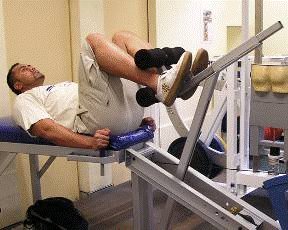
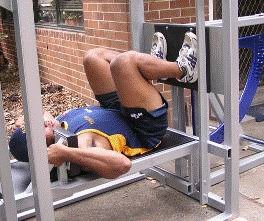
drawings of muscles and exercise apparatus
Showing posts with label ScrumTruk. Show all posts

Thursday, July 08, 2010

The ScrumTruk - an integral part of the Auckland strength and conditioning program

In November 2005 Auckland Rugby, through their then coach Pat Lam, installed a ScrumTruk, one of the first Myoquip machines to be exported from Australia. Now, almost five years on, the machine is still helping the Auckland squad in developing "strength and flexibility through the hips, back and shoulders"

The current strength and conditioning coach at Auckland is Simon Kent, proprietor of Dynamic Fitness Solutions. Simon sees the ScrumTruk as a very flexible tool for developing players:

"I use it with the boys in a number of different ways. It's a great way of teaching good body position especially for our young players. For the front row boys we load up the weight and the boys practice their engagement, with the heavy weight they can hit and 'squeeze' holding the position in an isometric hold.

"The more I am involved with the physical preparation of rugby athletes the more I believe in the importance of having strength and flexibility through the hips, back and shoulders. This enables the athlete to apply force more efficiently on the rugby field, the ScrumTruk is one tool that helps develop hip and back strength.

"The ScrumTruk allows me to teach correct scrum set-up and pushing position especially to our young athletes, for our more established athletes, the ScrumTruk provides a rugby specific strength training tool. ScrumTruk is a integral part of the Auckland strength and conditioning program."

The ScrumTruk has now been superseded in the MyoQuip range by the more advanced MyoTruk, but it still continues to give good service for a range of users internationally.
Read more...

Wednesday, January 14, 2009

Daniel Vickerman rates MyoQuip strength machines as "absolutely fantastic"

Dan Vickerman is recognised as one of the top lineout forwards in world rugby. Born in South Africa, he has the unusual distinction of having represented both South Africa and Australia at the Under-21 level. In 2002 he made his debut for the Wallabies against France, going on to make 55 Test appearances. He played Super Rugby with the ACT Brumbies from 2001 to 2003 and the NSW Waratahs from 2004 to 2008.

Having been forced to study online throughout his first degree, a Bachelor of Financial Planning through Open Universities Australia (RMIT), he responded to the opportunity to study at Cambridge by suspending his international rugby career to enjoy the luxury of full time study. He is now reading for a degree in Land Economy at Cambridge's Hughes Hall.

At 204cm, Dan's limb geometry is unsuited for exercises such as the squat. Not surprisingly he acknowledges that "I have suffered from back injuries in the past due to the nature of some exercises in the gym." In fact, a very high proportion of professional rugby forwards avoid squatting because of back problems.

Fortunately, for the past four seasons both in the Waratah's gym and at Camp Wallaby at Coff's Harbour, Vickerman has had access to the MyoQuip ScrumTruk which he describes as "an asset to me during my rugby career." Recently, when forced by injury to take a break from national representation after the Super 14 Final, he went back to his club, Sydney University, to undertake rehabilitation with strength and conditioning guru Martin Harland. At the Uni gym he made extensive use of both the ScrumTruk and the HipneeThrust lying leg press before setting off for Cambridge.

"For me the two machines, the ScrumTruk and the HipneeThrust, have been absolutely great," Vickerman says. "The use of these machines gives the ability to build strength without putting strain on one's lower back. As a forward the strength gained transfers well onto the field due to their practicality and specificity to what we do during the game."

(The Sydney University gymnasium has now replaced its ScrumTruk and HipneeThrust machines with the more advanced MyoTruk and MyoThrusta)


Read more...

Tuesday, November 18, 2008

At last! A dominant Wallaby scrum

Aussie aficionados of trench-warfare rugby will enjoy the video, "Wallabies scrums from Twickenham video highlights" posted on Green and Gold Rugby - THE Aussie Rugby Blog.

It's been a long time between drinks for the Aussie engine room, and great to see them vindicated after the bagging they copped pre-game from the English press and frontrowers. Considering the improved scrummaging on this tour, perhaps the fact that the Wallabies and all four Australian Super 14 franchises use the ScrumTruk is beginning to pay dividends.

Still one egg doesn't make an omelette, and the Green and Golds have to show they can do it again against the French this weekend. I am not sure that the English front row, Andy Sheridan in particular, are going to be in too good a shape to back up again against the Springboks.
Read more...

Wednesday, November 05, 2008

Fast-tracking the development of young rugby players in the four "esses" - size, strength, speed and skill

Sydney University centre Mitch Inman breaking a tackle

A two-year program of accelerating the physical and skill development of young players at Sydney University has returned big dividends.

Within days of losing the 2006 First Colts Grand Final due to being out-muscled at the breakdown, University coach Nick Ryan met with his team and together they made a pact to never again be pushed off the ball. The players allowed themselves a mere three weeks break before getting back into training for the 2007 season at a level of intensity not seen before in Sydney club rugby. The off-season training regimen consisted of 4 weights sessions and 3 field sessions per week, switching to 3 weights and 2 to 3 field sessions during the playing season plus regular individual video analysis and field sessions with the coach.

The central ingredient of the training has been the strength and conditioning components devised by Martin Harland and administered by him and his assistant, Tim Leahy. "I guess we have two training tenets" Harland explains, "that is to always train hard and to train hard in the right areas. Thus developing the culture of no short cuts and to attend to the things in a prioritized plan from what we lack the most or what will help us the most on the park." Harland's programs for rugby players place a high degree of emphasis on basic strength development, increased bodyweight and speed. At the same time, given the year-round training commitment, great care is taken to guard against player burnout.
"We are consistently monitoring signs of overtraining," says Leahy. "Our in-season training structure does differ from our pre-season regime. The two key factors that help us guard against overtraining and player burnout is to firstly ensure our players are educated and understand the importance of post-game recovery strategies. "Secondly a close working relationship with coaching staff to ensure on field and gym volumes are of an optimal load. All variables as well as player’s subjective observation of energy, fatigue levels and contra indicators to injury are taken into account when prescribing volumes."

With a strong strength and fitness foundation laid, Nick Ryan and his team coaches are free to focus on technical proficiency and team cohesion. "The aim of our training sessions," says Ryan, "is to up-skill and empower the players, so that when they take the field not only can they read the game and make the right decisions, but then execute and finish off the activity with the help of team mates who are on a similar skill level and wave length." The payoff in terms of enhanced performance from the integration of strength and rugby coaching has been dramatic.

In the 2007 season University First Colts lost just one game out of 25 in winning both Minor and Major Premierships. Seconds and Under-19 Colts also won both Minor and Major awards. The dramatic improvement in the physical development of players can be seen from the Table below. As compared with the 2006 First Colts team, the 2007 forward pack's average bodyweight increased 5kg to 104.3kg; the backs 5.8kg to 86.2kg; and the team as a whole 5.3kg to 95.8kg.

Average bodyweights of Sydney University 2006, 2007 and 2008 Colts teams; average bodyweight of 2008 Wallabies squad

The second year of intensive training produced even more impressive results. In the 2008 season all three Colts grades won both Minor and Major Premierships, with First Colts remaining undefeated throughout their 24-game season. Despite the age limit for Colts having dropped from Under-21 to Under-20, players' bodyweights again increased by 0.2kg for the forwards; 2.8kg for the backs; and 1.5kg overall.

"physical domination ... has enabled us to build a very strong defensive wall and to implement a highly structured game plan which we can maintain for the full 80 minutes."

To put the 2008 figures in perspective the Table also shows the bodyweights of the best professional rugby players in Australia, the current Wallabies squad. They outweigh this club-level Under-20 team by just 6kg per man in the forwards and 4.4kg in the backs. And this team of university students is currently on an unbroken 34-game winning streak! It is almost time for the administrators of Australian rugby to recognise and to take seriously the great experiment that is going on in their own backyard.Sydney University forward Ben McCalman finishing a tackle

Colts coach Nick Ryan has the extraordinary record of taking his team to the Grand Final in each of the 7 years he has coached; with his only loss the 4 point defeat in 2006. He says, " A very important outcome from the intensive training regime of the past 2 years has been our ability to achieve physical domination in matches. This has enabled us to build a very strong defensive wall and to implement a highly structured game plan which we can maintain for the full 80 minutes." As with the weight training, Ryan ensures that the field sessions are short and frequently varied, with the emphasis on having his team peak on Grand Final day in September. He certainly achieved this in 2008 with the winning scoreline 39-5.

In the regular season in 2008 Ryan's team averaged a 40-point winning margin and conceded only 8 points per game. Seconds and Thirds Colts also conceded just 8 and 5 points respectively per game.

A distinctive feature of the Sydney University rugby program has been its reliance on the MyoQuip range of strength building equipment. For the past four years the University gymnasium has been the primary development site for these machines. Not surprisingly MyoQuip's ScrumTruk and Hipnee Thrust* have been extensively used for lower body strength development. Martin Harland says, "These two lower limb extensor machines have been integral to training a wide cross-section of athletes in different sports at the University. In rugby they enable us to reduce the deleterious effects of heavy lower leg extensor exercises and on-field running loads. Traditional heavy squats & deadlifts are great for strength and size but are only moderately compatible with higher running loads for field or court sports. and incompatible with a sizeable subset of your player population for various reasons. To be able to de-load players spines while building hip & knee extensor strength through range of motion means more athletes able to train intensely in the gym and front up for intense speed & fitness work in the same week.” "

The combination of an intensive, well-structured and coordinated training regimen and the use of strength apparatus with high specificity for rugby can be seen to have produced accelerated physical development which has enabled players to perform at a consistently high standard.

*In recent months the University gymnasium has replaced its ScrumTruk and HipneeThrust machines with the more advanced and compact MyoTruk and MyoThrusta models.

Read more...

Sunday, October 19, 2008

The MyoTruk replaces the ScrumTruk in the MyoQuip range


MyoQuip is proud to announce the release of the MyoTruk, the second release in our Myo range of strength equipment embodying direct-linkage force transmission through heavy-duty industrial bearings.

The MyoTruk replaces the ScrumTruk, the first and only rugby-specific strength machine. The ScrumTruk has proven effective in safely enhancing the strength, power and body mass of rugby players, both backs and forwards, as well as athletes in other sports. Unlike most variable resistance machines the ScrumTruk was designed for complex, multi-joint and large muscle mass movement.

In rugby the ScrumTruk has been adopted by the Wallabies; Emirates Western Force; HSBC Waratahs; Queensland Reds; Auckland Blues; Northampton Saints; Sharks; Golden Lions and other leading clubs and schools.

Already its successor, the MyoTruk, has been adopted by the CA Brumbies; the New South Wales Institute of Sport (NSWIS); and Sydney Uni Sport & Fitness

Find out more about the MyoTruk
Read more...

Monday, September 29, 2008

Champion Australian rugby club powered by MyoQuip strength equipment

Australia's premier rugby club, Sydney University, has completed another outstanding season in 2008. A significant factor in its success in recent years has been its use of the MyoQuip ScrumTruk and HipneeThrust to build the size and strength of its players.

Some of the Club's achievements:
  • Has won the Sydney First Grade Premiership for the past four years
  • Has defeated the Brisbane Club Premiers in both 2007 and 2008 to claim the title of Australian Club Champions
  • Has won the last five Sydney Club Championships as well as the last four Colts Club Championships
  • Has won Premierships in all three Colts Grades in both 2007 and 2008
  • Was undefeated in 24 matches in First Grade Colts in 2008

In June 2006 I wrote an article titled "Building bigger and stronger rugby players - the Sydney University experiment" drawing attention to the increasing emphasis on size and strength in modern rugby:

"Modern defensive alignments and strategies have transformed rugby matches into contests of attrition where bigger and stronger teams tend to wear down their smaller and physically weaker opponents over the course of a game. Perhaps the most notable change has been the increased importance of physical dominance in the backline.

"Responding to this, Sydney University's rugby club has been able to demonstrate that with the right combination of coach and infrastructure, it is possible to fast track the physical development of players outside a professional playing environment. In fact within a couple of seasons these players are able to achieve a body mass comparable to that of seasoned professionals together with a solid foundation of basic strength."

Current-year data confirms that this is still the case. Based on the player data listed on their websites the average body weights of the current squads for the Wallabies, Waratahs and Brumbies are 103.0, 103.3 and 102.0kg respectively. The average body weight for Sydney University's starting fifteen in this month's First Grade Grand Final was 101.5kg. It is true that this team included three Wallabies in Phil Waugh, Al Campbell and Dean Mumm, but even with these players excluded the team's average body weight was still 100.1kg. It can be seen that the young, part-time, unpaid Sydney University players weigh only a couple of kilograms less than seasoned professionals.

For the past five years the University Club has been operating an Elite Development Squad (EDS) program for its top Grade and Colts players. Utilising one of the best equipped gymnasiums in Australian rugby, players train for eleven months of the year and undertake four weights sessions per week off-season and two to three while playing.

The program's strength and conditioning components have been devised by Martin Harland and administered by him and his assistant, Tim Leahy. Harland's programs for rugby players place a high degree of emphasis on basic strength development and rugby-specific fitness. A distinguishing feature of his approach is a concentration on heavy lower body work. In the past couple of years he has decreased the amount of squatting and deadlifting and and made more intensive use of the MyoQuip ScrumTruk and HipneeThrust, apparatus that targets the large mass leg extensor muscles, specifically the gluteal and quadriceps groups.

Exposing backline players to basic strength training

Another distinctive feature of Martin Harland's rugby training regimen is his requirement that backs undertake the same rigorous basic strength routines as forwards. Many strength and conditioning coaches reserve the heavy "grunt" work for forwards, or even restrict it to the tight five.

Exposing backs to very serious weight training has produced quite significant results at Sydney University, as evidenced by the following table comparing body weights of forwards and backs for the Wallabies, two of the four Australian Super 14 franchises and Sydney University:

Comparative Bodyweight of Forwards and Backs

Squad/Team (2008)

Av Weight (kg) - Forwards

Av Weight (k) - Backs

Difference

(kg)


Wallabies - Squad

110.5

93.4

17.1

NSW Waratahs - Squad

110.9

93.2

17.7

ACT Brumbies - Squad

110.0

93.8

17.2

Sydney University – Grand Final Team

107.3

94.9

12.4

Not surprisingly, the University's young forwards are outweighed by each of the professional squads. However, in the backs the situation is reversed with the University players outweighing the national and provincial squads.If we look at the column showing the difference in bodyweight between backs and forwards it can be seen that for Sydney University it averages 12.4kg, against 17.1 to 17.7kg for the professional squads, a very substantial difference.

The Sydney University experiment seems to be providing clear evidence that the bodyweight of rugby backs can be dramatically increased through serious weight training, and the results achieved by the Club in competition suggest that there has been no adverse impact on their playing performance.

The main justification for building heavier backs with superior leg drive lies in the already mentioned importance of physical dominance in the backline. With the modern emphasis on structure and coordination in defensive alignments, bigger and stronger backs are better able to continually repel opposition attacks and also over the course of a game are likely to create physical and mental fatigue in their counterparts.

Martin Harland has also regularly used both the ScrumTruk and the HipneeThrust in conditioning the University's rowers and female basketballers. The Rowing Club is currently ranked No. 1 in Australia, while the Sydney University Flames have appeared in the two most recent Grand Finals of the Australian Women's National Basketball League. The MyoQuip apparatus would appear to have strong applicability to not only these sports but also to other football codes such as American football, Australian football and rugby league.

(In recent months the Sydney University Gymnasium has replaced its ScrumTruk and HipneeThrust machines with the more advanced and compact MyoTruk and MyoThrusta models.)


Read more...

Friday, December 01, 2006

ScrumTruk's first Olympian

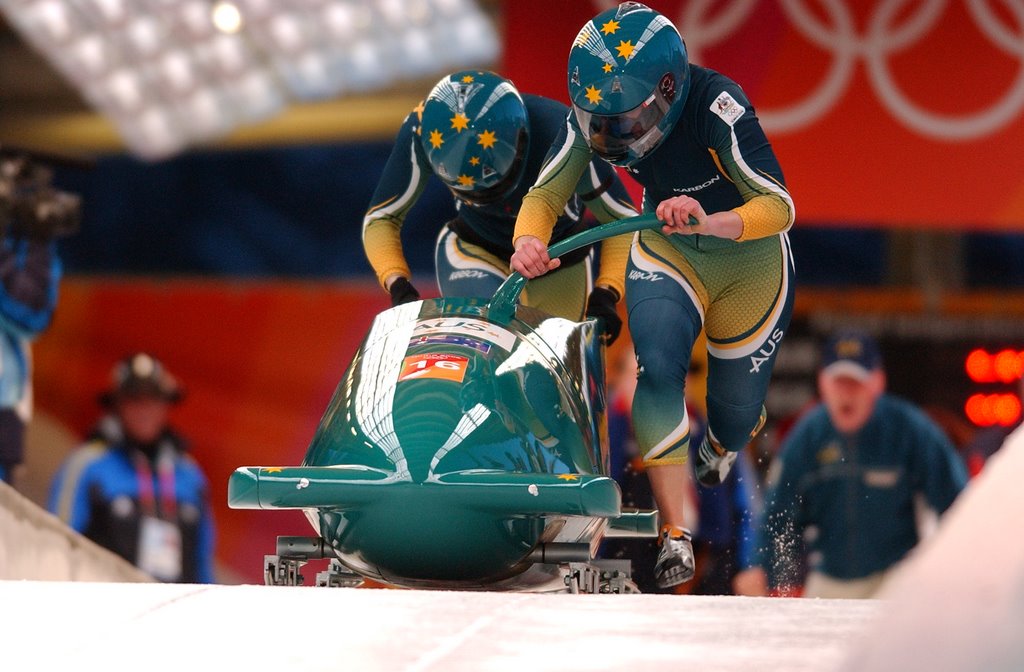
Originally developed for increasing the pushing strength of rugby forwards, MyoQuip's ScrumTruk has proved its versatility across a variety of sports. At the University of Sydney it has been used by Australian national representatives in rugby, rowing and women’s basketball, but the first Olympic representative to use it was in the winter sport of bobsleigh racing.

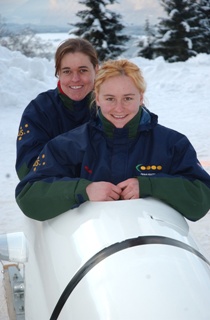
Fifth-year veterinary science student Astrid Loch-Wilkinson was the pilot of Australia’s first-ever women's bobsleigh team which competed at the Winter Olympics in Torino, Italy, in February. Astrid and brake woman Kylie Reed finished 14th with a time of 3 minutes 55.11 seconds for their four runs.
Athletes from power sports such as weight-lifting and athletics are often recruited for bobsleighing because they have appropriate attributes to gain an edge at the explosive push-start that characterizes the event. Astrid had the necessary athletic ability having been an Australian national 400m hurdling champion and a Sydney University Blue in soccer.
For her strength training she turned to Martin Harland, the University's Athlete Performance Manager, himself a former Winter Olympian in the bobsleigh. Harland was very impressed by Astrid's excellent training ethic and innate capacity for strength development.

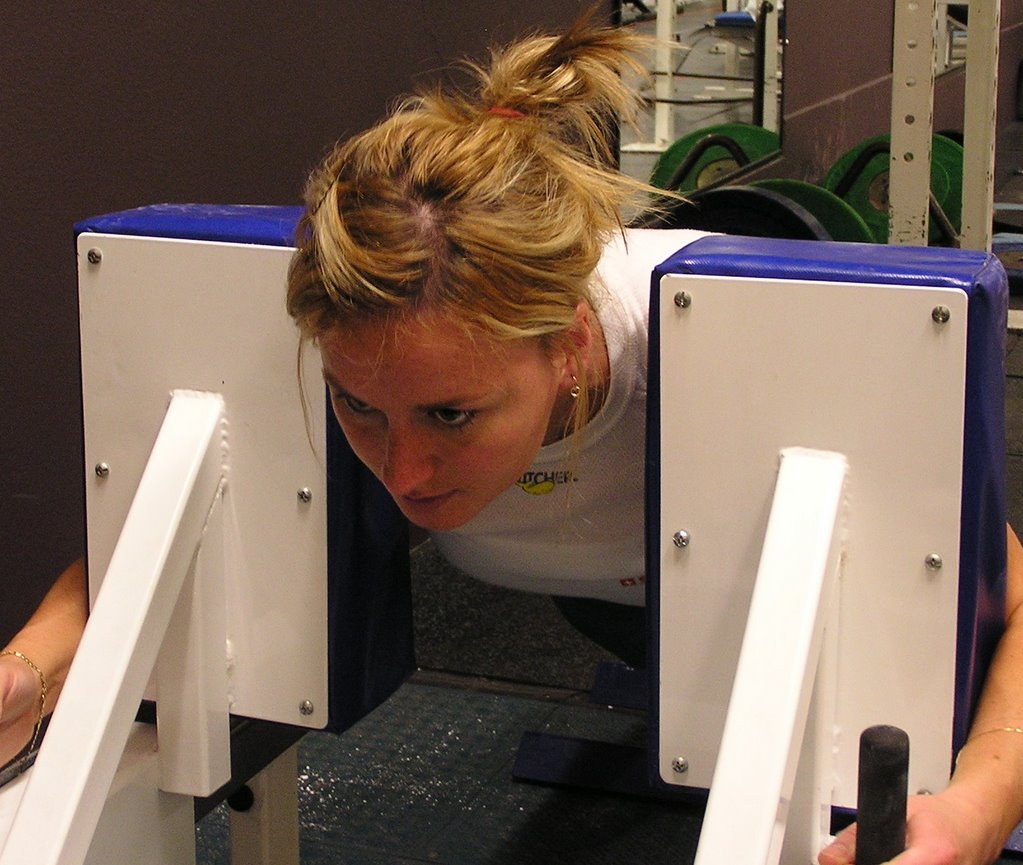
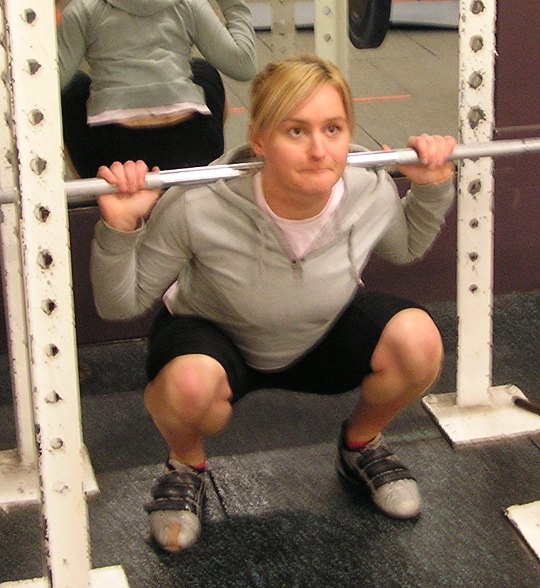
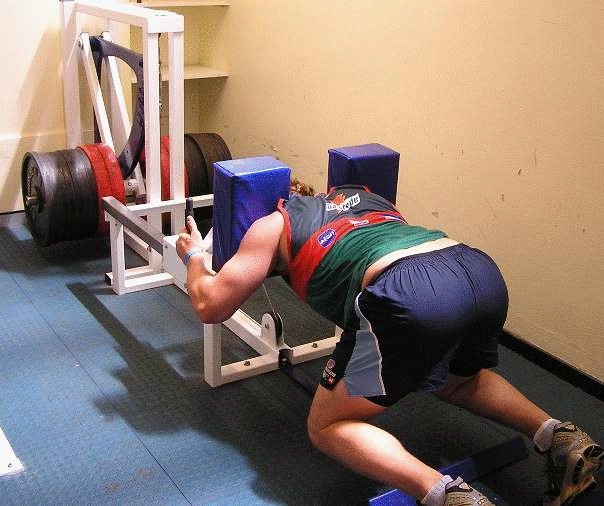
In addition to conventional basic strength exercises such as the squat and dead lift the pair made extensive use of the ScrumTruk at the university gymnasium. The machine has strong specificity for the bobsleigh push-start because in both activities force has to be generated and delivered in the horizontal plane.
"I used the ScrumTruk regularly in my strength training leading up to the Olympics," says Astrid. “I found the machine was great to use in conjunction with my Olympic lifting training. It assisted me in becoming stronger in the 'pushing' action related to bobsleigh".
Careering down a twisting track of ice at 125 kph in a flimsy shell would seem to require extraordinary courage. “My first run down the ice in a sled was terrifying as I basically had no idea what I was doing,” she admits. But after three years of piloting bobsleds in World Cup races, she says she is used to the speed.
“It becomes slower and slower the more I race. Before each race I study the track very intensively with my coach so I know precisely how to steer every part of it. I enjoy racing but it’s pretty intense and it doesn’t feel fast because I have to concentrate on the technique”, she says.

Some of the bobsleigh teams competing in Torino had million dollar budgets. By contrast Astrid and Kylie were largely self-funded. Because of Australia's isolation from alpine sports, much of their initial training consisted of pushing a billy-cart - a form of wheeled trolley used by children - around a local football oval. They were also required to travel to Europe for extended periods each year racing on the World Cup circuit.
“Bobsled racing costs $30,000 to $40,000 a year”, Astrid says. “I would like to go to the next Winter Games at Vancouver in 2010 but we need some funding”.
In the meantime she has embarked on a fourth sport. She is still training at the University gym under Olympic lifting coach Simon Kent and participating in weightlifting competitions.


Read more...

Tuesday, June 20, 2006

Building bigger and stronger rugby players - the Sydney University experiment

It is widely acknowledged that the average bodyweight of rugby players has increased considerably over recent years. Less recognised is the extent to which modern defensive alignments and strategies have transformed rugby matches into contests of attrition where bigger and stronger teams tend to wear down their smaller and physically weaker opponents over the course of a game. Perhaps the most notable change has been the increased importance of physical dominance in the backline.


Responding to this, Sydney University's rugby club has been able to demonstrate that with the right combination of coach and infrastructure, it is possible to fast track the physical development of players outside a professional playing environment. In fact within a couple of seasons these players are able to achieve a body mass comparable to that of seasoned professionals together with a solid foundation of basic strength.


In late May, Sydney University announced its team for the first round of the Tooheys New Cup, the premier competition in Sydney club rugby. All of the fifteen players are past or current students who had been developed through the Club's Colts and lower grade teams. None of them are paid to play for the Club, although the eleven who are still students receive modest scholarship assistance. Only three of the players are on professional contracts.


It is instructive to compare their bodyweight and age profiles with those of squads from four major rugby countries:


TeamAverage Weight (kg)Average Age
Wallabies - 2006 Squad102.626.1
All Blacks - 2006 Squad102.925.5
Springboks - 2006 Squad102.226.8
England - 2006 6 Nations Squad101.227.2
Sydney University - 2006 Tooheys New Cup Team100.522.5

Comparative Bodyweight and Age Profiles


It can be seen that the part-time, unpaid Sydney University players, though three to five years younger, weigh only a couple of kilograms less than the world's best players. This is quite extraordinary as normally a much greater weight disparity would be expected.


For the past three years Sydney University Football Club has been operating an Elite Development Squad (EDS) program for its top grade and colts players. Utilising one of the best equipped gymnasiums in Australian rugby, players train for eleven months of the year and undertake four weights sessions per week off-season and a lesser number while playing.


The program's strength and conditioning components have been devised and administered by Martin Harland, a sports scientist who has previously worked with professional rugby league, Australian football and basketball teams. His programs for rugby players place a high degree of emphasis on basic strength development and rugby-specific fitness. A distinguishing feature of his approach is a concentration on heavy lower body work through exercises such as squats, deadlifts and cleans. In addition, both backs and forwards make intensive use of the MyoQuip ScrumTruk, a rugby-specific apparatus that targets the large mass leg extensor muscles, specifically the gluteal and quadriceps groups. Hypertrophy or increased muscle mass is a natural and not unintended by-product of such training.


Exposing backline players to basic strength training


Another distinctive feature of Martin Harland's rugby training regimen is his requirement that backs undertake the same rigorous basic strength routines as forwards. Many strength and conditioning coaches reserve the heavy "grunt" work for forwards, or even restrict it to the tight five.


Exposing backs to very serious weight training has produced a quite extraordinary outcome at Sydney University, as evidenced by the following table comparing body weights of forwards and backs for the Wallabies, the four Australian Super 14 franchises and Sydney University:


Squad/Team (2006) Av Weight (kg) - ForwardsAv Weight (kg) - BacksDifference
Wallabies - Squad111.191.819.3
ACT Brumbies - Squad110.390.919.4
NSW Waratahs - Squad110.892.818.0
Queensland Reds - Squad109.792.417.3
Western Force - Squad109.192.916.2
Sydney University - Team105.395.110.2

Comparative Bodyweight of Forwards and Backs


Not surprisingly, the University's young forwards are outweighed by each of the five professional squads. However, in the backs the situation is reversed. The University players outweigh the national and provincial squads by between 2.2 and 4.2 kg per man.


If we look at the column showing the difference in bodyweight between backs and forwards it can be seen that for Sydney University it averages 10.2 kg, against 16.2 to 19.4 kg for Australia's professional squads, a very substantial difference.


The Sydney University experiment seems to be providing clear evidence that the bodyweight of rugby backs can be dramatically increased through serious weight training, but the question arises as to whether this has benefits in terms of playing performance.


One answer is that the other strength-oriented football code, American football, has traditionally used training methods similar to those of Martin Harland. All players, whether linemen or running backs, are required to do heavy gym work. Surely no one would seriously suggest that their quick players have inferior dynamic abilities to rugby players.


Another justification for building heavier backs with superior leg drive lies in the already mentioned importance of physical dominance in the rugby backline. With the modern emphasis on structure and coordination in defensive alignments, bigger and stronger backs are better able to continually repel opposition attacks and also over the course of a game are likely to create physical and mental fatigue in their counterparts.


Having achieved a strong foundation of basic strength and greater body mass, Martin Harland is then able to focus on speed and explosiveness in his players. It is clear that the Sydney University approach yields results on the playing field. 2005 was the Club's most successful year, winning the Sydney Club Championship, the First Grade Premiership and four lower grade Premierships.


Even more importantly, players who graduate from such a program are much better equipped to withstand the rigours of modern rugby.


Read more...

Sunday, April 23, 2006

Northampton Saints endorse the ScrumTruk

Northampton Saints Performance Coach Tim Exeter
Premiership club Northampton Saints pioneered the use of the ScrumTruk in the U.K. Performance Coach Tim Exeter installed two ScrumTruks prior to the 2005-2006 season. Exeter, a former Scotland A centre, worked in strength and conditioning with West Bromwich Albion FC, Coventry FC and Portsmouth FC, before coming back to rugby with Richmond RFC from 1997 to 1999 then joining the Saints in 2001 where his innovatory approach has revolutionised the performance department.

Tim Exeter credits the ScrumTruk with helping to improve the Saints' scrum performance:

The addition of ScrumTruk has enhanced our training. It is position specific and gives better transfer than traditional exercises. It helps de-load the lumbar spine which traditionally is restricted post match for some days. We mix in with some traditional exercises and this helps give the necessary variety and stimulation to the players. We have adapted exercises using double leg, single leg and walking up and back and found functional improvements in strength and stability and the players like it!"
Tom Smith, Saints, Scotland and Lions front row forward

The ScrumTruk also receives strong endorsement from Tom Smith, who says: "I have found ScrumTruk invaluable as a tool to improve strength specifically related to scrimmaging whilst reducing the impact on lower back and shoulders." A world class prop, Smith, who has been a Saints player since 2001, was a 61-cap veteran with Scotland, as well as playing 6 back-to-back tests on the last two Lions tours.


Read more...

Saturday, April 01, 2006

Bands, chains and broad biomechanical correspondence

[Summary: The addition of bands or chains to free weights permits adjustment of the resistance to the muscles' load-bearing capacity throughout an exercise movement. This broad biomechanical correspondence allows exercises to be performed explosively over their full range, effectively conditioning the body for actual sporting and athletic activities. The development of sophisticated mechanisms employing the same principle has important implications for sport-specific strength development.]

There are two main types of variable resistance exercise equipment:

Close biomechanical correspondence

Manufacturers of cam-driven machines claim to vary their resistance to closely match the torque curves of natural joint movements. In other words they assert a close biomechanical correspondence (CBC) between resistance and muscular capacity. However, given the variation between individuals in relative limb lengths, muscle attachment points, genetically endowed strength relativities between various muscles, etc., it is doubtful that such claims of accurate correspondence between load and load-bearing capacity are justifiable.

CBC machines are basically designed for single-joint movement of isolated muscle groups performed at a measured pace. Their very limited applicability to sports training is highlighted by Zatsiorsky's comment: "The important limitation of many strength machines is that they are designed to train muscles, not movement."

Broad biomechanical correspondence

The other type of variable resistance apparatus does not attempt to achieve any precise correspondence between resistance and muscular capacity.Rather the rationale for their use is that substantial benefits are achievable from load variance so long as the changing load-bearing capacity of the muscles involved is approximated. Bands and chains are examples of apparatus that rely only on such broad biomechanical correspondence (BBC).

In operation heavy rubber bands or steel chains are attached to either end of a loaded barbell and anchored to the floor or other fixed points. This enables a progressive increase in resistance for exercises such as squats and bench presses. A distinguishing feature of these exercises is that they are heavy load and involve multi-joint or whole limb movements.

The deceleration problem with free-weight exercises

Explosive strength is fundamental to many sporting or athletic activities but free weights are defective in building explosive strength. In the squat or bench press, for example, various studies have shown the bar decelerating for much of the final section of the range of motion. In the deceleration phase there is significantly decreased motor unit recruitment, velocity of movement and power production. In addition, when free weight movements are performed forcefully, antagonistic muscle action takes place to slow down and halt the limb to avoid soft tissue rupture or joint dislocation.

Conditioning the muscles for deceleration during the final stage of an exercise movement is counterproductive if the objective is to enhance ballistic-type sporting actions like throwing or jumping. This is also true where there is an inertia-dissipating or energy-absorbing mass to be moved, as in tackle engagements in football. Similar dynamics apply at the line of scrimmage in American football or in a rugby union scrum. In each of these cases the appropriate simulation is an acceleration through the whole range of limb movement.

Adding BBC characteristics to free weights enables exercises to be performed explosively or ballistically with the progressively increasing resistance providing a braking effect. Peak power occurs near the extreme points of angular motion.

A new generation of BBC machines

Recently MyoQuip have introduced a new system of lever and fulcrum technology that achieves the same basic effect as bands and chains but permits the development of sophisticated mechanisms with a high degree of specificity to particular sporting activities.

Because of their primitivity the use of bands and chains has largely been restricted to the power-lifting community. A major limitation of the equipment has been the difficulty in incrementally changing load. The fixed load component can be readily altered by adding or removing weight plates, but there is no way of making minor adjustments to the variable element provided by bands or chains.

With MyoQuip's machines, incremental load changes are effected simply by adding or removing weight plates, and the rate at which the load changes during a movement can be altered by choosing a different pin setting.

The MyoQuip technology also permits considerable flexibility in the orientation of effort. For example, the ScrumTruk machine is operated in the horizontal rather than the vertical plane, while the HipneeFlex, which is used to develop the leg flexor muscles, is configured for decreasing instead of increasing resistance.

The further development of machines delivering full-range muscle activation in either extension or flexion across multiple joints is likely to have important implications for strength training for sport.


Read more...

Thursday, March 02, 2006

Does intensive pre-season strength training protect rugby players from non-contact injury?

[Summary: Players at a leading Australian rugby club who undertook a high-intensity off-season strength training program experienced dramatically fewer non-contact injuries during the playing season than their less committed club mates. It is suggested that the lower incidence of injury might be attributable to an emphasis on improving basic strength and the use of rugby-specific strength equipment.]

Each year the Sydney University Football Club selects a group of players for its Elite Development Squad to prepare for the next season. For 2005 a squad of 50 was chosen which did not include any of the Club's seven Wallabies nor any of the players on Super 12 contracts. Players committed themselves to around fourteen weeks of intensive training involving six to seven sessions per week of weights, skills and fitness work despite either being full time students or working full time.

At the conclusion of the season the Club's doctor, Katherine Rae, and physiotherapist, Keiran Cleary, jointly issued a Medical Report analysing the injury experience of the Club's eight teams. They particularly highlighted the members of the Elite Development Squad, noting that during the season "the EDS squad suffered only two non contact injuries, both muscle strains, which resulted in only four games lost to injury."

More specifically, among the 36 players who completed the full EDS program there was "only one calf strain and one hamstring strain ... . They had no back pain or groin pain necessitating loss of game time." By contrast, for the Club as a whole, there were 28 instances of low back pain, 27 hamstring injuries, 27 groin injuries and 6 quadriceps strains.

Two non contact injuries in over 1000 hours of playing time is an extraordinarily low figure in itself, and certainly by comparison with the Club's other players who accumulated over 80 comparable injuries. The injury incidence for the Club as a whole seems to be broadly in line with that reported in various scientific studies including those focussed on professional players.

It is obviously unwise to attach too much significance to the experience of one club over a single season. However the disparity in injury rates between those in the EDS group and their team mates is so great that it is very unlikely to be attributable to mere chance. Therefore it is necessary to explore possible reasons for this very favorable outcome. I believe that there were three relevant factors at work:

Duration and intensity of the training program

An off-season involving around 90 uninterrupted training sessions creates a near ideal opportunity for players to enhance their basic strength and fitness for rugby.Very few non-professional players would have the commitment and dedication to stick to such an exacting schedule. And very few professional players would have such a large block of time available. For example, Australian full-time players normally participate in at least two of the three tiers of club, provincial and international rugby and are therefore playing through most of the year.

The EDS squad also had on-campus access to physiotherapists, doctors and nutritionists plus regular dietary supplementation. Thus, even though the squad members were not paid, they were training in a very professional environment.

Emphasis on basic strength development

Strength and conditioning in the EDS program was structured and administered by Martin Harland, a sports scientist who had previously worked with professional rugby league, Australian football and basketball teams. His programs for rugby players place a high degree of emphasis on basic strength development and rugby-specific fitness. A distinguishing feature of his approach is a concentration on heavy lower body work through exercises such as squats, deadlifts and cleans.


Use of the ScrumTruk

In addition to their free weights exercises the group regularly used the rugby specific MyoQuip ScrumTruk as a core component of their leg strength work. Certain unique attributes of this apparatus might be relevant to protection against injury. Although it works basically the same muscle groups as the barbell squat, the fact that the resistance is in the horizontal rather than the vertical plane means that there is no adverse loading on the lumbar spine. It is also more quadriceps specific than the squat and exercises effectively the muscles of the calf.

But its main benefit in injury minimization may be in relation to the hamstrings. The ScrumTruk specifically works this muscle group as well as adjacent areas such as the glutes, quadriceps and core stabilizers. But the most important effect might relate to the frequently observed importance of eccentric loading in developing the hamstrings. Both the barbell squat and the conventional leg press deliver constant resistance. When performing these movements concentrically the muscles involved are only under very partial load as the hip and knee joints move to full extension. By contrast the ScrumTruk's operation provides continually increasing resistance throughout the exercise movement. Because of this, the muscles involved are strongly activated over the full exercise range and most critically are working at close to full load at the conclusion of the movement. It would seem to follow logically that the more that muscles are being activated concentrically, the greater the eccentric load when the movement is reversed. Thus there is heavy eccentric loading on the hamstrings when they are near fully extension.

The low injury incidence by Sydney University's elite training squad seems to suggest that other teams might benefit similarly by implementing a long and intensive off-season training program concentrating on the development of basic lower body strength through complex free weight movements and the use of the ScrumTruk. The potential improved injury outcomes are additional to the very substantial strength gains from such a program.

Read more...

Sunday, February 05, 2006

Is Australian rugby finally getting the message about power?

Today's Sun-Herald [Sydney] has a brief article titled "The Brumbies turn to power." It makes the point that the "multi-phase attacking style" used by both the ACT Brumbies and the Wallabies with success in the late 1990s and the first few years of the new century "has been superseded by a more robust forward-oriented play."

ACT coach Laurie Fisher is quoted as saying: "I think we've lacked it [forwards getting to the advantage line] every year but it hadn't been as important until last season. You can't just outskill a side with a quality back line now. You've got to have a quality set piece, you've got to have a power game."

Let's hope that the Brumbies have been making good use of the ScrumTruk that they installed a few months ago.
Read more...

Saturday, December 31, 2005

ScrumTruk breaks 400kg barrier

Waratahs and Sydney University centre Tom Carter using 400kg on the ScrumTruk
New South Wales Waratahs rugby centre Tom Carter is claiming a new record for shunting the ScrumTruk. Yesterday Carter performed four reps with 400kg (880lbs) in strict form (starting with both hip and knee joints at 90 degrees to full lockout) from the No. 4 pin setting.

Tom Carter, who is recognised as one of the most dedicated trainers in Australian rugby, is chasing the poundages with heavy strength work in the lead-up to the start of the Super 14 competition in February.

It is a sign of changing times when we have backs, the show-ponies of rugby, out-grunting the forwards in the gym.


Read more...

Friday, December 30, 2005

Testing MyoQuip prototypes at Sydney University

MyoQuip is fortunate to have access to a comprehensive gym facility for testing the prototypes of its various machines. Early in 2004 the first version of the ScrumTruk was installed at Sydney University's Arena Gymnasium. Since then successive prototypes and models have been tested there.

Sydney University Sport currently has 250 athletes on scholarship across a wide range of sports. Their strength training is supervised by Martin Harland, a highly-regarded sports scientist who has worked with a number of Australian professional sporting teams. Martin also has direct responsibility for the University Rugby Club's EDS program.

Currently there are 70 players in the Elite Development Squad. Apart from their rugby they do intensive weight training for eleven months of the year. For the past two playing seasons the ScrumTruk has been an integral part of their programs. The 2005 season was the most successful in the Club's 142-year history. Premierships were won by five of its eight teams, including First Grade, Second Grade and First Colts. Across the grades the Club's players consistently drew comment for their size and physicality and ability to dominate at the scrum and maul.

During the current off-season the EDS players are continuing to use the ScrumTruk but are also working with prototypes of three new machines that will be released in the near future. These are the JumpTruk (for improving lineout lifting); the HipneeFlex (for developing hip and knee flexors); and the HipneeThrust (a supine leg press with plyometric characteristics). All three machines utilise QuadTorq technology.

A prototype of the HipneeFlex being used for full range activation of the hip and knee flexors
A prototype of the JumpTruk being used to develop lifting power and coordination of lineout support players
A prototype of the HipneeThrust being used for full range activation of the hip and knee extensors


Read more...