
The Exeter Chiefs have just completed a very successful second season in the Aviva Rugby Premiership, building on their 8th position in 2010-2011 to finish 5th and earn a place in the Heineken Cup competition next season.
When the Chiefs were promoted into the Aviva Premiership in season 2010-2011 they were widely tipped to be a one season wonder.They faced a difficult transition to the premier league with no time to buy in players to strengthen their squad and the need to adapt quickly to the greater physicality and speed of play in the top competition.
Fortunately in June 2010 Paddy Anson, Head of Strength and Conditioning with the Chiefs, visited the UK Strength and Conditioning Association Conference where Gen3 Kinematics were exhibiting the MyoQuip range of strength equipment which they had just began manufacturing. Anson was impressed by what he saw and ordered both the MyoTruk and MyoThrusta. The Exeter players took to their new grunt toys with such enthusiasm that Gen3 were compelled to make a couple of modifications to the machines to ensure that they would stand up to the pounding they were receiving from the men from the West Country. During that first season Paddy Anson said:
"We are really pleased with the performance gains that the players have achieved through using Gen3's MyoQuip equipment. Our testing scores have been consistently good by all of the players and the guys are now fitter and stronger than ever. We use their equipment heavily in our programmes and It has definitely helped us improve our performances as we continue to progress in the Premiership. I would recommend Gen3's MyoQuip equipment to anyone."
Reviewing that season Paddy acknowledged that the MyoQuip machines played a pivotal role in dramatically improving the strength and conditioning of the squad. Significantly they resulted in greater leg strength and driving power for both forwards and backs without any reduction in speed - crucial in top class rugby where backs can play like forwards and to cross the gain line you have to be more powerful and stronger. They also reduced the risk of injury in training. One clearly observable benefit was the fact that Exeter were equal top in the competition in terms of points scored in the last 20 minutes of matches.
The Chiefs have pursued a deliberate strategy of building strong links with local colleges and with Exeter University. The University's Director of Rugby, Keith Fleming, feels the success of the Exeter Chiefs has given a big boost to Exeter University Rugby. It used to run 3 rugby sides and now runs 9 and rugby has become the biggest club in the Athletic Union overtaking football.
Keith says, "The University can provide the Chiefs with a ready made pool of talent." To strengthen this pathway the Exeter University Sports Association has bought the same MyoQuip equipment as used by the Chiefs for its High Performance Gym, which has recently been expanded.
"By mirroring the equipment used by the Chiefs - especially the strength and conditioning equipment - we can do the same type of exercises and achieve the speed, strength and power results to meet the Chief's standards which should also reflect in our BUSA performances. It's a win, win association", says Keith.
At the recent Aviva Premiership Rugby Awards the Exeter Chiefs received two awards. Head Coach Rob Baxter was named QBE Director of Rugby for the season while winger Gonzalo Carnacho was declared Gatorade Game Changer of the season, an award based on official statistics for all players such as metres gained, number of carries, turnovers won, and tackles made.
One of the Chiefs' signings for next season is the 33-Test Wallaby Dean Mumm. Dean should have no difficulty working out with the MyoTruk and Myothrusta as he has been a member of the very successful Sydney University Football Club for the past 10 years. The Sydney University gymnasium is where the MyoQuip machines were first developed and tested.
Read more...
Showing posts with label rugby. Show all posts
Showing posts with label rugby. Show all posts
Wednesday, May 09, 2012


Sunday, February 20, 2011
The development of rugby wingers
Wingers are the cast-offs from a process of natural selection.
The process starts at the most junior age levels. Boys end up on the wings because they are the last ones chosen, basically because they are weedy and frightened of body contact. Usually they are safely out of the way there because the Under-8s play angry ant rugby where all the players swarm around the ball except for the wingers who sense there is danger there. They stand close to the sidelines where they can keep eye contact with their mummies who wave encouragement to them from time to time. By contrast their fathers either pretend they don't know them or yell abuse at them for their refusal to tackle. Tiny wingers also like to kick grass.
As they progress through the age ranks they occasionally receive the ball. Here the primeval "fight or flight" instinct kicks in. Wingers being congenitally under-endowed at the "fight" end of the spectrum are compensated by having a heightened aptitude for "flight". So they run. They run like gazelles away from a hungry lion. They can cover enormous distances laterally often traversing from sideline to sideline with no loss of momentum until someone stops chasing them.
When they mature they are expected to do just two things on the rugby field. The first is to catch the ball. But they have been programmed to associate having the ball with being chased. So their natural reaction is to drop it.
They are also expected to chase kicks. But they have not grasped the concept of running towards something, only to run from something. With nobody chasing them they see no reason to hurry.
It is off the field where they perform their most useful service. Late at night, primped and perfumed, they lure groupies away from serious rugby players who are engaged in the necessary business of re-analysing scrums and mauls and sinking piss.
One should never confuse the rat cunning of the winger with intelligence.
Read more...
The process starts at the most junior age levels. Boys end up on the wings because they are the last ones chosen, basically because they are weedy and frightened of body contact. Usually they are safely out of the way there because the Under-8s play angry ant rugby where all the players swarm around the ball except for the wingers who sense there is danger there. They stand close to the sidelines where they can keep eye contact with their mummies who wave encouragement to them from time to time. By contrast their fathers either pretend they don't know them or yell abuse at them for their refusal to tackle. Tiny wingers also like to kick grass.
As they progress through the age ranks they occasionally receive the ball. Here the primeval "fight or flight" instinct kicks in. Wingers being congenitally under-endowed at the "fight" end of the spectrum are compensated by having a heightened aptitude for "flight". So they run. They run like gazelles away from a hungry lion. They can cover enormous distances laterally often traversing from sideline to sideline with no loss of momentum until someone stops chasing them.
When they mature they are expected to do just two things on the rugby field. The first is to catch the ball. But they have been programmed to associate having the ball with being chased. So their natural reaction is to drop it.
They are also expected to chase kicks. But they have not grasped the concept of running towards something, only to run from something. With nobody chasing them they see no reason to hurry.
It is off the field where they perform their most useful service. Late at night, primped and perfumed, they lure groupies away from serious rugby players who are engaged in the necessary business of re-analysing scrums and mauls and sinking piss.
One should never confuse the rat cunning of the winger with intelligence.
Read more...
Wednesday, October 06, 2010
Physical imposition rugby – the Sydney University system
I wonder how many people watching the 2010 Sydney Premiership Club Grand Final realised they were seeing a classic demonstration of a revolutionary style of play that I have termed “physical imposition rugby”.
The clash of Australia’s two most historic and successful clubs saw Sydney University triumph by 46 points to six; five tries to nil; and seven goals to two. Both sides were weakened by injuries from the previous week, Randwick losing five players and University two.
Game strategies based around physical domination are nothing new in rugby, but where the Sydney University style is innovatory is that it is not just based on the forwards overpowering their opposition but the whole team systematically grinding the other team down.
The foundation of the University system is a training methodology which involves minimal actual conditioning but rather an almost exclusive focus on heavy strength and speed training. The counter-intuitive result of this radical approach is that the team is renowned for its ability to finish over the top of its opposition, particularly in the final quarter of games.
If we take the Grand Final as a template of how physical imposition rugby should be played we can distinguish a number of defining characteristics.
Sydney University play is structured and methodical with an emphasis on patience and relentless control. In defence the team presents a “brick wall” across the width of the field and has confidence in its ability to continually repel attackers. Two or three players engage the ball carrier and try to drive him back, usually so effectively that multiple phases yield either no net gain or a loss of territory. The aim is to frustrate opponents so that they eventually lose the ball in a turnover or knock on.
Although multiple players usually make the tackle and attempt to secure possession, virtually no one is subsequently committed at the breakdown. This frees players to fan out at the sides of the ruck in readiness for the next assault on the defensive line. There is no attempt to slow the opposition ball down as the more tackles the team can make with multiple defenders engaging a single attacker the greater the toll on the opposition’s reserves of strength and fitness.
In possession, because of their enhanced physicality University players enthusiastically attack the line, often recruiting support players for the ball carrier even amongst the backs. In tight play they frequently vary the pick and drive from the back of the ruck with passing to a small pod of forwards standing four to five metres to the side of the ruck.
One of the distinguishing features of the Sydney University style as it has now developed is the use of big midfield players who function like forwards. Both centres in the Grand Final weigh around 105kg and play very physically.
Supplementing the trench warfare is a strategy of field position where the emphasis is on relentlessly going forward. Both Berrick Barnes and Luke Burgess kicked into Randwick’s defensive corners aided by a very committed chase typically led by Tom Carter. This produced defensive lineouts near the Randwick try line or hurried kick with insufficient angle to gain much distance.
When Randwick attempted to kick deep, University usually had at least a couple of players in position to receive the ball. Rather than floating a long pass across field the ball receiver typically elected to counter attack directly, often into a heavily populated area where they would get past at least a couple of defenders before being brought to ground. Then the process of physical imposition would continue.
University’s patience and relentlessness predictably caused frustration in the Randwick players giving an outstanding kicker in Barnes opportunities to keep the scoreboard ticking over to yield a 16-6 lead at half time. In the second half physical and mental fatigue caused Randwick to concede another 30 unanswered points.
During the match University played some very enterprising rugby but much of it came after they had softened up their opponents.
The precondition for playing physical imposition rugby is a specific type of fitness which is essentially anaerobic and heavily strength based. However it also requires exceptional mobility in order to contain and counter the opposition game plan. Technical proficiency in the set pieces and mauls is a primary focus, but it is a 15-man involvement in physical imposition that is the strategy’s defining characteristic.
Sydney University has demonstrated that physical imposition can be employed very effectively at a semi-professional club level and there is no reason why it wouldn’t be equally successful in a fully professional environment. However this would require radical rethinking of both player conditioning and the role and attributes of centrefield players.
Read more...
The clash of Australia’s two most historic and successful clubs saw Sydney University triumph by 46 points to six; five tries to nil; and seven goals to two. Both sides were weakened by injuries from the previous week, Randwick losing five players and University two.
Game strategies based around physical domination are nothing new in rugby, but where the Sydney University style is innovatory is that it is not just based on the forwards overpowering their opposition but the whole team systematically grinding the other team down.
The foundation of the University system is a training methodology which involves minimal actual conditioning but rather an almost exclusive focus on heavy strength and speed training. The counter-intuitive result of this radical approach is that the team is renowned for its ability to finish over the top of its opposition, particularly in the final quarter of games.
If we take the Grand Final as a template of how physical imposition rugby should be played we can distinguish a number of defining characteristics.
Sydney University play is structured and methodical with an emphasis on patience and relentless control. In defence the team presents a “brick wall” across the width of the field and has confidence in its ability to continually repel attackers. Two or three players engage the ball carrier and try to drive him back, usually so effectively that multiple phases yield either no net gain or a loss of territory. The aim is to frustrate opponents so that they eventually lose the ball in a turnover or knock on.
Although multiple players usually make the tackle and attempt to secure possession, virtually no one is subsequently committed at the breakdown. This frees players to fan out at the sides of the ruck in readiness for the next assault on the defensive line. There is no attempt to slow the opposition ball down as the more tackles the team can make with multiple defenders engaging a single attacker the greater the toll on the opposition’s reserves of strength and fitness.
In possession, because of their enhanced physicality University players enthusiastically attack the line, often recruiting support players for the ball carrier even amongst the backs. In tight play they frequently vary the pick and drive from the back of the ruck with passing to a small pod of forwards standing four to five metres to the side of the ruck.
One of the distinguishing features of the Sydney University style as it has now developed is the use of big midfield players who function like forwards. Both centres in the Grand Final weigh around 105kg and play very physically.
Supplementing the trench warfare is a strategy of field position where the emphasis is on relentlessly going forward. Both Berrick Barnes and Luke Burgess kicked into Randwick’s defensive corners aided by a very committed chase typically led by Tom Carter. This produced defensive lineouts near the Randwick try line or hurried kick with insufficient angle to gain much distance.
When Randwick attempted to kick deep, University usually had at least a couple of players in position to receive the ball. Rather than floating a long pass across field the ball receiver typically elected to counter attack directly, often into a heavily populated area where they would get past at least a couple of defenders before being brought to ground. Then the process of physical imposition would continue.
University’s patience and relentlessness predictably caused frustration in the Randwick players giving an outstanding kicker in Barnes opportunities to keep the scoreboard ticking over to yield a 16-6 lead at half time. In the second half physical and mental fatigue caused Randwick to concede another 30 unanswered points.
During the match University played some very enterprising rugby but much of it came after they had softened up their opponents.
The precondition for playing physical imposition rugby is a specific type of fitness which is essentially anaerobic and heavily strength based. However it also requires exceptional mobility in order to contain and counter the opposition game plan. Technical proficiency in the set pieces and mauls is a primary focus, but it is a 15-man involvement in physical imposition that is the strategy’s defining characteristic.
Sydney University has demonstrated that physical imposition can be employed very effectively at a semi-professional club level and there is no reason why it wouldn’t be equally successful in a fully professional environment. However this would require radical rethinking of both player conditioning and the role and attributes of centrefield players.
Read more...
Tuesday, September 14, 2010
The Wallabies - sprinters not stayers
Two months ago, before the start of the 2010 Bledisloe Cup series, I posted an article titled “Are the Wallabies being properly conditioned for the Tri Nations Tests?” I started off by pointing out:
“A characteristic of the Deans era Wallabies is their seeming inability to sustain their performance over the full 80 minutes of a game. This raises the question of whether their training methods are appropriate for the intense physical demands of modern international rugby. In short, is there enough emphasis on strength training?”
In that article I argued that the best way to assess the Wallabies’ performance was in Tests against the All Blacks. This was because “distance travelled is not really a relevant factor and both nations always endeavour to select their strongest team, so these matches provide an ideal environment to search for consistent patterns evident over a number of matches.”
We have since played another three Bledisloe matches.
On July 2008, in Deans’s first match against his home country, the Wallabies won the second half 17-7 and also won the match. From then on it has been an unbroken succession of losses in both the second half and the overall match. Here is the record of second half scores:
2 August 08 0-18
13 September 08 14-25
1 November 08 14-19
18 July 09 3-12
22 August 09 6-16
19 September 09 6-33
31 October 09 3-19
31 July 10 14-17
7 August 10 0-3
11 September 10 8-17
So that’s our sorry record. Ten straight games; ten losing second halves; ten matches lost.
In the second half we have scored on average 7 points; the All Blacks scored 17.9.
The reason is glaringly obvious – the physical conditioning of the Wallabies is inappropriate. Forget about half time scores; no one cares which horse is first past the post the first time around in the Melbourne Cup. And to pursue the horse racing analogy further, a horse won’t “get two miles” if it’s been trained to run a mile.
Rugby is a physically draining game played over eighty minutes. It is also not really an aerobic sport but rather an anaerobic sport where there is a huge premium on strength and power.
On June 28 the Sydney Morning Herald ran an article titled, “Don’t despair – fitter Wallabies might rise from last in Tri Nations rankings”. The author, Spiro Zavas, wrote:
“It is an open secret that many Waratahs and Brumbies players shirked their full training obligations in the Super 14. An unfortunate feature of the Wallabies, this season and last season, has been the way they have faded in the second half of Test matches. A fitter Wallabies team might convert those half-time leads to full-time victories.”
To address this problem “the Wallabies conditioning coach will monitor the entire squad with GPS tracking devices that will record the intensity of their training.” In other words the focus was on getting the players more aerobically fit.
It would appear that the traditional Australian approach of placing less emphasis on strength and physicality than any of the other major rugby countries has become more pronounced in the Deans era. Rather than pursuing maximum strength the Wallabies’ weights sessions have reportedly seen a heavy focus on bar-speed routines using loads as little as 30% of 1RM.
At what point will Robbie Deans and his strength and conditioning coach Peter Harding face up to the fact that the current approach is not working and requires fundamental revision?
Read more...
“A characteristic of the Deans era Wallabies is their seeming inability to sustain their performance over the full 80 minutes of a game. This raises the question of whether their training methods are appropriate for the intense physical demands of modern international rugby. In short, is there enough emphasis on strength training?”
In that article I argued that the best way to assess the Wallabies’ performance was in Tests against the All Blacks. This was because “distance travelled is not really a relevant factor and both nations always endeavour to select their strongest team, so these matches provide an ideal environment to search for consistent patterns evident over a number of matches.”
We have since played another three Bledisloe matches.
On July 2008, in Deans’s first match against his home country, the Wallabies won the second half 17-7 and also won the match. From then on it has been an unbroken succession of losses in both the second half and the overall match. Here is the record of second half scores:
2 August 08 0-18
13 September 08 14-25
1 November 08 14-19
18 July 09 3-12
22 August 09 6-16
19 September 09 6-33
31 October 09 3-19
31 July 10 14-17
7 August 10 0-3
11 September 10 8-17
So that’s our sorry record. Ten straight games; ten losing second halves; ten matches lost.
In the second half we have scored on average 7 points; the All Blacks scored 17.9.
The reason is glaringly obvious – the physical conditioning of the Wallabies is inappropriate. Forget about half time scores; no one cares which horse is first past the post the first time around in the Melbourne Cup. And to pursue the horse racing analogy further, a horse won’t “get two miles” if it’s been trained to run a mile.
Rugby is a physically draining game played over eighty minutes. It is also not really an aerobic sport but rather an anaerobic sport where there is a huge premium on strength and power.
On June 28 the Sydney Morning Herald ran an article titled, “Don’t despair – fitter Wallabies might rise from last in Tri Nations rankings”. The author, Spiro Zavas, wrote:
“It is an open secret that many Waratahs and Brumbies players shirked their full training obligations in the Super 14. An unfortunate feature of the Wallabies, this season and last season, has been the way they have faded in the second half of Test matches. A fitter Wallabies team might convert those half-time leads to full-time victories.”
To address this problem “the Wallabies conditioning coach will monitor the entire squad with GPS tracking devices that will record the intensity of their training.” In other words the focus was on getting the players more aerobically fit.
It would appear that the traditional Australian approach of placing less emphasis on strength and physicality than any of the other major rugby countries has become more pronounced in the Deans era. Rather than pursuing maximum strength the Wallabies’ weights sessions have reportedly seen a heavy focus on bar-speed routines using loads as little as 30% of 1RM.
At what point will Robbie Deans and his strength and conditioning coach Peter Harding face up to the fact that the current approach is not working and requires fundamental revision?
Read more...
Thursday, July 08, 2010
Jerry Yanuyanutawa, rugby front rower, box-squatting 260kg for 6 reps
This video shows Jerry Yanuyanutawa, Sydney University front rower, box-squatting 260kg for 6 reps at the University gym in September 2008.
Prior to 2007, Jerry had been a back rower, but changed to the front row under the tutelage of Trevor Woodman, the University's scrum coach. For most of that season he played Third Grade but was elevated to the Firsts by Woodman for the Sydney Premiership Grand Final won by University 34-11.
In 2008 Yanuyanutawa scored 12 First Grade tries including one in the Grand Final again won by University 45-20. A highlight of that game was the dominance of the Uni scrum.
This video was shot in the week after that Grand Final. Right throughout the season Jerry's strength coach, Tim Leahy, had kept Jerry on a max strength program, although the amount of squatting was limited. Instead the lower body strength work was focussed on the MyoQuip MyoTruk and MyoThrusta apparatus together with the deadlift.
Read more...
Saturday, July 03, 2010
Are the Wallabies being properly conditioned for the Tri Nations Tests?
A characteristic of the Deans era Wallabies is their seeming inability to sustain their performance over the full 80 minutes of a game. This raises the question of whether their training methods are appropriate for the intense physical demands of modern international rugby. In short, is there enough emphasis on strength training?
It is difficult to draw any firm conclusions from the team’s patchy performances in the June Tests as quality of the opposition and the effects of long distance travel were complicating factors. A more valid measure is how the team has performed against its closest neighbour. In contests between Australia and New Zealand distance travelled is not really a relevant factor and both nations always endeavour to select their strongest team, so these matches provide an ideal environment to search for consistent patterns evident over a number of matches.
In the ten Trans-Tasman Tests prior to Robbie Deans assuming control the Wallabies led at half-time in 3 matches, were level in 2 matches and were behind in 5 matches. In the second half the Wallabies outscored their opponents 4 times, scored equal points once and were outscored 5 times. Overall they won 3 games and lost 7.
There have been 8 Wallabies-All Blacks games since Deans has taken over. During this period the Wallabies won an impressive 6 out of 8 first halves, but lost 7 out of 8 second halves and 7 out of 8 matches! The one time when the Wallabies won the second half and the match was in July 2008, when Deans and his assistants had just taken over. Since then the team has lost every second half and every match.
On June 28 the Sydney Morning Herald ran an article titled, “Don't despair - fitter Wallabies might rise from last in Tri Nations rankings”. The author, Spiro Zavas, wrote:
“It is an open secret that many Waratahs and Brumbies players shirked their full training obligations in the Super 14. An unfortunate feature of the Wallabies, this season and last season, has been the way they have faded in the second half of Test matches. A fitter Wallabies team might convert those half-time leads to full-time victories.”
To address this problem “the Wallabies conditioning coach will monitor the entire squad with GPS tracking devices that will record the intensity of their training.” Distance covered is hardly an appropriate measure of intensity given that rugby players spend much of a training session in prolonged static physical engagements. But having been labelled “shirkers” it is totally predictable that the players will run themselves into the ground to impress their masters.
Unofficial feedback from Wallaby training in the lead-up to the Tri Nations is that the players are running hills three times a week as well as having forwards running 100 metres 10 times with a 20 second rest between and 200 metres 10 times with a 20 second rest.
So the overwhelming emphasis appears to be on trying to improve aerobic fitness which ignores the fact that rugby is a strength-oriented sport, certainly the most strength-oriented of all the football codes. Players need to have a solid strength base to be able to compete for 80 minutes.
Traditionally Australian rugby has placed less emphasis on strength and physicality than any of the other major rugby countries, and it appears that this has become more pronounced in the Deans era. Rather than pursuing max strength the Wallabies’ weights sessions have reportedly seen a heavy focus on bar-speed routines using loads as little as 30% of 1RM.
One of the enduring impressions of the 2007 World Cup was the ferocity of the Northern Hemisphere teams at the breakdown. It is probably too late to do much about the upcoming Tri Nations, but unless the approach to training changes dramatically the Wallabies are likely to be physically overpowered in New Zealand next year.
Read more...
It is difficult to draw any firm conclusions from the team’s patchy performances in the June Tests as quality of the opposition and the effects of long distance travel were complicating factors. A more valid measure is how the team has performed against its closest neighbour. In contests between Australia and New Zealand distance travelled is not really a relevant factor and both nations always endeavour to select their strongest team, so these matches provide an ideal environment to search for consistent patterns evident over a number of matches.
In the ten Trans-Tasman Tests prior to Robbie Deans assuming control the Wallabies led at half-time in 3 matches, were level in 2 matches and were behind in 5 matches. In the second half the Wallabies outscored their opponents 4 times, scored equal points once and were outscored 5 times. Overall they won 3 games and lost 7.
There have been 8 Wallabies-All Blacks games since Deans has taken over. During this period the Wallabies won an impressive 6 out of 8 first halves, but lost 7 out of 8 second halves and 7 out of 8 matches! The one time when the Wallabies won the second half and the match was in July 2008, when Deans and his assistants had just taken over. Since then the team has lost every second half and every match.
On June 28 the Sydney Morning Herald ran an article titled, “Don't despair - fitter Wallabies might rise from last in Tri Nations rankings”. The author, Spiro Zavas, wrote:
“It is an open secret that many Waratahs and Brumbies players shirked their full training obligations in the Super 14. An unfortunate feature of the Wallabies, this season and last season, has been the way they have faded in the second half of Test matches. A fitter Wallabies team might convert those half-time leads to full-time victories.”
To address this problem “the Wallabies conditioning coach will monitor the entire squad with GPS tracking devices that will record the intensity of their training.” Distance covered is hardly an appropriate measure of intensity given that rugby players spend much of a training session in prolonged static physical engagements. But having been labelled “shirkers” it is totally predictable that the players will run themselves into the ground to impress their masters.
Unofficial feedback from Wallaby training in the lead-up to the Tri Nations is that the players are running hills three times a week as well as having forwards running 100 metres 10 times with a 20 second rest between and 200 metres 10 times with a 20 second rest.
So the overwhelming emphasis appears to be on trying to improve aerobic fitness which ignores the fact that rugby is a strength-oriented sport, certainly the most strength-oriented of all the football codes. Players need to have a solid strength base to be able to compete for 80 minutes.
Traditionally Australian rugby has placed less emphasis on strength and physicality than any of the other major rugby countries, and it appears that this has become more pronounced in the Deans era. Rather than pursuing max strength the Wallabies’ weights sessions have reportedly seen a heavy focus on bar-speed routines using loads as little as 30% of 1RM.
One of the enduring impressions of the 2007 World Cup was the ferocity of the Northern Hemisphere teams at the breakdown. It is probably too late to do much about the upcoming Tri Nations, but unless the approach to training changes dramatically the Wallabies are likely to be physically overpowered in New Zealand next year.
Read more...
Monday, June 14, 2010
Are Deans's Wallabies physically conditioned to last 80 minutes?
While there were some very encouraging signs in the Wallabies' performance against England in Perth it is significant that the home side was not able to build on their 14 point lead at half time and in fact lost the second half. This continues a quite worrying trend.
Last year there was intense speculation over the causes of the poor performance of the Wallabies during the Deans era, but one issue that has not been raised is whether their training has been appropriate for the intense physical demands of modern international rugby.
One indication that something is seriously wrong is the fact that the team has very frequently squandered a first-half lead. Of course there are so many factors that can influence how a game plays out that not much can be read into the scores in a particular game. The effects of long distance travel or a country fielding an under-strength team can have a major impact on the pattern of scoring.
However in contests between Australia and New Zealand distance is not really a relevant factor and both nations always endeavour to select their strongest team, so these matches provide an ideal environment to search for consistent patterns evident over a number of matches. Let's look at the last ten matches played between these countries prior to Robbie Deans taking over as coach. Australia is listed first with the first half scoreline, second half scoreline and overall result shown for each match.
15 Nov 03 13-7 W, 9-3 W, 22-10 W
17 Jul 04 0-3 L, 7-13 L, 7-16 L
7 Aug 04 12-12 D, 11-6 W, 23-18 W
13 Aug 05 13-3 W, 0-27 L, 13-30 L
3 Sep 05 5-20 L, 19-14 W, 24-34 L
8 Jul 06 7-14 L, 5-18 L, 12-32 L
29 Jul 06 6-10 L, 3-3 D, 9-13 L
19 Aug 06 20-11 W, 7-23 L, 27-34 L
30 Jun 07 6-15 L, 14-0 W, 20-15 W
21 Jul 07 9-9 D, 3-17 L, 12-26 L
It can be seen that the Wallabies won 3 of the first halves, drew 2 and lost 5. They won 4 second halves, drew 1 and lost 5. Overall they won 3 games and lost 7.
Now let's look at the stats for the eight Wallabies-All Blacks games since Deans has taken over:
26 Jul 08 17-12 W, 17-7 W, 34-19 W
2 Aug 08 10-21 L, 0-18 L, 10-39 L
13 Sep 08 10-3 W, 14-25 L, 24-28 L
1 Nov 08 14-9 W, 0-10 L, 14-19 L
18 Jul 09 13-10 W, 3-12 L, 16-22 L
22 Aug 09 12-3 W, 6-16 L, 18-19 L
19 Sep 09 6-16 L, 0-17 L, 6-33 L
31 Oct 09 16-13 W, 3-19 L, 19-32 L
Here we see that the Wallabies won an impressive 6 out of 8 first halves, but lost 7 out of 8 second halves and 7 out of 8 matches! Once the Deans coaching team had settled in, i.e., after the first Bledisloe match in July 2008, their team has lost very second half and every match. This looks like something more than random chance. The most likely culprit would seem to be inappropriate physical conditioning.
Read more...
Last year there was intense speculation over the causes of the poor performance of the Wallabies during the Deans era, but one issue that has not been raised is whether their training has been appropriate for the intense physical demands of modern international rugby.
One indication that something is seriously wrong is the fact that the team has very frequently squandered a first-half lead. Of course there are so many factors that can influence how a game plays out that not much can be read into the scores in a particular game. The effects of long distance travel or a country fielding an under-strength team can have a major impact on the pattern of scoring.
However in contests between Australia and New Zealand distance is not really a relevant factor and both nations always endeavour to select their strongest team, so these matches provide an ideal environment to search for consistent patterns evident over a number of matches. Let's look at the last ten matches played between these countries prior to Robbie Deans taking over as coach. Australia is listed first with the first half scoreline, second half scoreline and overall result shown for each match.
15 Nov 03 13-7 W, 9-3 W, 22-10 W
17 Jul 04 0-3 L, 7-13 L, 7-16 L
7 Aug 04 12-12 D, 11-6 W, 23-18 W
13 Aug 05 13-3 W, 0-27 L, 13-30 L
3 Sep 05 5-20 L, 19-14 W, 24-34 L
8 Jul 06 7-14 L, 5-18 L, 12-32 L
29 Jul 06 6-10 L, 3-3 D, 9-13 L
19 Aug 06 20-11 W, 7-23 L, 27-34 L
30 Jun 07 6-15 L, 14-0 W, 20-15 W
21 Jul 07 9-9 D, 3-17 L, 12-26 L
It can be seen that the Wallabies won 3 of the first halves, drew 2 and lost 5. They won 4 second halves, drew 1 and lost 5. Overall they won 3 games and lost 7.
Now let's look at the stats for the eight Wallabies-All Blacks games since Deans has taken over:
26 Jul 08 17-12 W, 17-7 W, 34-19 W
2 Aug 08 10-21 L, 0-18 L, 10-39 L
13 Sep 08 10-3 W, 14-25 L, 24-28 L
1 Nov 08 14-9 W, 0-10 L, 14-19 L
18 Jul 09 13-10 W, 3-12 L, 16-22 L
22 Aug 09 12-3 W, 6-16 L, 18-19 L
19 Sep 09 6-16 L, 0-17 L, 6-33 L
31 Oct 09 16-13 W, 3-19 L, 19-32 L
Here we see that the Wallabies won an impressive 6 out of 8 first halves, but lost 7 out of 8 second halves and 7 out of 8 matches! Once the Deans coaching team had settled in, i.e., after the first Bledisloe match in July 2008, their team has lost very second half and every match. This looks like something more than random chance. The most likely culprit would seem to be inappropriate physical conditioning.
Read more...
Saturday, May 22, 2010
The Waratahs’ ideal centre pairing – Carter-Horne
Over the past three seasons the Waratahs have been most successful in limiting opposition scoring and achieving a positive points spread by using Tom Carter at 12 and Rob Horne at 13.
From 2008 to 2010 four players have started at 12. Comparing them in terms of number of games in that position, average points scored by the Waratahs, points against and points difference:
Barnes 9, 30.1, 22.0, 8.1
Beale 5, 21.6, 22.0, -0.4
Carter 24, 20.6, 15.0 5.5
Tahu 3, 16.0, 16.7 -0.7
The average points spread has been greatest with Berrick Barnes at inside centre but the opposition was able to score points more freely than when Carter played in that position.
Over the same three years five players have started at 13. The stats:
Carraro 1, 18.0, 11.0, 7.0
Carter 8, 26.9, 23.0, 3.9
Horne 21, 21.9, 15.9, 6.0
Jacobs 7, 20.4, 17.3, 3.1
Tahu 4, 21.5, 17.5, 4.0
As we might expect, when Horne is at 13 opposition scoring is most restricted.
The Waratahs have used nine different centre combinations yielding the following performance stats:
Barnes-Carter 6, 29.8, 21.5, 8.3
Barnes-Horne 3, 30.7, 23.0, 7.7
Beale-Carter 2, 18.0, 27.5, -9.5
Beale-Tahu 3, 24.0, 18.3, 5.7
Carter-Carraro 1, 18.0, 11.0, 7.0
Carter-Horne 15, 21.3, 14.3, 7.0
Carter-Jacobs 7, 20.4, 17.3, 3.1
Carter-Tahu 1, 14.0, 15.0, -1.0
Tahu-Horne 3, 16.0, 16.7, -0.7
Barnes with either Carter or Horne outside him has yielded the highest points spread but hasn’t really contained opposition scoring. By contrast the pairing of Carter and Horne seems best able to create a defensive wall without restricting their team’s ability to score. Containing the opposition is usually a determining factor in finals football. Putting Carter and Horne together also makes sense in view of the number of games they have played together.
Read more...
From 2008 to 2010 four players have started at 12. Comparing them in terms of number of games in that position, average points scored by the Waratahs, points against and points difference:
Barnes 9, 30.1, 22.0, 8.1
Beale 5, 21.6, 22.0, -0.4
Carter 24, 20.6, 15.0 5.5
Tahu 3, 16.0, 16.7 -0.7
The average points spread has been greatest with Berrick Barnes at inside centre but the opposition was able to score points more freely than when Carter played in that position.
Over the same three years five players have started at 13. The stats:
Carraro 1, 18.0, 11.0, 7.0
Carter 8, 26.9, 23.0, 3.9
Horne 21, 21.9, 15.9, 6.0
Jacobs 7, 20.4, 17.3, 3.1
Tahu 4, 21.5, 17.5, 4.0
As we might expect, when Horne is at 13 opposition scoring is most restricted.
The Waratahs have used nine different centre combinations yielding the following performance stats:
Barnes-Carter 6, 29.8, 21.5, 8.3
Barnes-Horne 3, 30.7, 23.0, 7.7
Beale-Carter 2, 18.0, 27.5, -9.5
Beale-Tahu 3, 24.0, 18.3, 5.7
Carter-Carraro 1, 18.0, 11.0, 7.0
Carter-Horne 15, 21.3, 14.3, 7.0
Carter-Jacobs 7, 20.4, 17.3, 3.1
Carter-Tahu 1, 14.0, 15.0, -1.0
Tahu-Horne 3, 16.0, 16.7, -0.7
Barnes with either Carter or Horne outside him has yielded the highest points spread but hasn’t really contained opposition scoring. By contrast the pairing of Carter and Horne seems best able to create a defensive wall without restricting their team’s ability to score. Containing the opposition is usually a determining factor in finals football. Putting Carter and Horne together also makes sense in view of the number of games they have played together.
Read more...
Sunday, May 09, 2010
Could the Stormers miss the Super 14 semis?
With only one round remaining in the 2010 Super 14 there is still considerable uncertainty about three of the semi-final positions. The Bulls are certain to finish on top but there are five teams vying for the remaining three positions. Intriguingly each of these teams has to play another finals contender. The three relevant games are: Crusaders vs. Brumbies at Christchurch; Waratahs vs. Hurricanes at Sydney; and Stormers vs. Bulls at Cape Town.
The current competition points tally and points for-and-against difference for the five teams are:
Stormers 39 166
Waratahs 38 81
Brumbies 37 85
Hurricanes 37 51
Crusaders 36 75
The Reds are virtually no possibility of making the four. Mathematically there is only one way they could make it. They would have to win with a bonus point and the Stormers lose without any bonus points, plus they would have to make up the 90 points difference advantage that the Stormers hold over them.
The most likely semi-finalists are the Bulls, Stormers and the winners of the Waratahs-Hurricanes and Brumbies-Crusaders games. However both the Stormers if they lose and Crusaders even if they win are still vulnerable to a losing Waratahs sneaking past them. Not a likely scenario but it is still in their interests for the Waratahs to win.
If the Waratahs lose to the Hurricanes but earn two bonus points they will finish on 40 points. If the Stormers lose without earning a bonus point they will finish on 39 and thus miss out on the semis given that the Hurricanes and the winners of Brumbies-Crusaders will each finish on at least 40 points.
If the Waratahs lose to the Hurricanes but earn two bonus points and the Crusaders win without a bonus point they will both finish on 40. At present the Waratahs hold a six-point advantage over the Crusaders in terms of points difference, so if both the Waratahs-Hurricanes and Brumbies-Crusaders games had very tight finishes, the Waratahs could just nudge out the Crusaders.
In the semi-finals the Bulls will have a home game against the fourth finishing team, while the second finishing team will have a home game against the third finishing team.
The Stormers just need to beat the Bulls to lock in second place, but they should be hoping the Waratahs win or lose without earning the double bonus points in case they themselves lose.
The Waratahs need to win to secure their place, but will be hoping that both the Stormers and Brumbies lose so that they are assured of second place and a home semi.
The Brumbies are out unless they win, but could reach second spot if they have a bonus point win and the Stormers lose so long as the Waratahs don't have a bonus point win.
The Hurricanes are in if they win but out if they lose.
The Crusaders are out if they lose but at some risk of missing out even if they win. They should be hoping the Waratahs win or lose without earning the double bonus points.
Read more...
The current competition points tally and points for-and-against difference for the five teams are:
Stormers 39 166
Waratahs 38 81
Brumbies 37 85
Hurricanes 37 51
Crusaders 36 75
The Reds are virtually no possibility of making the four. Mathematically there is only one way they could make it. They would have to win with a bonus point and the Stormers lose without any bonus points, plus they would have to make up the 90 points difference advantage that the Stormers hold over them.
The most likely semi-finalists are the Bulls, Stormers and the winners of the Waratahs-Hurricanes and Brumbies-Crusaders games. However both the Stormers if they lose and Crusaders even if they win are still vulnerable to a losing Waratahs sneaking past them. Not a likely scenario but it is still in their interests for the Waratahs to win.
If the Waratahs lose to the Hurricanes but earn two bonus points they will finish on 40 points. If the Stormers lose without earning a bonus point they will finish on 39 and thus miss out on the semis given that the Hurricanes and the winners of Brumbies-Crusaders will each finish on at least 40 points.
If the Waratahs lose to the Hurricanes but earn two bonus points and the Crusaders win without a bonus point they will both finish on 40. At present the Waratahs hold a six-point advantage over the Crusaders in terms of points difference, so if both the Waratahs-Hurricanes and Brumbies-Crusaders games had very tight finishes, the Waratahs could just nudge out the Crusaders.
In the semi-finals the Bulls will have a home game against the fourth finishing team, while the second finishing team will have a home game against the third finishing team.
The Stormers just need to beat the Bulls to lock in second place, but they should be hoping the Waratahs win or lose without earning the double bonus points in case they themselves lose.
The Waratahs need to win to secure their place, but will be hoping that both the Stormers and Brumbies lose so that they are assured of second place and a home semi.
The Brumbies are out unless they win, but could reach second spot if they have a bonus point win and the Stormers lose so long as the Waratahs don't have a bonus point win.
The Hurricanes are in if they win but out if they lose.
The Crusaders are out if they lose but at some risk of missing out even if they win. They should be hoping the Waratahs win or lose without earning the double bonus points.
Read more...
Wednesday, May 05, 2010
MyoQuip manufacturing hub shifts to Britain
Innovative Australian strength equipment company, MyoQuip Pty Ltd, is shifting its main centre of operations to the UK following the appointment of Farnborough-based Gen3 Kinematics as its exclusive manufacturing licensee for the European Union.
MyoQuip was initially established to exploit the invention of a fundamentally unique method of developing pushing power of rugby forwards. Its first product, the ScrumTruk, was adopted by the Wallabies, each of the Australian Super 14 franchises, other rugby clubs, universities and private schools and colleges.
The ScrumTruk employed MyoQuip’s Broad Biomechanical Correspondence (BBC) technology which operates as a compensation mechanism for biomechanical disadvantage. For example, in the bottom range of the barbell squat, the hip and knee joint muscles operate at a considerable biomechanical disadvantage but then move into progressively more advantageous orientation as the exerciser rises. By contrast the BBC technology provides effective loading and high-range muscle fibre recruitment throughout the whole range of the exercise movement.
Taking advantage of its links to Sydney University’s 300 sporting scholarship holders, MyoQuip has refined and expanded its range of equipment now employed for many different sports, making it ideal for users such as the New South Wales Institute of Sport. At Sydney University machines such as the MyoTruk and MyoThrusta are routinely used for strength enhancement and injury rehabilitation by world champions and Olympic medallists in rowing and women’s basketball.
Gen3 Kinematics is a newly formed division of Gen3 Systems Limited, a financially independent, family owned and operated business for over 40 years, now in its 3rd generation - hence Gen3.
Its origins, foundations and future activities are firmly based in engineering. Initially in heavy engineering; 2nd Generation interests developed in the electronics industry resulting in a globally successful operation as both original equipment manufacturers and as specialist distributors.
Now in 2010 the 3rd Generation is offering diversification into specialist health care systems that focus on Kinematic Engineering, specifically “Engineering Solutions for Healthy Living”.
MyoQuip Managing Director Bruce Ross said: “In many ways Australia offers an ideal environment for a company operating in a field such as ours. You have a population with an intense interest in competitive sport, and there is a general willingness to ‘have a go’ and try something new.
Unfortunately there are also disadvantages such as geographical remoteness and limited population.
It is a fundamental principle of business that you go where the market is. For some time we have searched for a suitable European business partner and were extremely fortunate to have been approached by Gen3 Kinematics whose business philosophy meshes so well with ours. The fact that MyoQuip and Gen3 are both family owned companies probably contributes to this.
Their considerable expertise in engineering and electronics will be of great benefit to our partnership.”
Gen3 Kinematics Managing Director Graham Naisbitt said: “We are honoured and delighted to be associated with the hugely successful MyoQuip business and relish the opportunity to develop the market here in Europe. With MyoQuip systems already in use with Northampton Saints, we look forward to exploring opportunities with schools, colleges and universities as well as the rugby clubs in both Union and League but also with many other sports and rehab facilities in rowing, football, in fact with any sport where high level conditioning is important.
This new partnership benefits from having the already well established Gen3 Systems organisation behind it that will permit faster business growth especially with the Olympics so nearly upon us.”
Contact:
Bruce Ross
MyoQuip Pty Ltd
Box 105
Holme Building
University of Sydney
NSW 2006
Australia
Phone: +61 (0)2 9566 4029
Mobile: +61 (0)4 0328 1988
Email: bross@pacific.net.au
Web: http://www.myoquip.com.au/
Graham Naisbitt
Gen3 Kinematics
B2 Armstrong Mall
Southwood Business Park
Farnborough
Hampshire GU14 0NR
UK
Phone: +44 (0)12 5252 1500
Email: sales@gen3kinematics.com
Web: http://www.gen3kinematics.com/
Read more...
MyoQuip was initially established to exploit the invention of a fundamentally unique method of developing pushing power of rugby forwards. Its first product, the ScrumTruk, was adopted by the Wallabies, each of the Australian Super 14 franchises, other rugby clubs, universities and private schools and colleges.
The ScrumTruk employed MyoQuip’s Broad Biomechanical Correspondence (BBC) technology which operates as a compensation mechanism for biomechanical disadvantage. For example, in the bottom range of the barbell squat, the hip and knee joint muscles operate at a considerable biomechanical disadvantage but then move into progressively more advantageous orientation as the exerciser rises. By contrast the BBC technology provides effective loading and high-range muscle fibre recruitment throughout the whole range of the exercise movement.
Taking advantage of its links to Sydney University’s 300 sporting scholarship holders, MyoQuip has refined and expanded its range of equipment now employed for many different sports, making it ideal for users such as the New South Wales Institute of Sport. At Sydney University machines such as the MyoTruk and MyoThrusta are routinely used for strength enhancement and injury rehabilitation by world champions and Olympic medallists in rowing and women’s basketball.
Gen3 Kinematics is a newly formed division of Gen3 Systems Limited, a financially independent, family owned and operated business for over 40 years, now in its 3rd generation - hence Gen3.
Its origins, foundations and future activities are firmly based in engineering. Initially in heavy engineering; 2nd Generation interests developed in the electronics industry resulting in a globally successful operation as both original equipment manufacturers and as specialist distributors.
Now in 2010 the 3rd Generation is offering diversification into specialist health care systems that focus on Kinematic Engineering, specifically “Engineering Solutions for Healthy Living”.
MyoQuip Managing Director Bruce Ross said: “In many ways Australia offers an ideal environment for a company operating in a field such as ours. You have a population with an intense interest in competitive sport, and there is a general willingness to ‘have a go’ and try something new.
Unfortunately there are also disadvantages such as geographical remoteness and limited population.
It is a fundamental principle of business that you go where the market is. For some time we have searched for a suitable European business partner and were extremely fortunate to have been approached by Gen3 Kinematics whose business philosophy meshes so well with ours. The fact that MyoQuip and Gen3 are both family owned companies probably contributes to this.
Their considerable expertise in engineering and electronics will be of great benefit to our partnership.”
Gen3 Kinematics Managing Director Graham Naisbitt said: “We are honoured and delighted to be associated with the hugely successful MyoQuip business and relish the opportunity to develop the market here in Europe. With MyoQuip systems already in use with Northampton Saints, we look forward to exploring opportunities with schools, colleges and universities as well as the rugby clubs in both Union and League but also with many other sports and rehab facilities in rowing, football, in fact with any sport where high level conditioning is important.
This new partnership benefits from having the already well established Gen3 Systems organisation behind it that will permit faster business growth especially with the Olympics so nearly upon us.”
Contact:
Bruce Ross
MyoQuip Pty Ltd
Box 105
Holme Building
University of Sydney
NSW 2006
Australia
Phone: +61 (0)2 9566 4029
Mobile: +61 (0)4 0328 1988
Email: bross@pacific.net.au
Web: http://www.myoquip.com.au/
Graham Naisbitt
Gen3 Kinematics
B2 Armstrong Mall
Southwood Business Park
Farnborough
Hampshire GU14 0NR
UK
Phone: +44 (0)12 5252 1500
Email: sales@gen3kinematics.com
Web: http://www.gen3kinematics.com/
Read more...
Sunday, April 04, 2010
The key remaining games of the 2010 Super 14 with six weeks to go
A number of unexpected results have compressed the Super 14 points table but probably reduced the potential semi-finallists to eight teams.
The Australian media has focussed on the fact that the Waratahs are nominally top of the table, but they are there on sufferance as a consequence of not yet having had a bye. The real situation becomes clear after adjusting team points by adding four points for the bye. With this correction the current table becomes:
Bulls 32
Crusaders 29
Stormers 28
Waratahs 28
Reds 25
Chiefs 25
Brumbies 25
Blues 24
Hurricanes 18
Sharks 16
Cheetahs 13
Highlanders 11
Force 9
Lions 7
Thus the true position of the Waratahs is fourth place
It would now appear that the Hurricanes have virtually dropped out of contention, leaving eight points separating eight teams. As we have seen this week, teams in the bottom six are still capable of causing upsets, but the key matches are likely to be those between teams still in contention. Looking at the run home for each of them:
The Bulls on 32 have to play the Chiefs and Reds away, then finish with home games against the Crusaders and Stormers. They can no longer be regarded as certainties to make the semis but should get there.
The Crusaders on 29 are at home to the Waratahs, then away to the Stormers and Bulls, before hosting the Brumbies in the final round.
The Stormers on 28 are away to the Blues, Chiefs and Reds, at home to the Crusaders, then away to the Bulls.
The Waratahs on 28 are away to the Crusaders, at home to the Brumbies, then away to the Chiefs.
The Reds on 25 are at home to the Bulls and Stormers, then away to the Brumbies.
The Chiefs on 25 are at home to the Bulls, Stormers and Waratahs then away to the Blues.
The Brumbies on 25 are away to the Waratahs, at home to the Reds and away to the Crusaders.They may regret only having collected one bonus point thus far.
The Blues on 24 are at home to the Stormers and Chiefs.
It could be that the eighth-placed Blues, by virtue of their easier run home, may sneak into the finals series, but the qualifying teams and order of finishing may only be resolved in the final week
Read more...
The Australian media has focussed on the fact that the Waratahs are nominally top of the table, but they are there on sufferance as a consequence of not yet having had a bye. The real situation becomes clear after adjusting team points by adding four points for the bye. With this correction the current table becomes:
Bulls 32
Crusaders 29
Stormers 28
Waratahs 28
Reds 25
Chiefs 25
Brumbies 25
Blues 24
Hurricanes 18
Sharks 16
Cheetahs 13
Highlanders 11
Force 9
Lions 7
Thus the true position of the Waratahs is fourth place
It would now appear that the Hurricanes have virtually dropped out of contention, leaving eight points separating eight teams. As we have seen this week, teams in the bottom six are still capable of causing upsets, but the key matches are likely to be those between teams still in contention. Looking at the run home for each of them:
The Bulls on 32 have to play the Chiefs and Reds away, then finish with home games against the Crusaders and Stormers. They can no longer be regarded as certainties to make the semis but should get there.
The Crusaders on 29 are at home to the Waratahs, then away to the Stormers and Bulls, before hosting the Brumbies in the final round.
The Stormers on 28 are away to the Blues, Chiefs and Reds, at home to the Crusaders, then away to the Bulls.
The Waratahs on 28 are away to the Crusaders, at home to the Brumbies, then away to the Chiefs.
The Reds on 25 are at home to the Bulls and Stormers, then away to the Brumbies.
The Chiefs on 25 are at home to the Bulls, Stormers and Waratahs then away to the Blues.
The Brumbies on 25 are away to the Waratahs, at home to the Reds and away to the Crusaders.They may regret only having collected one bonus point thus far.
The Blues on 24 are at home to the Stormers and Chiefs.
It could be that the eighth-placed Blues, by virtue of their easier run home, may sneak into the finals series, but the qualifying teams and order of finishing may only be resolved in the final week
Read more...
Tuesday, March 30, 2010
The key remaining games in the 2010 Super 14
The Super 14 has now passed the halfway point with seven weeks remaining before the finals series. The points table presents a somewhat confusing picture, with some teams having played seven games and the others, having had a bye, only six. The situation becomes somewhat clearer if team totals are adjusted by allowing four points for the bye. With this correction the current table becomes:
Bulls 32
Stormers 27
Crusaders 27
Waratahs 23
Reds 23
Brumbies 21
Chiefs 21
Blues 20
Hurricanes 16
Cheetahs 13
Sharks 12
Highlanders 10
Force 5
Lions 3
It would appear that there are nine teams still with some prospect of making the semi finals; the Cheetahs, Sharks, Highlanders, Force and Lions having dropped out of contention. Although the bottom five may still cause the odd upset, the key matches are going to be those between the top nine.
Bonus points may still be important, although thus far there is a very limited spread of these extra points between the top nine. The Stormers, Crusaders, Waratahs, Reds and Hurricanes each have three; the Bulls and Blues have four; while the outliers are the Brumbies and Chiefs on one and five respectively.
Looking at the key matches for each of the nine in the run home:
The Bulls on 32 play away against the Blues, Chiefs and Reds, before finishing with home games against the Crusaders and Stormers.
The Stormers on 27 play away against the Blues, Chiefs and Reds, then a home game against the Crusaders, before finishing with an away game against the Bulls.
The Crusaders on 27 play away against the Hurricanes, then are home to the Waratahs, away to the Stormers and Bulls, before finishing at home to the Brumbies.
The Waratahs on 23 play away to the Crusaders, home to the Brumbies, away to the Chiefs, then home to the Hurricanes.
The Reds on 23 are at home to the Bulls and Stormers, then away to the Brumbies and Hurricanes.
The Brumbies on 21 are at home to the Hurricanes, away to the Waratahs, home to the Reds, then away to the Crusaders.
The Chiefs on 21 are at home to the Bulls and Stormers, away to the Hurricanes, home to the Waratahs, then away to the Blues.
The Blues on 20 are at home to the Bulls, Stormers and Chiefs.
Finally, the Hurricanes on 16 are at home to the Crusaders, away to the Brumbies, home to the Chiefs, and finally away to the Waratahs.
The key matches this weekend are Blues vs. Bulls and Hurricanes vs. Crusaders. If these go according to script the Blues and Hurricanes might basically drop out of contention. Unless one or more of the top three begin to drop a number of games, there is likely to be a fierce contest for the fourth semi spot between the three Australian contenders and the Chiefs. Matches between those four over the last three weeks: Waratahs - Brumbies, Brumbies - Reds, and Chiefs - Waratahs may well be the discriminator.
Of course, upset wins by the bottom five teams or an accumulation of bonus points may upset this logic.
Read more...
Bulls 32
Stormers 27
Crusaders 27
Waratahs 23
Reds 23
Brumbies 21
Chiefs 21
Blues 20
Hurricanes 16
Cheetahs 13
Sharks 12
Highlanders 10
Force 5
Lions 3
It would appear that there are nine teams still with some prospect of making the semi finals; the Cheetahs, Sharks, Highlanders, Force and Lions having dropped out of contention. Although the bottom five may still cause the odd upset, the key matches are going to be those between the top nine.
Bonus points may still be important, although thus far there is a very limited spread of these extra points between the top nine. The Stormers, Crusaders, Waratahs, Reds and Hurricanes each have three; the Bulls and Blues have four; while the outliers are the Brumbies and Chiefs on one and five respectively.
Looking at the key matches for each of the nine in the run home:
The Bulls on 32 play away against the Blues, Chiefs and Reds, before finishing with home games against the Crusaders and Stormers.
The Stormers on 27 play away against the Blues, Chiefs and Reds, then a home game against the Crusaders, before finishing with an away game against the Bulls.
The Crusaders on 27 play away against the Hurricanes, then are home to the Waratahs, away to the Stormers and Bulls, before finishing at home to the Brumbies.
The Waratahs on 23 play away to the Crusaders, home to the Brumbies, away to the Chiefs, then home to the Hurricanes.
The Reds on 23 are at home to the Bulls and Stormers, then away to the Brumbies and Hurricanes.
The Brumbies on 21 are at home to the Hurricanes, away to the Waratahs, home to the Reds, then away to the Crusaders.
The Chiefs on 21 are at home to the Bulls and Stormers, away to the Hurricanes, home to the Waratahs, then away to the Blues.
The Blues on 20 are at home to the Bulls, Stormers and Chiefs.
Finally, the Hurricanes on 16 are at home to the Crusaders, away to the Brumbies, home to the Chiefs, and finally away to the Waratahs.
The key matches this weekend are Blues vs. Bulls and Hurricanes vs. Crusaders. If these go according to script the Blues and Hurricanes might basically drop out of contention. Unless one or more of the top three begin to drop a number of games, there is likely to be a fierce contest for the fourth semi spot between the three Australian contenders and the Chiefs. Matches between those four over the last three weeks: Waratahs - Brumbies, Brumbies - Reds, and Chiefs - Waratahs may well be the discriminator.
Of course, upset wins by the bottom five teams or an accumulation of bonus points may upset this logic.
Read more...
Thursday, November 12, 2009
Too old at 30 - Australian rugby's "scrapheap" policy
The Australian rugby coach and his selectors appear to be following a quite deliberate policy of favouring emerging players over those with significant international playing experience. One consequence of this is that the Australian Super 14 franchises are being denuded of senior players who traditionally mentor and guide those who are just learning their craft.
In the Test against Ireland, the Wallabies do not have a single player aged 30 or more in their starting fifteen. Their opponents have eight, a majority of the team! The average age of our 22-man squad is 25.2 years; theirs is 27.5. Our oldest starter is 28.
Consider the average age of the most recent teams of the top ten rugby countries, i.e., Tri-Nations, Six Nations plus Argentina. Every other side's players are more than a year older than the Wallabies. And every other country has two or more starting players who are at least 30 years old.
Rugby is an unusually complex game. It takes players years to achieve real competency. And yet we are seeing a new generation of talented youngsters rushed from school into professional football and then on to the international level. A minority manage to establish themselves at the top, but I wonder whether even they achieve their full potential. In their development years they should be playing in an environment where they can dominate instead of one where they constantly struggle to survive.
Because of the centralised control of the sport by the ARU, the premature discarding of experienced players has extremely adverse impacts at the Super 14 levels and even down through the clubs. The central body dictates how much players can be paid by the franchises who are basically mendicants surviving on handouts from the centre. It is therefore only those players who are on ARU contracts who earn large incomes. Once taken off the national list players have little choice but to round out their careers in Europe or in the Bermuda Triangle of Japanese rugby.
The effect of this is that all their accumulated wisdom and experience is lost to their Super 14 teams and their clubs; basically to Australian rugby. And then people say that we don't have a large enough talent pool in Australia. The main way in which the great minds who control our sport have dealt with this problem is to buy in so-called rugby league marquee players who then spend years trying to master the fundamentals of our sport. How can young players benefit by playing with extravagantly paid blow-ins who know vastly less than they do?
It has been observed that rugby is basically war without the guns. When you're forced to slog it out in the trenches, who would you want with you? A grizzled battle-scarred veteran or an over-excited kid who believes all the hype and publicity generated about him. Small wonder that we can't string wins together.
Read more...
In the Test against Ireland, the Wallabies do not have a single player aged 30 or more in their starting fifteen. Their opponents have eight, a majority of the team! The average age of our 22-man squad is 25.2 years; theirs is 27.5. Our oldest starter is 28.
Consider the average age of the most recent teams of the top ten rugby countries, i.e., Tri-Nations, Six Nations plus Argentina. Every other side's players are more than a year older than the Wallabies. And every other country has two or more starting players who are at least 30 years old.
Rugby is an unusually complex game. It takes players years to achieve real competency. And yet we are seeing a new generation of talented youngsters rushed from school into professional football and then on to the international level. A minority manage to establish themselves at the top, but I wonder whether even they achieve their full potential. In their development years they should be playing in an environment where they can dominate instead of one where they constantly struggle to survive.
Because of the centralised control of the sport by the ARU, the premature discarding of experienced players has extremely adverse impacts at the Super 14 levels and even down through the clubs. The central body dictates how much players can be paid by the franchises who are basically mendicants surviving on handouts from the centre. It is therefore only those players who are on ARU contracts who earn large incomes. Once taken off the national list players have little choice but to round out their careers in Europe or in the Bermuda Triangle of Japanese rugby.
The effect of this is that all their accumulated wisdom and experience is lost to their Super 14 teams and their clubs; basically to Australian rugby. And then people say that we don't have a large enough talent pool in Australia. The main way in which the great minds who control our sport have dealt with this problem is to buy in so-called rugby league marquee players who then spend years trying to master the fundamentals of our sport. How can young players benefit by playing with extravagantly paid blow-ins who know vastly less than they do?
It has been observed that rugby is basically war without the guns. When you're forced to slog it out in the trenches, who would you want with you? A grizzled battle-scarred veteran or an over-excited kid who believes all the hype and publicity generated about him. Small wonder that we can't string wins together.
Read more...
Saturday, November 07, 2009
Rugby's Age of the Low Skinfold Giants
In 1991 England's international rugby forwards and backs weighed, on average, 100 kg and 83 kg respectively. Their counterparts in 2003 weighed 109 kg and 90 kg. (England Rugby Injury and Training Audit 2002-04)
By comparison in this year's Test against the Wallabies the England squad's average weight had further risen to 113.4 kg for the forwards and 93.4 kg for the backs. Thus in just 18 years elite level forwards had increased their weight by some 13 kg and the backs by 10 kg. And a much greater proportion of the bulk of the modern player is lean body mass.
Present day players are not just bigger, but also stronger and fitter and, certainly with the forwards, much quicker than those of the pre-professional era. Thus there is massively greater force being generated in the game's collisions, even without taken account of the modern two-on-one techniques of tackling. Little wonder then that the coaches' preferred teams have been decimated by injury from both playing and training.
For this Test the Wallaby forwards were outweighed by about one kg per man and the backs by two kg. But there was a very significant weight discrepancy in the front row. England's engine room five averaged a massive 119 kg while their opponents were a relatively puny 114 kg.
One of the greatest differences between the squads was in the players' ages. Ten of the home team's squad of 22 were aged 29 or older. By contrast the Australians, who seem to be taking the view that anyone over 30 is ready for the Golden Oldies, had just three.
There is a ten-year age gap between the ages of the reserve outside backs. Ayoola Enrile is 29 while James O'Connor is just 19. But this is inconsequential compared to the massive difference in their body weights. Enrile weighs 110 kg, a full 30 kg heavier than O'Connor!
Small wonder then that The Australian in late October attributed to Robbie Deans the view that "there could come a time when the Matt Giteaus, James O'Connors and Will Genias of the game simply find themselves too small to survive at the top level.”
Read more...
By comparison in this year's Test against the Wallabies the England squad's average weight had further risen to 113.4 kg for the forwards and 93.4 kg for the backs. Thus in just 18 years elite level forwards had increased their weight by some 13 kg and the backs by 10 kg. And a much greater proportion of the bulk of the modern player is lean body mass.
Present day players are not just bigger, but also stronger and fitter and, certainly with the forwards, much quicker than those of the pre-professional era. Thus there is massively greater force being generated in the game's collisions, even without taken account of the modern two-on-one techniques of tackling. Little wonder then that the coaches' preferred teams have been decimated by injury from both playing and training.
For this Test the Wallaby forwards were outweighed by about one kg per man and the backs by two kg. But there was a very significant weight discrepancy in the front row. England's engine room five averaged a massive 119 kg while their opponents were a relatively puny 114 kg.
One of the greatest differences between the squads was in the players' ages. Ten of the home team's squad of 22 were aged 29 or older. By contrast the Australians, who seem to be taking the view that anyone over 30 is ready for the Golden Oldies, had just three.
There is a ten-year age gap between the ages of the reserve outside backs. Ayoola Enrile is 29 while James O'Connor is just 19. But this is inconsequential compared to the massive difference in their body weights. Enrile weighs 110 kg, a full 30 kg heavier than O'Connor!
Small wonder then that The Australian in late October attributed to Robbie Deans the view that "there could come a time when the Matt Giteaus, James O'Connors and Will Genias of the game simply find themselves too small to survive at the top level.”
Read more...
Monday, January 05, 2009
The essence of rugby
Rugby football is a game I can't claim absolutely to understand in all its niceties, if you know what I mean. I can follow the broad, general principles, of course. I mean to say, I know that the main scheme is to work the ball down the field somehow and deposit it over the line at the other end, and that, in order to squelch this programme, each side is allowed a certain amount of assault and battery and do things to its fellow-man which, if done elsewhere, would result in fourteen days without the option, coupled with some strong remarks from the Bench.
P.G. Wodehouse, Very Good, Jeeves, 1930
Read more...
Wednesday, November 05, 2008
Fast-tracking the development of young rugby players in the four "esses" - size, strength, speed and skill

A two-year program of accelerating the physical and skill development of young players at Sydney University has returned big dividends.
Within days of losing the 2006 First Colts Grand Final due to being out-muscled at the breakdown, University coach Nick Ryan met with his team and together they made a pact to never again be pushed off the ball. The players allowed themselves a mere three weeks break before getting back into training for the 2007 season at a level of intensity not seen before in Sydney club rugby. The off-season training regimen consisted of 4 weights sessions and 3 field sessions per week, switching to 3 weights and 2 to 3 field sessions during the playing season plus regular individual video analysis and field sessions with the coach.
The central ingredient of the training has been the strength and conditioning components devised by Martin Harland and administered by him and his assistant, Tim Leahy. "I guess we have two training tenets" Harland explains, "that is to always train hard and to train hard in the right areas. Thus developing the culture of no short cuts and to attend to the things in a prioritized plan from what we lack the most or what will help us the most on the park." Harland's programs for rugby players place a high degree of emphasis on basic strength development, increased bodyweight and speed. At the same time, given the year-round training commitment, great care is taken to guard against player burnout.
"We are consistently monitoring signs of overtraining," says Leahy. "Our in-season training structure does differ from our pre-season regime. The two key factors that help us guard against overtraining and player burnout is to firstly ensure our players are educated and understand the importance of post-game recovery strategies. "Secondly a close working relationship with coaching staff to ensure on field and gym volumes are of an optimal load. All variables as well as player’s subjective observation of energy, fatigue levels and contra indicators to injury are taken into account when prescribing volumes."
With a strong strength and fitness foundation laid, Nick Ryan and his team coaches are free to focus on technical proficiency and team cohesion. "The aim of our training sessions," says Ryan, "is to up-skill and empower the players, so that when they take the field not only can they read the game and make the right decisions, but then execute and finish off the activity with the help of team mates who are on a similar skill level and wave length." The payoff in terms of enhanced performance from the integration of strength and rugby coaching has been dramatic.
In the 2007 season University First Colts lost just one game out of 25 in winning both Minor and Major Premierships. Seconds and Under-19 Colts also won both Minor and Major awards. The dramatic improvement in the physical development of players can be seen from the Table below. As compared with the 2006 First Colts team, the 2007 forward pack's average bodyweight increased 5kg to 104.3kg; the backs 5.8kg to 86.2kg; and the team as a whole 5.3kg to 95.8kg.

The second year of intensive training produced even more impressive results. In the 2008 season all three Colts grades won both Minor and Major Premierships, with First Colts remaining undefeated throughout their 24-game season. Despite the age limit for Colts having dropped from Under-21 to Under-20, players' bodyweights again increased by 0.2kg for the forwards; 2.8kg for the backs; and 1.5kg overall.
"physical domination ... has enabled us to build a very strong defensive wall and to implement a highly structured game plan which we can maintain for the full 80 minutes."
To put the 2008 figures in perspective the Table also shows the bodyweights of the best professional rugby players in Australia, the current Wallabies squad. They outweigh this club-level Under-20 team by just 6kg per man in the forwards and 4.4kg in the backs. And this team of university students is currently on an unbroken 34-game winning streak! It is almost time for the administrators of Australian rugby to recognise and to take seriously the great experiment that is going on in their own backyard.
In the regular season in 2008 Ryan's team averaged a 40-point winning margin and conceded only 8 points per game. Seconds and Thirds Colts also conceded just 8 and 5 points respectively per game.
A distinctive feature of the Sydney University rugby program has been its reliance on the MyoQuip range of strength building equipment. For the past four years the University gymnasium has been the primary development site for these machines. Not surprisingly MyoQuip's ScrumTruk and Hipnee Thrust* have been extensively used for lower body strength development. Martin Harland says, "These two lower limb extensor machines have been integral to training a wide cross-section of athletes in different sports at the University. In rugby they enable us to reduce the deleterious effects of heavy lower leg extensor exercises and on-field running loads. Traditional heavy squats & deadlifts are great for strength and size but are only moderately compatible with higher running loads for field or court sports. and incompatible with a sizeable subset of your player population for various reasons. To be able to de-load players spines while building hip & knee extensor strength through range of motion means more athletes able to train intensely in the gym and front up for intense speed & fitness work in the same week.” "
The combination of an intensive, well-structured and coordinated training regimen and the use of strength apparatus with high specificity for rugby can be seen to have produced accelerated physical development which has enabled players to perform at a consistently high standard.
*In recent months the University gymnasium has replaced its ScrumTruk and HipneeThrust machines with the more advanced and compact MyoTruk and MyoThrusta models.Read more...
Sunday, October 19, 2008
The MyoTruk replaces the ScrumTruk in the MyoQuip range

MyoQuip is proud to announce the release of the MyoTruk, the second release in our Myo range of strength equipment embodying direct-linkage force transmission through heavy-duty industrial bearings.
The MyoTruk replaces the ScrumTruk, the first and only rugby-specific strength machine. The ScrumTruk has proven effective in safely enhancing the strength, power and body mass of rugby players, both backs and forwards, as well as athletes in other sports. Unlike most variable resistance machines the ScrumTruk was designed for complex, multi-joint and large muscle mass movement.
In rugby the ScrumTruk has been adopted by the Wallabies; Emirates Western Force; HSBC Waratahs; Queensland Reds; Auckland Blues; Northampton Saints; Sharks; Golden Lions and other leading clubs and schools.
Already its successor, the MyoTruk, has been adopted by the CA Brumbies; the New South Wales Institute of Sport (NSWIS); and Sydney Uni Sport & Fitness
Find out more about the MyoTruk
Read more...
Monday, September 29, 2008
Champion Australian rugby club powered by MyoQuip strength equipment
Australia's premier rugby club, Sydney University, has completed another outstanding season in 2008. A significant factor in its success in recent years has been its use of the MyoQuip ScrumTruk and HipneeThrust to build the size and strength of its players.
Some of the Club's achievements:
- Has won the Sydney First Grade Premiership for the past four years
- Has defeated the Brisbane Club Premiers in both 2007 and 2008 to claim the title of Australian Club Champions
- Has won the last five Sydney Club Championships as well as the last four Colts Club Championships
- Has won Premierships in all three Colts Grades in both 2007 and 2008
- Was undefeated in 24 matches in First Grade Colts in 2008
In June 2006 I wrote an article titled "Building bigger and stronger rugb y players - the Sydney University experiment" drawing attention to the increasing emphasis on size and strength in modern rugby:
 y players - the Sydney University experiment" drawing attention to the increasing emphasis on size and strength in modern rugby:
"Modern defensive alignments and strategies have transformed rugby matches into contests of attrition where bigger and stronger teams tend to wear down their smaller and physically weaker opponents over the course of a game. Perhaps the most notable change has been the increased importance of physical dominance in the backline.
"Responding to this, Sydney University's rugby club has been able to demonstrate that with the right combination of coach and infrastructure, it is possible to fast track the physical development of players outside a professional playing environment. In fact within a couple of seasons these players are able to achieve a body mass comparable to that of seasoned professionals together with a solid foundation of basic strength."
Current-year data confirms that this is still the case. Based on the player data listed on their websites the average body weights of the current squads for the Wallabies, Waratahs and Brumbies are 103.0, 103.3 and 102.0kg respectively. The average body weight for Sydney University's starting fifteen in this month's First Grade Grand Final was 101.5kg. It is true that this team included three Wallabies in Phil Waugh, Al Campbell and Dean Mumm, but even with these players excluded the team's average body weight was still 100.1kg. It can be seen that the young, part-time, unpaid Sydney University players weigh only a couple of kilograms less than seasoned professionals.
For the past five years the University Club has been operating an Elite Development Squad (EDS) program for its top Grade and Colts players. Utilising one of the best equipped gymnasiums in Australian rugb y, players train for eleven months of the year and undertake four weights sessions per week off-season and two to three while playing.
 y, players train for eleven months of the year and undertake four weights sessions per week off-season and two to three while playing.
 The program's strength and conditioning components have been devised by Martin Harland and administered by him and his assistant, Tim Leahy. Harland's programs for rugby players place a high degree of emphasis on basic strength development and rugby-specific fitness. A distinguishing feature of his approach is a concentration on heavy lower body work. In the past couple of years he has decreased the amount of squatting and deadlifting and and made more intensive use of the MyoQuip ScrumTruk and HipneeThrust, apparatus that targets the large mass leg extensor muscles, specifically the gluteal and quadriceps groups.
Exposing backline players to basic strength training
Another distinctive feature of Martin Harland's rugby training regimen is his requirement that backs undertake the same rigorous basic strength routines as forwards. Many strength and conditioning coaches reserve the heavy "grunt" work for forwards, or even restrict it to the tight five.
Exposing backs to very serious weight training has produced quite significant results at Sydney University, as evidenced by the following table comparing body weights of forwards and backs for the Wallabies, two of the four Australian Super 14 franchises and Sydney University:
| Comparative Bodyweight of Forwards and Backs | |||
| Squad/Team (2008) | Av Weight (kg) - Forwards | Av Weight (k) - Backs | Difference (kg) |
| Wallabies - Squad | 110.5 | 93.4 | 17.1 |
| NSW Waratahs - Squad | 110.9 | 93.2 | 17.7 |
| ACT Brumbies - Squad | 110.0 | 93.8 | 17.2 |
| Sydney University – Grand Final Team | 107.3 | 94.9 | 12.4 |
Not surprisingly, the University's young forwards are outweighed by each of the professional squads. However, in the backs the situation is reversed with the University players outweighing the national and provincial squads.If we look at the column showing the difference in bodyweight between backs and forwards it can be seen that for Sydney University it averages 12.4kg, against 17.1 to 17.7kg for the professional squads, a very substantial difference.
The Sydney University experiment seems to be providing clear evidence that the bodyweight of rugby backs can be dramatically increased through serious weight training, and the results achieved by the Club in competition suggest that there has been no adverse impact on their playing performance.
The main justification for building heavier backs with superior leg drive lies in the already mentioned importance of physical dominance in the backline. With the modern emphasis on structure and coordination in defensive alignments, bigger and stronger backs are better able to continually repel opposition attacks and also over the course of a game are likely to create physical and mental fatigue in their counterparts.
Martin Harland has also regularly used both the ScrumTruk and the HipneeThrust in conditioning the University's rowers and female basketballers. The Rowing Club is currently ranked No. 1 in Australia, while the Sydney University Flames have appeared in the two most recent Grand Finals of the Australian Women's National Basketball League. The MyoQuip apparatus would appear to have strong applicability to not only these sports but also to other football codes such as American football, Australian football and rugby league.
(In recent months the Sydney University Gymnasium has replaced its ScrumTruk and HipneeThrust machines with the more advanced and compact MyoTruk and MyoThrusta models.)
Read more...
Wednesday, April 18, 2007
Some thoughts on engagement under the new rugby scrum law
An email I received from Colin Astley reads:
"With the new scrum engagement rules everybody's looking for that little something to get the advantage. What are your views on my theory that if you use a quick 'squat' on the engage call, this would give you that extra 'bang' and you would be coming in at a rising angle. As there is only a split second to utilise this technique, the player would have to train the stretch-shortening of the muscle.
"Look forward to your thoughts,
"Colin"
I think that Colin is really onto something significant here. What we are observing under the new rules is a tendency to revert to the practice of the No. 8 pulling back on the locks while the referee goes through his " Crouch - Touch - Pause - Engage" chant. On "Engage" the No. 8 pushes with straightened arms against the buttocks of the locks before attempting to wedge his head between the locks' hips.
Prior to the "Engage" the front seven of the pack are pulling forward or leaning forward against the restraint of the No. 8. Once that brake is released they are pitched forward. Apart from the difficulty of coordinating the transmission and timing of force through the three rows of players, there are other problems from a biomechanical viewpoint.
In conventional scrummaging, front rowers typically crouch so that they maintain a stable position while being positioned to generate a powerful shove. By contrast, if they are being pulled backward their natural tendency is to adopt a very different body configuration. They will be more erect, and in particular their hips will be higher. That is what seems to be happening since the introduction of the new law - front rows are falling forward into the engagement with a consequent increase in collapses and resets.
I think that Colin has not thought through issues of timing when he suggests "a quick 'squat' on the engage call". That is far too late in the sequence. However, if around the time of the "Pause" call all forwards crouch or sink, they will be in an ideal position to rapidly generate a cohesive and coordinated upward-slanting shove on the "Engage". The structured and measured sequencing of the referee's calls under the new law makes such a technique very feasible.
What Colin is talking about when he refers to "stretch-shortening" is a phenomenon utilised by jumpers and gymnasts to increase jumping height and also observable in the ballistic back swing or pre-stretch of throwers and racquet game players:
"The stretch-shorten cycle (SSC) describes a period in which a muscle undergoes eccentric work, is stretched, contracts isometrically to stop the counter movement, and follows immediately with maximal contraction with the intention of applying a maximal force. The cycle utilises the principle of stretch reflex, of the length-tension relationship of muscle, storage of elastic energy in the muscle-tendon complex, enhanced potentiation of muscle, and chemical energy from the preload effect." (Doug McClymont and Mike Cron, "Total impact method: a variation on engagement technique in the rugby scrum" http://www.coachesinfo.com/category/rugby/84/)
There is absolutely no doubt that a pack which is trained to utilise stretch-shortening from a low crouch position will generate much more effective and purposeful force than one that one that adopts the "pull-back-then-release-the-brakes" method.
I believe that the new scrum law is potentially a significant improvement, subject to two conditions. Firstly, referees must rigidly enforce Law 20.2 (b) which requires of front rowers that "each player's shoulders must be no lower than the hips". Secondly, the practice of No. 8s pulling back the pack should be outlawed as it has been clearly demonstrated that its effect is directly contrary to the primary intent of the new law, i.e., to produce safer engagements and to minimise resets.
Read more...
"With the new scrum engagement rules everybody's looking for that little something to get the advantage. What are your views on my theory that if you use a quick 'squat' on the engage call, this would give you that extra 'bang' and you would be coming in at a rising angle. As there is only a split second to utilise this technique, the player would have to train the stretch-shortening of the muscle.
"Look forward to your thoughts,
"Colin"
I think that Colin is really onto something significant here. What we are observing under the new rules is a tendency to revert to the practice of the No. 8 pulling back on the locks while the referee goes through his " Crouch - Touch - Pause - Engage" chant. On "Engage" the No. 8 pushes with straightened arms against the buttocks of the locks before attempting to wedge his head between the locks' hips.
Prior to the "Engage" the front seven of the pack are pulling forward or leaning forward against the restraint of the No. 8. Once that brake is released they are pitched forward. Apart from the difficulty of coordinating the transmission and timing of force through the three rows of players, there are other problems from a biomechanical viewpoint.
In conventional scrummaging, front rowers typically crouch so that they maintain a stable position while being positioned to generate a powerful shove. By contrast, if they are being pulled backward their natural tendency is to adopt a very different body configuration. They will be more erect, and in particular their hips will be higher. That is what seems to be happening since the introduction of the new law - front rows are falling forward into the engagement with a consequent increase in collapses and resets.
I think that Colin has not thought through issues of timing when he suggests "a quick 'squat' on the engage call". That is far too late in the sequence. However, if around the time of the "Pause" call all forwards crouch or sink, they will be in an ideal position to rapidly generate a cohesive and coordinated upward-slanting shove on the "Engage". The structured and measured sequencing of the referee's calls under the new law makes such a technique very feasible.
What Colin is talking about when he refers to "stretch-shortening" is a phenomenon utilised by jumpers and gymnasts to increase jumping height and also observable in the ballistic back swing or pre-stretch of throwers and racquet game players:
"The stretch-shorten cycle (SSC) describes a period in which a muscle undergoes eccentric work, is stretched, contracts isometrically to stop the counter movement, and follows immediately with maximal contraction with the intention of applying a maximal force. The cycle utilises the principle of stretch reflex, of the length-tension relationship of muscle, storage of elastic energy in the muscle-tendon complex, enhanced potentiation of muscle, and chemical energy from the preload effect." (Doug McClymont and Mike Cron, "Total impact method: a variation on engagement technique in the rugby scrum" http://www.coachesinfo.com/category/rugby/84/)
There is absolutely no doubt that a pack which is trained to utilise stretch-shortening from a low crouch position will generate much more effective and purposeful force than one that one that adopts the "pull-back-then-release-the-brakes" method.
I believe that the new scrum law is potentially a significant improvement, subject to two conditions. Firstly, referees must rigidly enforce Law 20.2 (b) which requires of front rowers that "each player's shoulders must be no lower than the hips". Secondly, the practice of No. 8s pulling back the pack should be outlawed as it has been clearly demonstrated that its effect is directly contrary to the primary intent of the new law, i.e., to produce safer engagements and to minimise resets.
Read more...
Wednesday, November 29, 2006
Body height in the rugby scrum: the value of equal hip and knee joint angles
Introduction
Despite the undoubted importance of efficient force delivery in the scrum, there is very limited published material addressing the actual dynamics of force delivery.
Powerful scrummaging is dependent on appropriate body position and limb alignment, not just in the relatively static situation immediately after engagement but throughout the entire contest of the scrum. Much of what passes for best practice in scrum formation reflects a failure to critically examine the actual geometry and mechanics of body position and how these change during the scrum contest.
I believe that an optimal configuration of body position and limb alignment on engagement involves hip and knee angles each set at 90° with both trunk and shank being parallel to the ground. During the scrum, hip and knee joints should move synchronously so that their angles remain equal. The hips may sink slightly relative to the shoulders but trunk and shank should remain parallel.

"Thighs approximately vertical. It's obvious that the more acute the angle of the knee the greater the potential range of the drive, but the more strength is required to initiate it. … [Y]ou only have to go into the full-flexed position to realise that a drive from that position is very much slower and more difficult than a drive from a half-squat. Players tend to assume the position in which they feel most capable of a snap drive. On the other hand, the smaller their degree of flexion the smaller the range of drive. For a six-foot player, a flexion of 90° at the knee produces a potential forward movement of about a foot, which allows for a snap drive, and the necessary continuation shove. That is more than enough for all practical purposes, and may well be seen as a maximum."
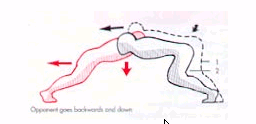 He may be forced to "take his feet so far back that he goes to ground flat on his face … Even if he doesn't go to ground the position he is forced to adopt allows less and less of the power generated behind him to be transmitted though on to the opposition."
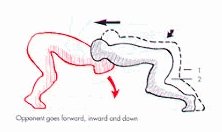 Alternatively, the prop that is being forced to scrummage too low may "bend forward at the hip, his head gradually getting well below the line of the hip," as in the figure at right.
 Further on there is a series of images showing the sequence of scrum formation. The final image, reproduced at left shows the engagement. My rough scaling indicates that the loose head prop's hip and knee angles are around 90° and 120° respectively. However it appears that his shoulders are about 15°lower than his hips. This would not only be illegal but would place him and his fellow front rowers in an inherently unstable situation. He is not in a position either to support his own bodyweight or to generate a horizontal shove.

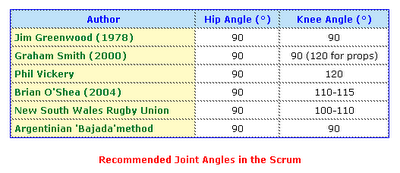

The figure above depicts the limb configurations of a player packed into a scrum with his hip and knee angles both at 90°. (For the sake of illustration I have assumed that the player is 1850mm tall with trunk, thigh and shank lengths of 650mm, 460mm and 480mm respectively.) In order to compare the 90-90 configuration with that advocated by some of the experts listed above, the figure below shows how the body position of the player would change if he retained the 90° hip angle but increased his knee angle to 110°.
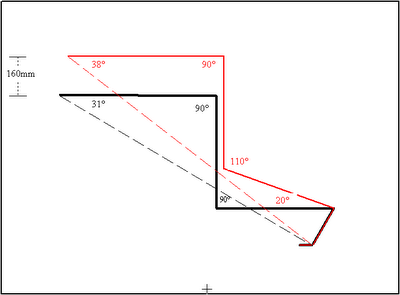

Read more...
Despite the undoubted importance of efficient force delivery in the scrum, there is very limited published material addressing the actual dynamics of force delivery.
Powerful scrummaging is dependent on appropriate body position and limb alignment, not just in the relatively static situation immediately after engagement but throughout the entire contest of the scrum. Much of what passes for best practice in scrum formation reflects a failure to critically examine the actual geometry and mechanics of body position and how these change during the scrum contest.
I believe that an optimal configuration of body position and limb alignment on engagement involves hip and knee angles each set at 90° with both trunk and shank being parallel to the ground. During the scrum, hip and knee joints should move synchronously so that their angles remain equal. The hips may sink slightly relative to the shoulders but trunk and shank should remain parallel.
Body height and joint angles – what the experts advocate
Modern thinking on scrummaging usually advocates consistency of body shape for all participants regardless of position, with the feet approximately shoulder width apart and toes level. There also seems to be general agreement on the need for the trunk to be horizontal or for the shoulders to be slightly higher than the hips. (Greenwood, 1978; Smith, 2000; NSWRU, 2004; Vickery; O'Shea, 2004: Argentinian Bajada method)
However, when joint angles are discussed there is substantial divergence of opinion on the appropriate angle at the knee joint:
Jim Greenwood, Total Rugby, 1978
More than three decades on Greenwood's book, though overtaken by a succession of Law changes, remains a rugby classic. Its underlying logic is compelling. The figure below summarises his views on body position:
Modern thinking on scrummaging usually advocates consistency of body shape for all participants regardless of position, with the feet approximately shoulder width apart and toes level. There also seems to be general agreement on the need for the trunk to be horizontal or for the shoulders to be slightly higher than the hips. (Greenwood, 1978; Smith, 2000; NSWRU, 2004; Vickery; O'Shea, 2004: Argentinian Bajada method)
However, when joint angles are discussed there is substantial divergence of opinion on the appropriate angle at the knee joint:
Jim Greenwood, Total Rugby, 1978
More than three decades on Greenwood's book, though overtaken by a succession of Law changes, remains a rugby classic. Its underlying logic is compelling. The figure below summarises his views on body position:

Greenwood argued that the optimal pushing position required hips below shoulders, 90° joint angles at hip and knee, and "knees near the deck." It can be seen from his drawing 1c above that the trunk and shank are parallel.
The figure also considers the effect of different joint angles on force delivery, and this is further discussed elsewhere in the book:
"Thighs approximately vertical. It's obvious that the more acute the angle of the knee the greater the potential range of the drive, but the more strength is required to initiate it. … [Y]ou only have to go into the full-flexed position to realise that a drive from that position is very much slower and more difficult than a drive from a half-squat. Players tend to assume the position in which they feel most capable of a snap drive. On the other hand, the smaller their degree of flexion the smaller the range of drive. For a six-foot player, a flexion of 90° at the knee produces a potential forward movement of about a foot, which allows for a snap drive, and the necessary continuation shove. That is more than enough for all practical purposes, and may well be seen as a maximum."
Greenwood also emphasises pack height:
"Shoulder height in the front row determines how low the pack can get. From every point of view, the lower the pack gets the better - provided the hooker is capable of striking. … Against the head, it's better to get even lower than usual. What this comes to is that the props get closer and closer to the basic driving position, with their feet further back and wider, their hips correspondingly lower, and their upper bodies close to horizontal. This has two advantages: it restricts the opposing hooker's strike, and may even prevent it, and it ensures a more powerful and effective drive. It's worth pointing out that most scrum-machines are set too high to allow effective low scrumming practice."
Smith emphasises body position. "Each player must take up a position by which the force generated by the large muscles of the lower body, the quadriceps and gluteals particularly, can be transmitted effectively and SAFELY through the spine, the shoulders and the neck."
"The power the legs can produce or resist is conditioned by the angle at the knee. With the thigh vertical, or near vertical, this angle should be maintained between 90° and 120°. The greater angle will be required by the props who need to be more upright in stance in order to provide a base on which, the locks can push. The other forwards can however, adjust their positions to achieve 90° at knee."
Smith examines the consequences of a prop being experienced enough and strong enough "to alter the height of the scrummage quite legally." and "produce a significant disruption of the opposition scrummage. A prop can thus legally force his opponent to scrummage lower, at a height he finds uncomfortable, and which is mechanically inefficient."
An opponent who is unequal to this pressure will normally react in one of two ways. Firstly, he can move his feet further and further back to relieve the discomfort, as in the figure below:
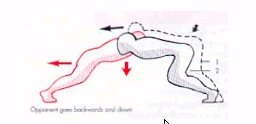 He may be forced to "take his feet so far back that he goes to ground flat on his face … Even if he doesn't go to ground the position he is forced to adopt allows less and less of the power generated behind him to be transmitted though on to the opposition."
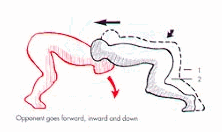 Alternatively, the prop that is being forced to scrummage too low may "bend forward at the hip, his head gradually getting well below the line of the hip," as in the figure at right.
"Because of the pressure from behind by his own lock the prop can be put into a seriously uncomfortable position. He's caught in a vice, and his position becomes even more unpleasant should his superior opponent drive forward at him."
This document states that "almost 99% of all scrimmaging problems can be related directly to the body shape of the participant(s)." Amongst its prescriptions for "correct body shape" are:
"Knee bend (100 - 110° approx) directly beneath hips will assist in generating and transferring weight.
"High, steady hips will allow those players behind to apply force through a near vertical surface. The hips should NOT at anytime be higher than the shoulders."
 Further on there is a series of images showing the sequence of scrum formation. The final image, reproduced at left shows the engagement. My rough scaling indicates that the loose head prop's hip and knee angles are around 90° and 120° respectively. However it appears that his shoulders are about 15°lower than his hips. This would not only be illegal but would place him and his fellow front rowers in an inherently unstable situation. He is not in a position either to support his own bodyweight or to generate a horizontal shove.
"The knee must be bent to generate the explosive power of the legs. If only slightly bent, there will only be a small, but quick, motion forwards. If a deep bend, the forward movement will be slow but be farther. Straight legs prohibit players going backwards but there is little forward momentum. The ideal is a vertical thigh with an angle of about 120 degrees between the thigh and the calf which should provide the required thrust."
In discussing body shape O'Shea specifies:
"A bend at the knees which provides an angle of approximately 110-115°, which permits power generation by the legs. This position is a 'trade-off' between the generation of dynamic power and the length of push that can be achieved. If the bend at the knees is not adequate the distance gained by the push is hardly worthwhile. If the bend at the knees is too great the loss of mechanical advantage makes it difficult to be dynamic."

He does not deal directly with the hip angle but calls for a "straight, flat back" and "high hips" that "should not be higher than the shoulders." Significantly, when illustrating individual common faults, he uses a diagram, reproduced above. where the player with correct technique appears to be in the 90-90 position.
Argentinian teams are renowned for the effectiveness of their scrummaging and the central importance of the scrum to their game. From an early age, Argentinian forwards are schooled in the 'Bajada' or 'Bajadita,' a radically different scrum method invented in the late 'Sixties by the legendary Francisco Ocampo.
A defining characteristic is the 'Empuje Coordinado' or 'Coordinated Push.' "The scrumhalf gives a three part call after the "engage". On "pressure" all members of the pack tighten their binds and fill their lungs with air. On the call "one" everyone sinks; the legs at this point should be at 90 degrees. On "two" the pack comes straight forward while violently expelling the air from their lungs. A key note is that nobody moves their feet until forward momentum is established. If the first drive is insufficient the scrumhalf begins the call again and the opposing pack is usually caught off guard and pushed back." Rugby Union from the Virtual Library of Sport
Sergio Espector, a Level 3 Argentinian coach, recently summarised the main features of the Bajada. After the engagement he stipulates that "all eight players must flex their knees to 90 degrees ... [and] players must never move their feet off the ground until they overcome their opponents and have positive inertia."
The Bajada is recognised as an extremely effective and powerful form of scrummaging.
Summarising the views of these authors:
Analysing joint angles in the scrum
We can visualise the body in scrummaging mode as a system of skeletal levers articulated primarily at the hip and knee joints. The levers are activated by muscular contraction of the relevant extensor and flexor muscle groups. The task is to determine optimal ways to operate those levers to achieve the desired goal of delivering force in the horizontal plane, given that the primary objective of any pack is to effectively resist and, if possible, overcome the horizontal weight force generated from the opposing pack.

The figure above depicts the limb configurations of a player packed into a scrum with his hip and knee angles both at 90°. (For the sake of illustration I have assumed that the player is 1850mm tall with trunk, thigh and shank lengths of 650mm, 460mm and 480mm respectively.) In order to compare the 90-90 configuration with that advocated by some of the experts listed above, the figure below shows how the body position of the player would change if he retained the 90° hip angle but increased his knee angle to 110°.
As can be seen in the figure a knee angle of 110° requires the shank to slope upward 20° above the horizontal. This results in the height of the trunk above ground level rising by 160mm, a quite substantial difference when packs are preparing to engage.
A pack using the 90-110 configuration and therefore accustomed to training and playing with an obtuse knee angle will be disadvantaged if forced lower on engagement. The front row will have no choice but to reduce their knee angle if they are to avoid packing illegally, i.e., with hips above shoulders, and the rest of the pack will have to similarly adjust. Quite apart from the illegality, a failure to adjust the knee angle places the front row in an essentially unstable body position with the risk of the shoulders being driven even further below hip height.
As with the squat exercise, when players under severe load go into a deeper joint contraction than they are accustomed to, they have to operate in a 'zone of discomfort.' The cohesion of the pack is threatened; players may be forced to give ground and at the very least are not in a position to generate a powerful forward shove.
By contrast, a pack accustomed to function with a 90° knee angle can quite comfortably cope if the engagement takes them higher than they would prefer, as they are still operating in the range of joint angles they are familiar with.
Effective scrummaging requires coordinated and synchronised activity by all eight members of a pack. It is also essential that throughout the whole scrum engagement the pack remains in a position to initiate or effectively repel considerable force. Adoption of a 90-90 joint configuration facilitates both objectives.
Coordinated action can be readily achieved if players are trained to start from a common orientation of the joints whatever their playing position, and then to keep their shanks and trunk parallel at all times. This means that the joint angles at hip and knee remain equal as the pack drives forward. Each player is effectively contributing to the collective transmission of force along the line of their backs.
Muscles generate most force in the mid range between full extension and full flexion. From a starting point of 90-90 the leg extensors typically remain operating within that efficient range even when the pack achieves a significant shunt forward. Figure 8 illustrates how joint angles change following a push forward of 300mm. As Greenwood suggests, a "forward movement of about a foot ... may well be seen as a maximum" without repositioning of the feet. As can be seen both joint angles have extended to 138°, but this still leaves the players in a position to continue their forward momentum if necessary. Note that both the trunk and shanks have dropped 6° below the horizontal.
Muscles generate most force in the mid range between full extension and full flexion. From a starting point of 90-90 the leg extensors typically remain operating within that efficient range even when the pack achieves a significant shunt forward. Figure 8 illustrates how joint angles change following a push forward of 300mm. As Greenwood suggests, a "forward movement of about a foot ... may well be seen as a maximum" without repositioning of the feet. As can be seen both joint angles have extended to 138°, but this still leaves the players in a position to continue their forward momentum if necessary. Note that both the trunk and shanks have dropped 6° below the horizontal.

The 90-90 joint alignment provides the optimal platform for horizontal force delivery which can be sustained through a considerable range of movement forward, while simultaneously tending to force the opposing pack to function within a 'zone of discomfort.'
Reference
Jim Greenwood, Total Rugby: 15-Man Rugby for Coach and Player, London: Lepus Books, 1978
Read more...
Subscribe to:
Posts (Atom)

 Posts
Posts


