
An email I received from Colin Astley reads:
"With the new scrum engagement rules everybody's looking for that little something to get the advantage. What are your views on my theory that if you use a quick 'squat' on the engage call, this would give you that extra 'bang' and you would be coming in at a rising angle. As there is only a split second to utilise this technique, the player would have to train the stretch-shortening of the muscle.
"Look forward to your thoughts,
"Colin"
I think that Colin is really onto something significant here. What we are observing under the new rules is a tendency to revert to the practice of the No. 8 pulling back on the locks while the referee goes through his " Crouch - Touch - Pause - Engage" chant. On "Engage" the No. 8 pushes with straightened arms against the buttocks of the locks before attempting to wedge his head between the locks' hips.
Prior to the "Engage" the front seven of the pack are pulling forward or leaning forward against the restraint of the No. 8. Once that brake is released they are pitched forward. Apart from the difficulty of coordinating the transmission and timing of force through the three rows of players, there are other problems from a biomechanical viewpoint.
In conventional scrummaging, front rowers typically crouch so that they maintain a stable position while being positioned to generate a powerful shove. By contrast, if they are being pulled backward their natural tendency is to adopt a very different body configuration. They will be more erect, and in particular their hips will be higher. That is what seems to be happening since the introduction of the new law - front rows are falling forward into the engagement with a consequent increase in collapses and resets.
I think that Colin has not thought through issues of timing when he suggests "a quick 'squat' on the engage call". That is far too late in the sequence. However, if around the time of the "Pause" call all forwards crouch or sink, they will be in an ideal position to rapidly generate a cohesive and coordinated upward-slanting shove on the "Engage". The structured and measured sequencing of the referee's calls under the new law makes such a technique very feasible.
What Colin is talking about when he refers to "stretch-shortening" is a phenomenon utilised by jumpers and gymnasts to increase jumping height and also observable in the ballistic back swing or pre-stretch of throwers and racquet game players:
"The stretch-shorten cycle (SSC) describes a period in which a muscle undergoes eccentric work, is stretched, contracts isometrically to stop the counter movement, and follows immediately with maximal contraction with the intention of applying a maximal force. The cycle utilises the principle of stretch reflex, of the length-tension relationship of muscle, storage of elastic energy in the muscle-tendon complex, enhanced potentiation of muscle, and chemical energy from the preload effect." (Doug McClymont and Mike Cron, "Total impact method: a variation on engagement technique in the rugby scrum" http://www.coachesinfo.com/category/rugby/84/)
There is absolutely no doubt that a pack which is trained to utilise stretch-shortening from a low crouch position will generate much more effective and purposeful force than one that one that adopts the "pull-back-then-release-the-brakes" method.
I believe that the new scrum law is potentially a significant improvement, subject to two conditions. Firstly, referees must rigidly enforce Law 20.2 (b) which requires of front rowers that "each player's shoulders must be no lower than the hips". Secondly, the practice of No. 8s pulling back the pack should be outlawed as it has been clearly demonstrated that its effect is directly contrary to the primary intent of the new law, i.e., to produce safer engagements and to minimise resets.
Read more...
Wednesday, April 18, 2007


Friday, December 01, 2006
ScrumTruk's first Olympian
Originally developed for increasing the pushing strength of rugby forwards, MyoQuip's ScrumTruk has proved its versatility across a variety of sports. At the University of Sydney it has been used by Australian national representatives in rugby, rowing and women’s basketball, but the first Olympic representative to use it was in the winter sport of bobsleigh racing.
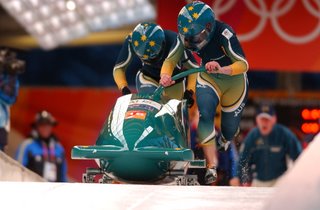 Fifth-year veterinary science student Astrid Loch-Wilkinson was the pilot of Australia’s first-ever women's bobsleigh team which competed at the Winter Olympics in Torino, Italy, in February. Astrid and brake woman Kylie Reed finished 14th with a time of 3 minutes 55.11 seconds for their four runs.
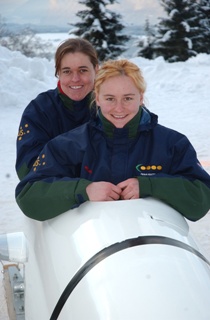
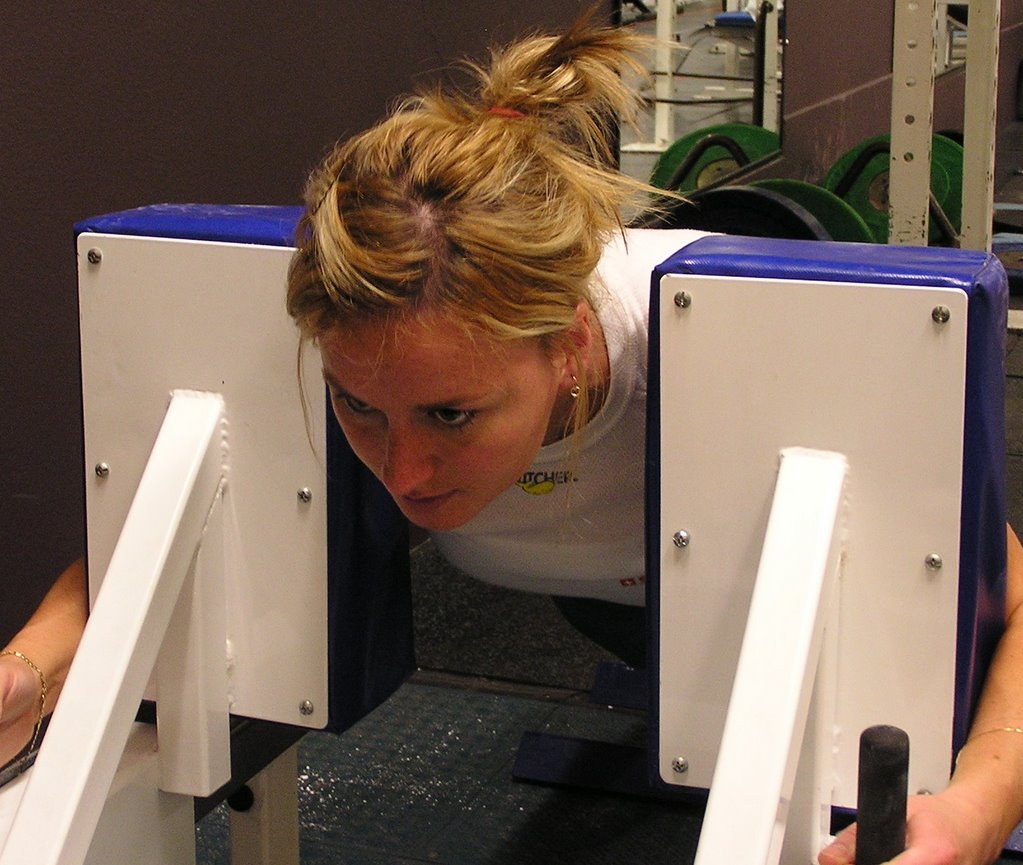
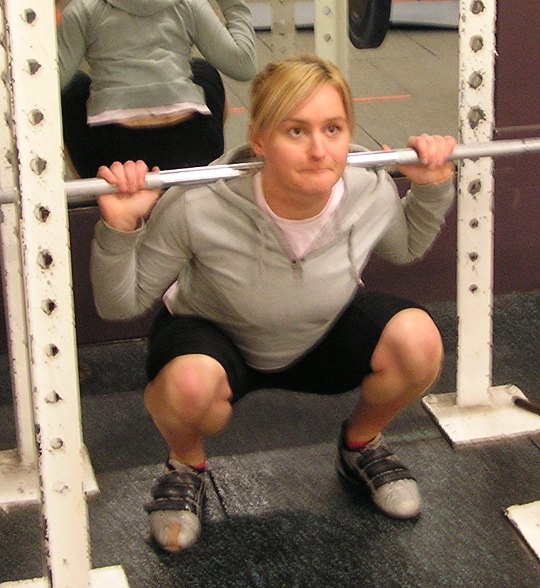
In addition to conventional basic strength exercises such as the squat and dead lift the pair made extensive use of the ScrumTruk at the university gymnasium. The machine has strong specificity for the bobsleigh push-start because in both activities force has to be generated and delivered in the horizontal plane.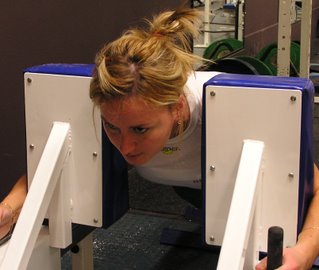
Read more...
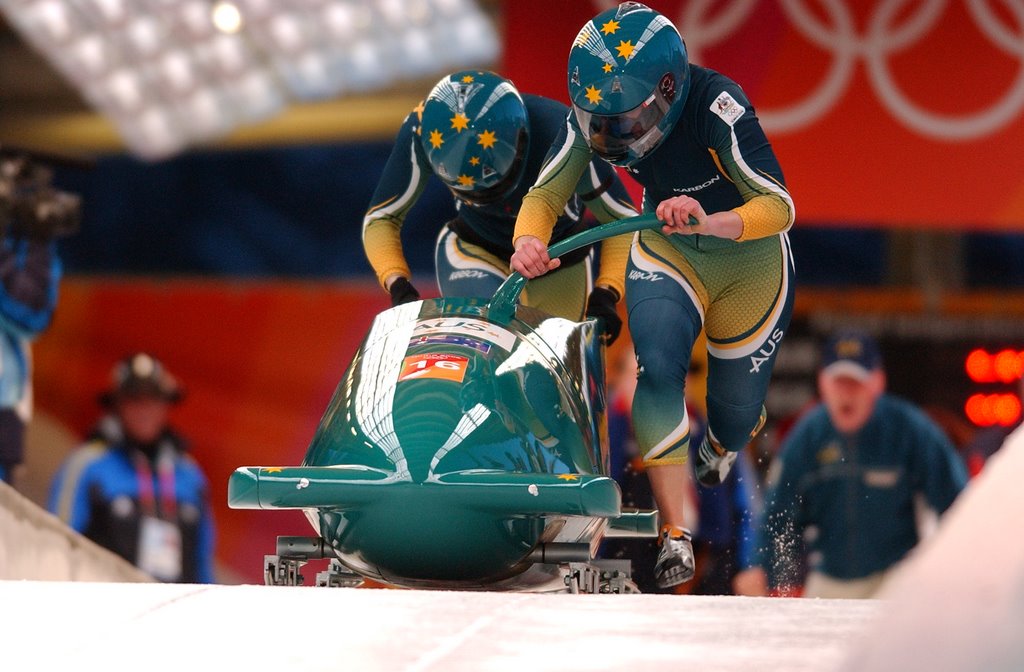 Fifth-year veterinary science student Astrid Loch-Wilkinson was the pilot of Australia’s first-ever women's bobsleigh team which competed at the Winter Olympics in Torino, Italy, in February. Astrid and brake woman Kylie Reed finished 14th with a time of 3 minutes 55.11 seconds for their four runs.
Athletes from power sports such as weight-lifting and athletics are often recruited for bobsleighing because they have appropriate attributes to gain an edge at the explosive push-start that characterizes the event. Astrid had the necessary athletic ability having been an Australian national 400m hurdling champion and a Sydney University Blue in soccer.
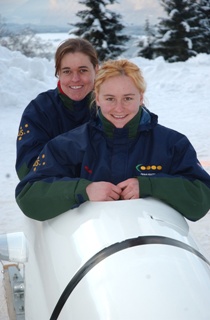
For her strength training she turned to Martin Harland, the University's Athlete Performance Manager, himself a former Winter Olympian in the bobsleigh. Harland was very impressed by Astrid's excellent training ethic and innate capacity for strength development.
In addition to conventional basic strength exercises such as the squat and dead lift the pair made extensive use of the ScrumTruk at the university gymnasium. The machine has strong specificity for the bobsleigh push-start because in both activities force has to be generated and delivered in the horizontal plane.
"I used the ScrumTruk regularly in my strength training leading up to the Olympics," says Astrid. “I found the machine was great to use in conjunction with my Olympic lifting training. It assisted me in becoming stronger in the 'pushing' action related to bobsleigh".
Careering down a twisting track of ice at 125 kph in a flimsy shell would seem to require extraordinary courage. “My first run down the ice in a sled was terrifying as I basically had no idea what I was doing,” she admits. But after three years of piloting bobsleds in World Cup races, she says she is used to the speed.
“It becomes slower and slower the more I race. Before each race I study the track very intensively with my coach so I know precisely how to steer every part of it. I enjoy racing but it’s pretty intense and it doesn’t feel fast because I have to concentrate on the technique”, she says.
Some of the bobsleigh teams competing in Torino had million dollar budgets. By contrast Astrid and Kylie were largely self-funded. Because of Australia's isolation from alpine sports, much of their initial training consisted of pushing a billy-cart - a form of wheeled trolley used by children - around a local football oval. They were also required to travel to Europe for extended periods each year racing on the World Cup circuit.
“Bobsled racing costs $30,000 to $40,000 a year”, Astrid says. “I would like to go to the next Winter Games at Vancouver in 2010 but we need some funding”.

Read more...
Wednesday, November 29, 2006
Body height in the rugby scrum: the value of equal hip and knee joint angles
Introduction
Despite the undoubted importance of efficient force delivery in the scrum, there is very limited published material addressing the actual dynamics of force delivery.
Powerful scrummaging is dependent on appropriate body position and limb alignment, not just in the relatively static situation immediately after engagement but throughout the entire contest of the scrum. Much of what passes for best practice in scrum formation reflects a failure to critically examine the actual geometry and mechanics of body position and how these change during the scrum contest.
I believe that an optimal configuration of body position and limb alignment on engagement involves hip and knee angles each set at 90° with both trunk and shank being parallel to the ground. During the scrum, hip and knee joints should move synchronously so that their angles remain equal. The hips may sink slightly relative to the shoulders but trunk and shank should remain parallel.

"Thighs approximately vertical. It's obvious that the more acute the angle of the knee the greater the potential range of the drive, but the more strength is required to initiate it. … [Y]ou only have to go into the full-flexed position to realise that a drive from that position is very much slower and more difficult than a drive from a half-squat. Players tend to assume the position in which they feel most capable of a snap drive. On the other hand, the smaller their degree of flexion the smaller the range of drive. For a six-foot player, a flexion of 90° at the knee produces a potential forward movement of about a foot, which allows for a snap drive, and the necessary continuation shove. That is more than enough for all practical purposes, and may well be seen as a maximum."
 He may be forced to "take his feet so far back that he goes to ground flat on his face … Even if he doesn't go to ground the position he is forced to adopt allows less and less of the power generated behind him to be transmitted though on to the opposition."
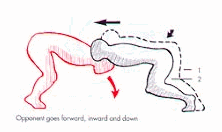 Alternatively, the prop that is being forced to scrummage too low may "bend forward at the hip, his head gradually getting well below the line of the hip," as in the figure at right.
 Further on there is a series of images showing the sequence of scrum formation. The final image, reproduced at left shows the engagement. My rough scaling indicates that the loose head prop's hip and knee angles are around 90° and 120° respectively. However it appears that his shoulders are about 15°lower than his hips. This would not only be illegal but would place him and his fellow front rowers in an inherently unstable situation. He is not in a position either to support his own bodyweight or to generate a horizontal shove.


The figure above depicts the limb configurations of a player packed into a scrum with his hip and knee angles both at 90°. (For the sake of illustration I have assumed that the player is 1850mm tall with trunk, thigh and shank lengths of 650mm, 460mm and 480mm respectively.) In order to compare the 90-90 configuration with that advocated by some of the experts listed above, the figure below shows how the body position of the player would change if he retained the 90° hip angle but increased his knee angle to 110°.

Read more...
Despite the undoubted importance of efficient force delivery in the scrum, there is very limited published material addressing the actual dynamics of force delivery.
Powerful scrummaging is dependent on appropriate body position and limb alignment, not just in the relatively static situation immediately after engagement but throughout the entire contest of the scrum. Much of what passes for best practice in scrum formation reflects a failure to critically examine the actual geometry and mechanics of body position and how these change during the scrum contest.
I believe that an optimal configuration of body position and limb alignment on engagement involves hip and knee angles each set at 90° with both trunk and shank being parallel to the ground. During the scrum, hip and knee joints should move synchronously so that their angles remain equal. The hips may sink slightly relative to the shoulders but trunk and shank should remain parallel.
Body height and joint angles – what the experts advocate
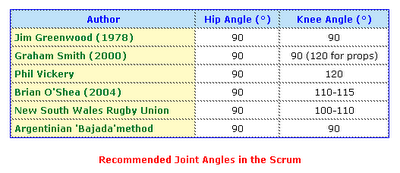
Modern thinking on scrummaging usually advocates consistency of body shape for all participants regardless of position, with the feet approximately shoulder width apart and toes level. There also seems to be general agreement on the need for the trunk to be horizontal or for the shoulders to be slightly higher than the hips. (Greenwood, 1978; Smith, 2000; NSWRU, 2004; Vickery; O'Shea, 2004: Argentinian Bajada method)
However, when joint angles are discussed there is substantial divergence of opinion on the appropriate angle at the knee joint:
Jim Greenwood, Total Rugby, 1978
More than three decades on Greenwood's book, though overtaken by a succession of Law changes, remains a rugby classic. Its underlying logic is compelling. The figure below summarises his views on body position:
Modern thinking on scrummaging usually advocates consistency of body shape for all participants regardless of position, with the feet approximately shoulder width apart and toes level. There also seems to be general agreement on the need for the trunk to be horizontal or for the shoulders to be slightly higher than the hips. (Greenwood, 1978; Smith, 2000; NSWRU, 2004; Vickery; O'Shea, 2004: Argentinian Bajada method)
However, when joint angles are discussed there is substantial divergence of opinion on the appropriate angle at the knee joint:
Jim Greenwood, Total Rugby, 1978
More than three decades on Greenwood's book, though overtaken by a succession of Law changes, remains a rugby classic. Its underlying logic is compelling. The figure below summarises his views on body position:

Greenwood argued that the optimal pushing position required hips below shoulders, 90° joint angles at hip and knee, and "knees near the deck." It can be seen from his drawing 1c above that the trunk and shank are parallel.
The figure also considers the effect of different joint angles on force delivery, and this is further discussed elsewhere in the book:
"Thighs approximately vertical. It's obvious that the more acute the angle of the knee the greater the potential range of the drive, but the more strength is required to initiate it. … [Y]ou only have to go into the full-flexed position to realise that a drive from that position is very much slower and more difficult than a drive from a half-squat. Players tend to assume the position in which they feel most capable of a snap drive. On the other hand, the smaller their degree of flexion the smaller the range of drive. For a six-foot player, a flexion of 90° at the knee produces a potential forward movement of about a foot, which allows for a snap drive, and the necessary continuation shove. That is more than enough for all practical purposes, and may well be seen as a maximum."
Greenwood also emphasises pack height:
"Shoulder height in the front row determines how low the pack can get. From every point of view, the lower the pack gets the better - provided the hooker is capable of striking. … Against the head, it's better to get even lower than usual. What this comes to is that the props get closer and closer to the basic driving position, with their feet further back and wider, their hips correspondingly lower, and their upper bodies close to horizontal. This has two advantages: it restricts the opposing hooker's strike, and may even prevent it, and it ensures a more powerful and effective drive. It's worth pointing out that most scrum-machines are set too high to allow effective low scrumming practice."
Smith emphasises body position. "Each player must take up a position by which the force generated by the large muscles of the lower body, the quadriceps and gluteals particularly, can be transmitted effectively and SAFELY through the spine, the shoulders and the neck."
"The power the legs can produce or resist is conditioned by the angle at the knee. With the thigh vertical, or near vertical, this angle should be maintained between 90° and 120°. The greater angle will be required by the props who need to be more upright in stance in order to provide a base on which, the locks can push. The other forwards can however, adjust their positions to achieve 90° at knee."
Smith examines the consequences of a prop being experienced enough and strong enough "to alter the height of the scrummage quite legally." and "produce a significant disruption of the opposition scrummage. A prop can thus legally force his opponent to scrummage lower, at a height he finds uncomfortable, and which is mechanically inefficient."
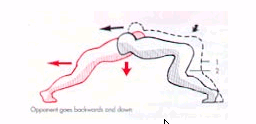
An opponent who is unequal to this pressure will normally react in one of two ways. Firstly, he can move his feet further and further back to relieve the discomfort, as in the figure below:
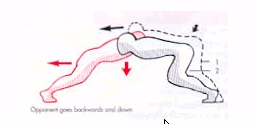 He may be forced to "take his feet so far back that he goes to ground flat on his face … Even if he doesn't go to ground the position he is forced to adopt allows less and less of the power generated behind him to be transmitted though on to the opposition."
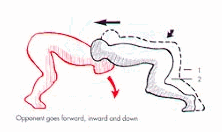 Alternatively, the prop that is being forced to scrummage too low may "bend forward at the hip, his head gradually getting well below the line of the hip," as in the figure at right.
"Because of the pressure from behind by his own lock the prop can be put into a seriously uncomfortable position. He's caught in a vice, and his position becomes even more unpleasant should his superior opponent drive forward at him."
This document states that "almost 99% of all scrimmaging problems can be related directly to the body shape of the participant(s)." Amongst its prescriptions for "correct body shape" are:
"Knee bend (100 - 110° approx) directly beneath hips will assist in generating and transferring weight.
"High, steady hips will allow those players behind to apply force through a near vertical surface. The hips should NOT at anytime be higher than the shoulders."
 Further on there is a series of images showing the sequence of scrum formation. The final image, reproduced at left shows the engagement. My rough scaling indicates that the loose head prop's hip and knee angles are around 90° and 120° respectively. However it appears that his shoulders are about 15°lower than his hips. This would not only be illegal but would place him and his fellow front rowers in an inherently unstable situation. He is not in a position either to support his own bodyweight or to generate a horizontal shove.
"The knee must be bent to generate the explosive power of the legs. If only slightly bent, there will only be a small, but quick, motion forwards. If a deep bend, the forward movement will be slow but be farther. Straight legs prohibit players going backwards but there is little forward momentum. The ideal is a vertical thigh with an angle of about 120 degrees between the thigh and the calf which should provide the required thrust."
In discussing body shape O'Shea specifies:
"A bend at the knees which provides an angle of approximately 110-115°, which permits power generation by the legs. This position is a 'trade-off' between the generation of dynamic power and the length of push that can be achieved. If the bend at the knees is not adequate the distance gained by the push is hardly worthwhile. If the bend at the knees is too great the loss of mechanical advantage makes it difficult to be dynamic."

He does not deal directly with the hip angle but calls for a "straight, flat back" and "high hips" that "should not be higher than the shoulders." Significantly, when illustrating individual common faults, he uses a diagram, reproduced above. where the player with correct technique appears to be in the 90-90 position.
Argentinian teams are renowned for the effectiveness of their scrummaging and the central importance of the scrum to their game. From an early age, Argentinian forwards are schooled in the 'Bajada' or 'Bajadita,' a radically different scrum method invented in the late 'Sixties by the legendary Francisco Ocampo.
A defining characteristic is the 'Empuje Coordinado' or 'Coordinated Push.' "The scrumhalf gives a three part call after the "engage". On "pressure" all members of the pack tighten their binds and fill their lungs with air. On the call "one" everyone sinks; the legs at this point should be at 90 degrees. On "two" the pack comes straight forward while violently expelling the air from their lungs. A key note is that nobody moves their feet until forward momentum is established. If the first drive is insufficient the scrumhalf begins the call again and the opposing pack is usually caught off guard and pushed back." Rugby Union from the Virtual Library of Sport
Sergio Espector, a Level 3 Argentinian coach, recently summarised the main features of the Bajada. After the engagement he stipulates that "all eight players must flex their knees to 90 degrees ... [and] players must never move their feet off the ground until they overcome their opponents and have positive inertia."
The Bajada is recognised as an extremely effective and powerful form of scrummaging.
Summarising the views of these authors:
Analysing joint angles in the scrum
We can visualise the body in scrummaging mode as a system of skeletal levers articulated primarily at the hip and knee joints. The levers are activated by muscular contraction of the relevant extensor and flexor muscle groups. The task is to determine optimal ways to operate those levers to achieve the desired goal of delivering force in the horizontal plane, given that the primary objective of any pack is to effectively resist and, if possible, overcome the horizontal weight force generated from the opposing pack.

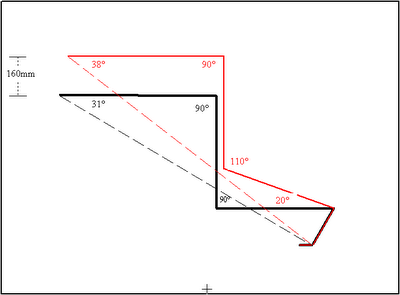
The figure above depicts the limb configurations of a player packed into a scrum with his hip and knee angles both at 90°. (For the sake of illustration I have assumed that the player is 1850mm tall with trunk, thigh and shank lengths of 650mm, 460mm and 480mm respectively.) In order to compare the 90-90 configuration with that advocated by some of the experts listed above, the figure below shows how the body position of the player would change if he retained the 90° hip angle but increased his knee angle to 110°.
As can be seen in the figure a knee angle of 110° requires the shank to slope upward 20° above the horizontal. This results in the height of the trunk above ground level rising by 160mm, a quite substantial difference when packs are preparing to engage.
A pack using the 90-110 configuration and therefore accustomed to training and playing with an obtuse knee angle will be disadvantaged if forced lower on engagement. The front row will have no choice but to reduce their knee angle if they are to avoid packing illegally, i.e., with hips above shoulders, and the rest of the pack will have to similarly adjust. Quite apart from the illegality, a failure to adjust the knee angle places the front row in an essentially unstable body position with the risk of the shoulders being driven even further below hip height.
As with the squat exercise, when players under severe load go into a deeper joint contraction than they are accustomed to, they have to operate in a 'zone of discomfort.' The cohesion of the pack is threatened; players may be forced to give ground and at the very least are not in a position to generate a powerful forward shove.
By contrast, a pack accustomed to function with a 90° knee angle can quite comfortably cope if the engagement takes them higher than they would prefer, as they are still operating in the range of joint angles they are familiar with.
Effective scrummaging requires coordinated and synchronised activity by all eight members of a pack. It is also essential that throughout the whole scrum engagement the pack remains in a position to initiate or effectively repel considerable force. Adoption of a 90-90 joint configuration facilitates both objectives.
Coordinated action can be readily achieved if players are trained to start from a common orientation of the joints whatever their playing position, and then to keep their shanks and trunk parallel at all times. This means that the joint angles at hip and knee remain equal as the pack drives forward. Each player is effectively contributing to the collective transmission of force along the line of their backs.
Muscles generate most force in the mid range between full extension and full flexion. From a starting point of 90-90 the leg extensors typically remain operating within that efficient range even when the pack achieves a significant shunt forward. Figure 8 illustrates how joint angles change following a push forward of 300mm. As Greenwood suggests, a "forward movement of about a foot ... may well be seen as a maximum" without repositioning of the feet. As can be seen both joint angles have extended to 138°, but this still leaves the players in a position to continue their forward momentum if necessary. Note that both the trunk and shanks have dropped 6° below the horizontal.
Muscles generate most force in the mid range between full extension and full flexion. From a starting point of 90-90 the leg extensors typically remain operating within that efficient range even when the pack achieves a significant shunt forward. Figure 8 illustrates how joint angles change following a push forward of 300mm. As Greenwood suggests, a "forward movement of about a foot ... may well be seen as a maximum" without repositioning of the feet. As can be seen both joint angles have extended to 138°, but this still leaves the players in a position to continue their forward momentum if necessary. Note that both the trunk and shanks have dropped 6° below the horizontal.

The 90-90 joint alignment provides the optimal platform for horizontal force delivery which can be sustained through a considerable range of movement forward, while simultaneously tending to force the opposing pack to function within a 'zone of discomfort.'
Reference
Jim Greenwood, Total Rugby: 15-Man Rugby for Coach and Player, London: Lepus Books, 1978
Read more...
Monday, November 27, 2006
Scots overpowered by Wallaby size
Following the Wallabies' emphatic defeat of Scotland at Murrayfield in Edinburgh on Saturday, it was interesting to note comments by the Scots' coach Frank Hadden:
"It's difficult to front up week after week against heavier sides.
"We've hidden that for a while but the Australian pack were able to create the opportunities for their danger players.
"They have quality backs and when they are going forward they're very difficult to stop."
The rugby community is gradually waking up to the idea that increased size and strength confers a huge advantage in the sport, and not just in the forwards. Heavy backs are also able to gradually wear down their lighter opponents.
It is difficult for a national coach to do much about the physical attributes of his players - he basically has to work with the available material over a very short preparation period. The groundwork for physical dominance has to be laid much earlier - even at school level.
Those in charge of Scottish rugby would do well to investigate what is being achieved at Sydney University in terms of the systematic physical development of young players.
Read more...
"It's difficult to front up week after week against heavier sides.
"We've hidden that for a while but the Australian pack were able to create the opportunities for their danger players.
"They have quality backs and when they are going forward they're very difficult to stop."
The rugby community is gradually waking up to the idea that increased size and strength confers a huge advantage in the sport, and not just in the forwards. Heavy backs are also able to gradually wear down their lighter opponents.
It is difficult for a national coach to do much about the physical attributes of his players - he basically has to work with the available material over a very short preparation period. The groundwork for physical dominance has to be laid much earlier - even at school level.
Those in charge of Scottish rugby would do well to investigate what is being achieved at Sydney University in terms of the systematic physical development of young players.
Read more...
Thursday, October 26, 2006
A biomechanical model for estimating moments of force at hip and knee joints in the barbell squat
Introduction
The barbell squat is a complex, mass load bearing multi-articular exercise movement. It is the basic lower body exercise prescribed in training programs for many sports even though it is unpopular with most athletes and is often performed inexpertly. One of the major problems when performing a full squat with heavy weights is that there appears to be excessive loading in the bottom part of the movement. At the same time loading through the top range of the movement seems inadequate.
This study examines the extent to which these effects may be attributable to changing values of resistive torque in moving from deep flexion to full extension of the hip and knee joints, i.e., to changes in limb geometry. A basic biomechanical model of the squat has been developed to calculate moments of force or torque applied about the axes of the hip and knee joints at various angles of those joints. I am not aware of any previous comparable study of the free weight squat.
The Model
A mathematically scaled model of a person of 180cm height and 100kg body weight was created consisting of four linked segments. These were the upper body or HAT (head, arms and trunk) assumed to be a rigid member; the thighs; the shanks; and the feet. The lengths of the segments as a percentage of total height were 50, 24, 22, and 4 respectively. Centres of gravity for the thighs and shanks were assumed to be both at 43.3% of segment length measured proximally. The proportion of body weight for the upper body, thighs and shanks was estimated as 68.6%, 20.0% and 8.6% respectively.
In order for stability to be maintained in squatting, the centre of gravity of the system (exerciser's body plus weight bar) must remain directly over the feet. Unless the centre of mass is constantly positioned directly above the ground reaction force vector, a moment would exist and the system would rotate, i.e., tip forward or backward.
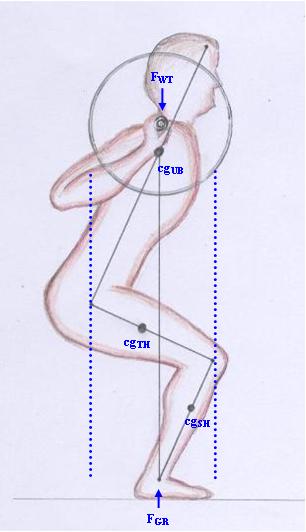
To provide a determinate model and to facilitate calculation, a number of simplifying assumptions were used, Firstly, throughout the exercise movement the hip and knee joints move synchronously, i.e., at any point their angles are equal. Secondly, the force vector of the weight bar (FWB) was assumed to be located directly above that of the upper body (cgUB). Thirdly, it was assumed that the centre of gravity of the system remains directly above the ankle joint rather than at the midpoint of the foot as is usually and more correctly assumed. Figure 1 shows a simplified free body diagram incorporating the assumptions.
At each observation point throughout the exercise the body is evaluated in a static or constant velocity state and therefore can be treated as rigid. Moments of force were calculated for the knee and hip joints using a link-segment model of the form described in Winter (1990).
Other than its contribution to total body mass the weight of the exerciser's feet was ignored. For the present calculations the mass of the loaded weight bar was assumed to be 100kg. Its force (FWB) contributes to moments about the joints. The vertical reaction force (FGR) from the floor to the exerciser's feet also provides a force of flexion about the hip and knee joints. The constant velocity assumption means that the ground reaction force is simply the sum of the body mass and the mass of the weight bar, i.e., 200kg in this application of the model.
The range of motion investigated was from deep flexion of 40° for both hip and knee joints to lock-out or full extension at 180°.
Results
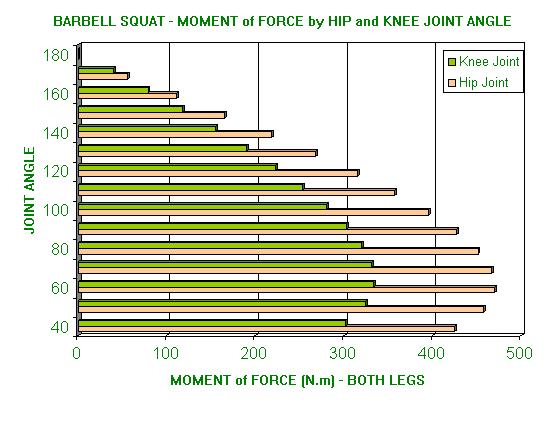
Figure 2 shows the moments of force about the hip and knee joints calculated using the model. It can be seen that very high moment values occur in deep squat positions. In fact at 60° flexion of both joints, torque values are 470N.m and 333N.m for the hip and knee joints respectively. In this model the parallel position for the thigh occurs at joint angles of 62.5°. This is the position where the hip and knee joints are furthest from the force vectors of the weight bar and upper body, with the result that torque values for hip and knee joints reach their maxima here at 471N.m and 334N.m respectively.
Below this point it can be seen that torque values are declining, but this effect is counteracted by the fact that the leg extensor muscles are lengthening and therefore increasingly less able to deliver force.
It can also be seen that as the exerciser rises above joint angles of around 90° the torque values decline markedly and approach zero with full extension or lock-out.
I am unaware of any published studies of strength curves for complex exercises like the barbell squat but it can be expected that the leg extensor muscles function most efficiently in the mid range of the exercise movement. The conjunction of such a muscle strength profile with the torque curves shown above means that a heavy load would place the exerciser in a biomechanically disadvantageous position in the deep range of the movement. At the same time there would be inadequate effective activation of the leg extensor muscles through the top range.
It should be noted that the torque values were calculated with the exerciser stationary at each joint position, so they are isometrically determined. Different results would be obtained if measurements were made of actual dynamic movement. Results would also vary if the assumption of synchronised joint angles did not apply. However in both situations similar extreme variations in torque between bottom end and top end positions could be anticipated.
Correcting for variations in joint torque
A number of methods have been developed to improve the efficacy of the squat exercise. The most well known involve the addition of metal chains or rubber bands to the squat apparatus. With the former sections of chain are hung from each end of the weight bar. As the lifter descends links begin to pile on the floor, lessening the effective load and consequently the joint torque.
The usual method of using bands when squatting is to attach one or more heavy rubber bands to each end of the weight bar and anchor them to hooks on the floor. As the lifter rises tension in the bands increases adding to the effective load and the joint torque. However this system has no effect on the torque at the bottom end of the movement. To correct this a reverse band technique is employed. Here the bands from the weight bar are attached to the top of the squat rack or the ceiling. As the lifter descends tension in the bands increases, thereby compensating for the increasing torque in the bottom range.
The MyoQuip ScrumTruk has been developed to overcome the deficiencies in the conventional squat. It solves the problem of excessive variation in torque in two ways. Firstly it is operated in a horizontal body position thus greatly reducing the contribution of the user's own body weight to torque generation. Secondly its use of QuadTorq variable resistance technology compensates for torque variation at both ends of the movement. The ability to make adjustments to the rate of change of load means that the user can experience appropriate load and effective muscle activation through the whole range of movement.
Why tall people can't squat
It is generally recognised that people with long limbs are poor squatters. They often look awkward performing the exercise and the poundages they lift are usually unimpressive. The present study sheds light on why this is so.
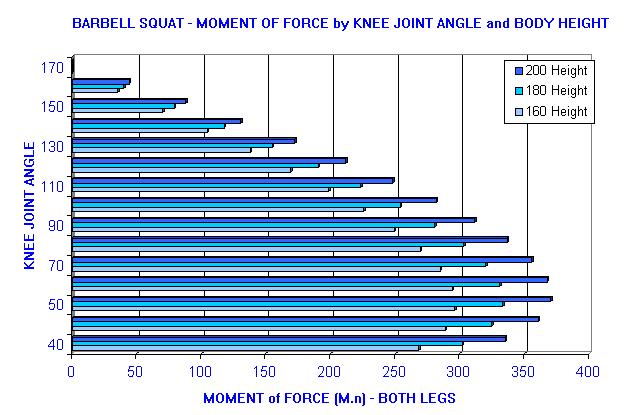
Figures 3 and 4 compare the joint moment forces generated in the squat by three lifters of different height. In each case we assume that the lifter weighs 100kg and is squatting a weight bar loaded to 100kg. The assumed body heights are 160cm, 180cm and 200cm. Inspection of the two charts indicates that torque values vary directly with body height. In fact it can be seen that the moments of force at any joint angle are 25% higher for an athlete of 200cm than for one of 160cm. Therefore in the bottom range of the movement they are much more subjected to excessive loading.
There is an additional effect. Given that work can be measured as force times distance, it is obvious that a tall person will rise further and therefore perform more work than a shorter person. Again our 200cm subject is performing 25% more work than their 160cm counterpart.
Thus there are logical reasons for the perceived poor performance of tall people in the barbell squat.
Conclusion
This study has demonstrated that throughout a deep squat movement with heavy loading the moments of force experienced at the hip and knee joints typically vary from excessive to inconsequential. Because of this the leg extensor muscles are likely to be effectively activated for only a minor part of the exercise movement.
It therefore seems appropriate to question the efficacy of the squat as a general exercise for developing leg strength. In particular the wisdom of its use in preparing athletes for participation in sports that themselves have high incidence of back and knee injury must be doubted.
References
Abelbeck, K.G. Biomechanical model and evaluation of a linear motion squat type exercise. J. Strength Conditioning Res. 16: 516-524. 2002.
Robertson, D.G.E., G.E. Caldwell, J. Hamill, G Kamen and S.N. Whittlesey. Research Methods in Biomechanics. Champaign, IL: Human Kinetics, 2004.
Winter, D.A. Biomechanics and Motor Control of Human Movement. New York: John Wiley & Sons, Inc. 2nd Edn. 1990.
Read more...
The barbell squat is a complex, mass load bearing multi-articular exercise movement. It is the basic lower body exercise prescribed in training programs for many sports even though it is unpopular with most athletes and is often performed inexpertly. One of the major problems when performing a full squat with heavy weights is that there appears to be excessive loading in the bottom part of the movement. At the same time loading through the top range of the movement seems inadequate.
This study examines the extent to which these effects may be attributable to changing values of resistive torque in moving from deep flexion to full extension of the hip and knee joints, i.e., to changes in limb geometry. A basic biomechanical model of the squat has been developed to calculate moments of force or torque applied about the axes of the hip and knee joints at various angles of those joints. I am not aware of any previous comparable study of the free weight squat.
The Model
A mathematically scaled model of a person of 180cm height and 100kg body weight was created consisting of four linked segments. These were the upper body or HAT (head, arms and trunk) assumed to be a rigid member; the thighs; the shanks; and the feet. The lengths of the segments as a percentage of total height were 50, 24, 22, and 4 respectively. Centres of gravity for the thighs and shanks were assumed to be both at 43.3% of segment length measured proximally. The proportion of body weight for the upper body, thighs and shanks was estimated as 68.6%, 20.0% and 8.6% respectively.
In order for stability to be maintained in squatting, the centre of gravity of the system (exerciser's body plus weight bar) must remain directly over the feet. Unless the centre of mass is constantly positioned directly above the ground reaction force vector, a moment would exist and the system would rotate, i.e., tip forward or backward.
To provide a determinate model and to facilitate calculation, a number of simplifying assumptions were used, Firstly, throughout the exercise movement the hip and knee joints move synchronously, i.e., at any point their angles are equal. Secondly, the force vector of the weight bar (FWB) was assumed to be located directly above that of the upper body (cgUB). Thirdly, it was assumed that the centre of gravity of the system remains directly above the ankle joint rather than at the midpoint of the foot as is usually and more correctly assumed. Figure 1 shows a simplified free body diagram incorporating the assumptions.
At each observation point throughout the exercise the body is evaluated in a static or constant velocity state and therefore can be treated as rigid. Moments of force were calculated for the knee and hip joints using a link-segment model of the form described in Winter (1990).
Other than its contribution to total body mass the weight of the exerciser's feet was ignored. For the present calculations the mass of the loaded weight bar was assumed to be 100kg. Its force (FWB) contributes to moments about the joints. The vertical reaction force (FGR) from the floor to the exerciser's feet also provides a force of flexion about the hip and knee joints. The constant velocity assumption means that the ground reaction force is simply the sum of the body mass and the mass of the weight bar, i.e., 200kg in this application of the model.
The range of motion investigated was from deep flexion of 40° for both hip and knee joints to lock-out or full extension at 180°.
Figure 1

Results
Figure 2 shows the moments of force about the hip and knee joints calculated using the model. It can be seen that very high moment values occur in deep squat positions. In fact at 60° flexion of both joints, torque values are 470N.m and 333N.m for the hip and knee joints respectively. In this model the parallel position for the thigh occurs at joint angles of 62.5°. This is the position where the hip and knee joints are furthest from the force vectors of the weight bar and upper body, with the result that torque values for hip and knee joints reach their maxima here at 471N.m and 334N.m respectively.
Below this point it can be seen that torque values are declining, but this effect is counteracted by the fact that the leg extensor muscles are lengthening and therefore increasingly less able to deliver force.
It can also be seen that as the exerciser rises above joint angles of around 90° the torque values decline markedly and approach zero with full extension or lock-out.
I am unaware of any published studies of strength curves for complex exercises like the barbell squat but it can be expected that the leg extensor muscles function most efficiently in the mid range of the exercise movement. The conjunction of such a muscle strength profile with the torque curves shown above means that a heavy load would place the exerciser in a biomechanically disadvantageous position in the deep range of the movement. At the same time there would be inadequate effective activation of the leg extensor muscles through the top range.
Figure 2
![]()
It should be noted that the torque values were calculated with the exerciser stationary at each joint position, so they are isometrically determined. Different results would be obtained if measurements were made of actual dynamic movement. Results would also vary if the assumption of synchronised joint angles did not apply. However in both situations similar extreme variations in torque between bottom end and top end positions could be anticipated.
Correcting for variations in joint torque
A number of methods have been developed to improve the efficacy of the squat exercise. The most well known involve the addition of metal chains or rubber bands to the squat apparatus. With the former sections of chain are hung from each end of the weight bar. As the lifter descends links begin to pile on the floor, lessening the effective load and consequently the joint torque.
The usual method of using bands when squatting is to attach one or more heavy rubber bands to each end of the weight bar and anchor them to hooks on the floor. As the lifter rises tension in the bands increases adding to the effective load and the joint torque. However this system has no effect on the torque at the bottom end of the movement. To correct this a reverse band technique is employed. Here the bands from the weight bar are attached to the top of the squat rack or the ceiling. As the lifter descends tension in the bands increases, thereby compensating for the increasing torque in the bottom range.
The MyoQuip ScrumTruk has been developed to overcome the deficiencies in the conventional squat. It solves the problem of excessive variation in torque in two ways. Firstly it is operated in a horizontal body position thus greatly reducing the contribution of the user's own body weight to torque generation. Secondly its use of QuadTorq variable resistance technology compensates for torque variation at both ends of the movement. The ability to make adjustments to the rate of change of load means that the user can experience appropriate load and effective muscle activation through the whole range of movement.
Why tall people can't squat
It is generally recognised that people with long limbs are poor squatters. They often look awkward performing the exercise and the poundages they lift are usually unimpressive. The present study sheds light on why this is so.
Figure 3
![]()

Figures 3 and 4 compare the joint moment forces generated in the squat by three lifters of different height. In each case we assume that the lifter weighs 100kg and is squatting a weight bar loaded to 100kg. The assumed body heights are 160cm, 180cm and 200cm. Inspection of the two charts indicates that torque values vary directly with body height. In fact it can be seen that the moments of force at any joint angle are 25% higher for an athlete of 200cm than for one of 160cm. Therefore in the bottom range of the movement they are much more subjected to excessive loading.
Figure 4
![]()
There is an additional effect. Given that work can be measured as force times distance, it is obvious that a tall person will rise further and therefore perform more work than a shorter person. Again our 200cm subject is performing 25% more work than their 160cm counterpart.
Thus there are logical reasons for the perceived poor performance of tall people in the barbell squat.
Conclusion
This study has demonstrated that throughout a deep squat movement with heavy loading the moments of force experienced at the hip and knee joints typically vary from excessive to inconsequential. Because of this the leg extensor muscles are likely to be effectively activated for only a minor part of the exercise movement.
It therefore seems appropriate to question the efficacy of the squat as a general exercise for developing leg strength. In particular the wisdom of its use in preparing athletes for participation in sports that themselves have high incidence of back and knee injury must be doubted.
References
Abelbeck, K.G. Biomechanical model and evaluation of a linear motion squat type exercise. J. Strength Conditioning Res. 16: 516-524. 2002.
Robertson, D.G.E., G.E. Caldwell, J. Hamill, G Kamen and S.N. Whittlesey. Research Methods in Biomechanics. Champaign, IL: Human Kinetics, 2004.
Winter, D.A. Biomechanics and Motor Control of Human Movement. New York: John Wiley & Sons, Inc. 2nd Edn. 1990.
Read more...
Monday, October 16, 2006
Harland force behind the Students
by Aaron Scott*
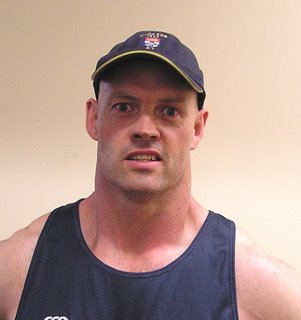
For much of the winter David Lyons looked a spent force as an International rugby player. Throughout the Super 14 season his form was slated by critics: he was too predictable, too one-dimensional, not dynamic enough. He found himself relegated to the Waratah's bench. In May he was a shock omission from the Wallabies training squad. He didn't play a Test all winter. Only gradually did it emerge that he had been suffering from a prolapsed disc in his back. Either way, it seemed that the 40-Test veteran and 2004 John Eales medal winner was washed-up at 26.
Enter University's Strength and Conditioning coach, Martin Harland. Lyons' problems were pin-pointed. Two years of injury (groin and back) had eroded his superb physical attributes. Barely able to drag himself through an 80-minute match, Lyons had shunned the gym and the training paddock. His legs had all but atrophied.
Harland decided to settle the prolapsed disc in Lyons' back, redevelop his core strength, then rebuild the dynamism in his legs. Within 13 weeks Lyons was playing a starring role in the Students dramatic victory over Randwick in the Tooheys New Cup Final. He was back in the starting line-up for the Waratahs in the recent APC tournament. He has been named in the 37-man squad for the Wallabies Spring Tour.
"My body is feeling really good," he recently told the Sun-Herald. "My priority was to build my core and back strength, and that feels fine now."
This is a story that says a lot about Lyons. But it is also a story that speaks volumes for Martin Harland. Not that he would admit this.
"David makes it easy for me because he is such a good trainer," says Harland. "He looks after himself, he listens and he's forward thinking in his own programs. I give him a program and he embellishes it - and it's only ever with good things."
The truth is, however, that Harland's skill as a strength and conditioning coach and his exquisite understanding of the physiological make-up of an athlete's body were pivotal in Lyons' rebirth as a footballer and, consequently, in the Students' stunning 2006 success. And this is just one example among many.
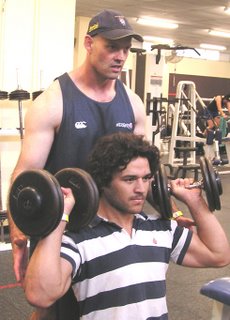
"I think there's no coincidence that Sydney University Rugby was struggling after the premierships in '99 and 2000," says Students' outside centre and Waratah, Tom Carter. "Then Marty comes on board, manages an Elite Development Squad and we've won back-to-back premierships over the last two years. We've won, I think, nine premierships out of a possible 14, and won two Club Championships. Marty's Elite Development Squad has basically changed the whole club.
The EDS Carter talks of was established by then-Rugby-Director Todd Louden and Harland back in 2003 as a pre-season fitness, conditioning and skills program. This year 25 elite players will participate in the program that begins in October.
"For me I was playing Australian 7's, weighing 90 kilos and I was physically inept," says Carter. "I was never going to go to the next level. Marty's EDS has certainly changed me physically to a point where I can now compete at that level. It's a feature of 90% of the players that come out of Sydney Uni Football Club - they're physically superior. We go into Super 14 programs so much better off because we're exposed to this high quality training."
These comments give some indication of Harland's contribution to the Football club. His work with the rugby boys, however, is simply one facet of his incredibly varied program.
"Most trainers only work in one sport," says President of Sydney University Sport, Bruce Ross. "Marty is quite amazing because he works across such a broad field. He's working, of course, with our rugby squads, he's had a lot to do with the extraordinary development our rowers have experienced, he's recently worked with the Flames, with the cricketers and, of course, earlier on with Astrid Loch-Wilkinson representing Australia in the bobsleigh."
It's this variety of sports, this vast spread of fitness and strength levels that Harland thrives on.
For years he worked exclusively with elite-level football teams: the Illawarra Steelers, St George-Illawarra Dragons and Sydney Swans. The positions were an exciting divergence for a young sprinter turned Olympic bobsleigher (he competed at the 1988 Calgary Olympics before a severe back injury forced him from the sport in 1989) who completed an Exercise Science degree with first class honours in 1994.
It was the huge amount of research he did in sprinting and power development that saw him snaffled up by the Steelers as a sprint coach in 1995. When the club amalgamated with St George in 1999 his position blossomed into a full-time strength and conditioning role.
In 2000 he shifted codes to AFL where he worked as strength coach for the Sydney Swans.
"It was a lot of fun," says Harland. "It was very different; I'd never had anything to do with the sport before so I really enjoyed it. But AFL is very full-on in terms of what they ask of you."
With the birth of his first child Harland rejected a two-year contract with the Swans and decided to head back to the Andrew Farrar-coached Dragons. It was short-lived. With Nathan Brown's appointment as coach in 2003, Harland's contract was not renewed.
"It put my nose out at first," he says, "but in the end I think it has been for the best."
Harland shifted to the Sydney Academy of Sport where he was contracted to work with the Sydney University Football Club. As the SAS was gradually consumed by the NSW Institute of Sport, Harland's involvement with Sydney University deepened.
None of the higher profile NRL or AFL positions, however, offered the disparate challenges that Harland now faces at Sydney University. And it is this variety, this sheer diversity that Harland revels in.
"With high-level sport everyone is much the same in terms of training age which makes it easier if you know your stuff," says Harland. "You can bash the group and you know what will happen. Here you have a massive training age difference, from guys and girls who have never trained but are still fantastic at their sport, to those who are so highly trained you're really splitting hairs trying to get those physical results.
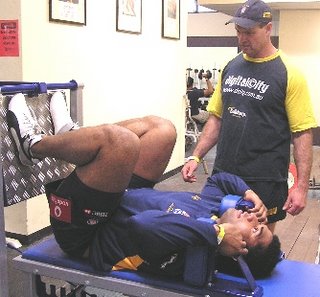
"And I love the different sports. Some sports I've perhaps watched once - like European Handball - but a scholarship holder will give me a video of a game, tell me what they need and away we go. So I'm always learning as well. You know, high-level coaches - I pick their brains, high-level athletes - I pick their brains, medical staff - I pick their brains. I learn so much here and it keeps me sane. You never fall into a comfort zone, never fall into a rut."
And - with Harland's impeccable understanding of training methods and how they work on a cellular level - it's unlikely that Sydney University's fine stable of athletes will slip into a rut.
*A Media and Communications graduate from Sydney University, Aaron Scott is currently working as a sports journalist for Sydney University Sport. He also writes freelance articles for the Sun-Herald and Inside Sport.
Read more...

For much of the winter David Lyons looked a spent force as an International rugby player. Throughout the Super 14 season his form was slated by critics: he was too predictable, too one-dimensional, not dynamic enough. He found himself relegated to the Waratah's bench. In May he was a shock omission from the Wallabies training squad. He didn't play a Test all winter. Only gradually did it emerge that he had been suffering from a prolapsed disc in his back. Either way, it seemed that the 40-Test veteran and 2004 John Eales medal winner was washed-up at 26.
Enter University's Strength and Conditioning coach, Martin Harland. Lyons' problems were pin-pointed. Two years of injury (groin and back) had eroded his superb physical attributes. Barely able to drag himself through an 80-minute match, Lyons had shunned the gym and the training paddock. His legs had all but atrophied.
Harland decided to settle the prolapsed disc in Lyons' back, redevelop his core strength, then rebuild the dynamism in his legs. Within 13 weeks Lyons was playing a starring role in the Students dramatic victory over Randwick in the Tooheys New Cup Final. He was back in the starting line-up for the Waratahs in the recent APC tournament. He has been named in the 37-man squad for the Wallabies Spring Tour.
"My body is feeling really good," he recently told the Sun-Herald. "My priority was to build my core and back strength, and that feels fine now."
This is a story that says a lot about Lyons. But it is also a story that speaks volumes for Martin Harland. Not that he would admit this.
"David makes it easy for me because he is such a good trainer," says Harland. "He looks after himself, he listens and he's forward thinking in his own programs. I give him a program and he embellishes it - and it's only ever with good things."
The truth is, however, that Harland's skill as a strength and conditioning coach and his exquisite understanding of the physiological make-up of an athlete's body were pivotal in Lyons' rebirth as a footballer and, consequently, in the Students' stunning 2006 success. And this is just one example among many.
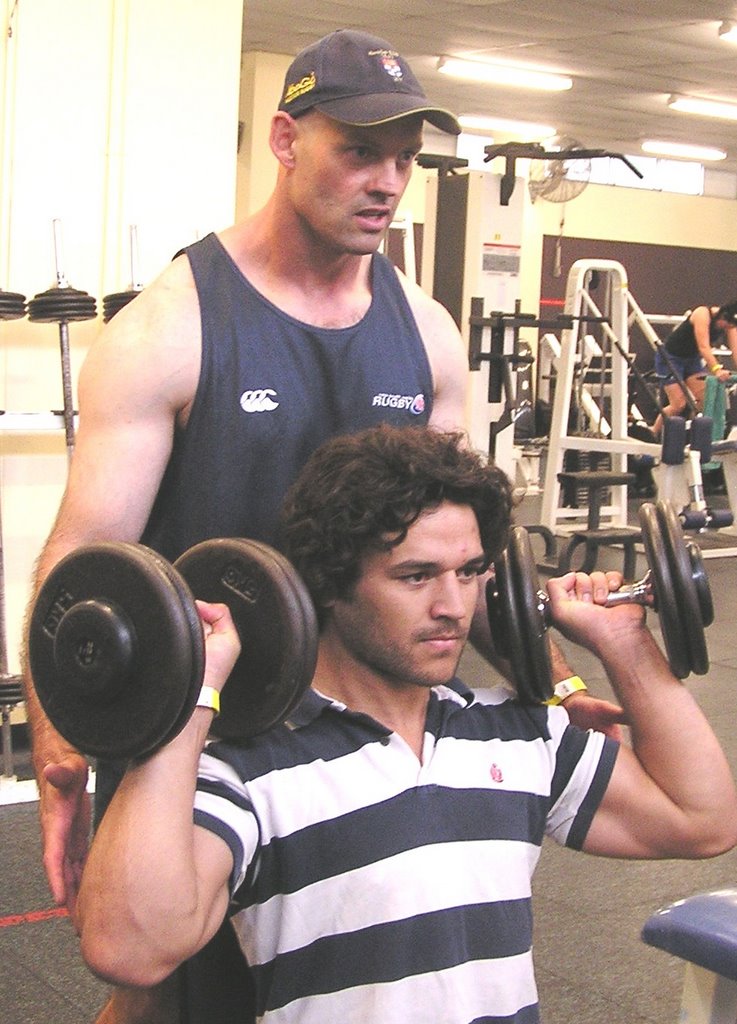
"I think there's no coincidence that Sydney University Rugby was struggling after the premierships in '99 and 2000," says Students' outside centre and Waratah, Tom Carter. "Then Marty comes on board, manages an Elite Development Squad and we've won back-to-back premierships over the last two years. We've won, I think, nine premierships out of a possible 14, and won two Club Championships. Marty's Elite Development Squad has basically changed the whole club.
The EDS Carter talks of was established by then-Rugby-Director Todd Louden and Harland back in 2003 as a pre-season fitness, conditioning and skills program. This year 25 elite players will participate in the program that begins in October.
"For me I was playing Australian 7's, weighing 90 kilos and I was physically inept," says Carter. "I was never going to go to the next level. Marty's EDS has certainly changed me physically to a point where I can now compete at that level. It's a feature of 90% of the players that come out of Sydney Uni Football Club - they're physically superior. We go into Super 14 programs so much better off because we're exposed to this high quality training."
These comments give some indication of Harland's contribution to the Football club. His work with the rugby boys, however, is simply one facet of his incredibly varied program.
"Most trainers only work in one sport," says President of Sydney University Sport, Bruce Ross. "Marty is quite amazing because he works across such a broad field. He's working, of course, with our rugby squads, he's had a lot to do with the extraordinary development our rowers have experienced, he's recently worked with the Flames, with the cricketers and, of course, earlier on with Astrid Loch-Wilkinson representing Australia in the bobsleigh."
It's this variety of sports, this vast spread of fitness and strength levels that Harland thrives on.
For years he worked exclusively with elite-level football teams: the Illawarra Steelers, St George-Illawarra Dragons and Sydney Swans. The positions were an exciting divergence for a young sprinter turned Olympic bobsleigher (he competed at the 1988 Calgary Olympics before a severe back injury forced him from the sport in 1989) who completed an Exercise Science degree with first class honours in 1994.
It was the huge amount of research he did in sprinting and power development that saw him snaffled up by the Steelers as a sprint coach in 1995. When the club amalgamated with St George in 1999 his position blossomed into a full-time strength and conditioning role.
In 2000 he shifted codes to AFL where he worked as strength coach for the Sydney Swans.
"It was a lot of fun," says Harland. "It was very different; I'd never had anything to do with the sport before so I really enjoyed it. But AFL is very full-on in terms of what they ask of you."
With the birth of his first child Harland rejected a two-year contract with the Swans and decided to head back to the Andrew Farrar-coached Dragons. It was short-lived. With Nathan Brown's appointment as coach in 2003, Harland's contract was not renewed.
"It put my nose out at first," he says, "but in the end I think it has been for the best."
Harland shifted to the Sydney Academy of Sport where he was contracted to work with the Sydney University Football Club. As the SAS was gradually consumed by the NSW Institute of Sport, Harland's involvement with Sydney University deepened.
None of the higher profile NRL or AFL positions, however, offered the disparate challenges that Harland now faces at Sydney University. And it is this variety, this sheer diversity that Harland revels in.
"With high-level sport everyone is much the same in terms of training age which makes it easier if you know your stuff," says Harland. "You can bash the group and you know what will happen. Here you have a massive training age difference, from guys and girls who have never trained but are still fantastic at their sport, to those who are so highly trained you're really splitting hairs trying to get those physical results.
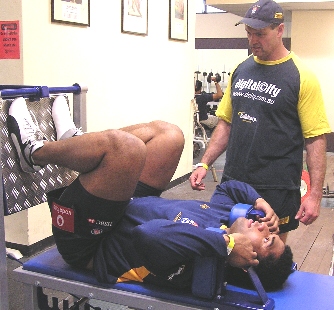
"And I love the different sports. Some sports I've perhaps watched once - like European Handball - but a scholarship holder will give me a video of a game, tell me what they need and away we go. So I'm always learning as well. You know, high-level coaches - I pick their brains, high-level athletes - I pick their brains, medical staff - I pick their brains. I learn so much here and it keeps me sane. You never fall into a comfort zone, never fall into a rut."
And - with Harland's impeccable understanding of training methods and how they work on a cellular level - it's unlikely that Sydney University's fine stable of athletes will slip into a rut.
*A Media and Communications graduate from Sydney University, Aaron Scott is currently working as a sports journalist for Sydney University Sport. He also writes freelance articles for the Sun-Herald and Inside Sport.
Read more...
Subscribe to:
Posts (Atom)

 Posts
Posts


