
Writing in the Sky Sportzine English international rugby referee Steve Lander states that "It has long been an open secret amongst coaches, players and referees that the law" in relation to uncontested scrums "is open to 'manipulation'."
Uncontested scrums "change the shape of the game and the dominant scrum is effectively depowered. Furthermore, without the contest and the need to scrummage, back row players are free to close down space ... ." However, there is little that a referee can do to prevent manipulation of the law. "From a match official's perspective. if a coach, physio or player indicates that he is injured then he is injured. In terms of safety, it is as simple as that."
Lander points out that the law requires that "both teams must provide front row cover within the 22 players selected to replace the hooker on the first occasion for injury, blood, sin bin or sending off. Similarly, for either, but not both props on the first occasion for the same reasons."
"A coach has complied with law if he has replaced a hooker and prop on the first occasion. If the team cannot provide a suitably trained player for a subsequent injury to a prop or hooker" he is entitled to request uncontested scrums.
I suggest that the problem can be virtually eliminated at least at the professional level by requiring teams to nominate a 23rd player as "designated front row substitute." The player would have to be physically capable of taking any of the front row positions.
The designated substitute would only be entitled and required to take the field if the normal substitution possibilities for either hooker or prop positions had been exhausted. The first circumstance in which they would enter the game would be if both the hooker and the reserve hooker had left the field "for injury, blood, sin bin or sending off." The other circumstance would be if two of the three players chosen as props or reserve prop had left the field for any of the same reasons.
If such a requirement were introduced, uncontested scrums would be almost eliminated and the opportunity for coaches of teams with inferior scrums to exploit the laws would be removed.
rugby
scrum
Steve Lander
Read more...
Sunday, March 19, 2006


Thursday, March 02, 2006
Does intensive pre-season strength training protect rugby players from non-contact injury?
[Summary: Players at a leading Australian rugby club who undertook a high-intensity off-season strength training program experienced dramatically fewer non-contact injuries during the playing season than their less committed club mates. It is suggested that the lower incidence of injury might be attributable to an emphasis on improving basic strength and the use of rugby-specific strength equipment.]
Each year the Sydney University Football Club selects a group of players for its Elite Development Squad to prepare for the next season. For 2005 a squad of 50 was chosen which did not include any of the Club's seven Wallabies nor any of the players on Super 12 contracts. Players committed themselves to around fourteen weeks of intensive training involving six to seven sessions per week of weights, skills and fitness work despite either being full time students or working full time.
At the conclusion of the season the Club's doctor, Katherine Rae, and physiotherapist, Keiran Cleary, jointly issued a Medical Report analysing the injury experience of the Club's eight teams. They particularly highlighted the members of the Elite Development Squad, noting that during the season "the EDS squad suffered only two non contact injuries, both muscle strains, which resulted in only four games lost to injury."
More specifically, among the 36 players who completed the full EDS program there was "only one calf strain and one hamstring strain ... . They had no back pain or groin pain necessitating loss of game time." By contrast, for the Club as a whole, there were 28 instances of low back pain, 27 hamstring injuries, 27 groin injuries and 6 quadriceps strains.
Two non contact injuries in over 1000 hours of playing time is an extraordinarily low figure in itself, and certainly by comparison with the Club's other players who accumulated over 80 comparable injuries. The injury incidence for the Club as a whole seems to be broadly in line with that reported in various scientific studies including those focussed on professional players.
It is obviously unwise to attach too much significance to the experience of one club over a single season. However the disparity in injury rates between those in the EDS group and their team mates is so great that it is very unlikely to be attributable to mere chance. Therefore it is necessary to explore possible reasons for this very favorable outcome. I believe that there were three relevant factors at work:
Duration and intensity of the training program
An off-season involving around 90 uninterrupted training sessions creates a near ideal opportunity for players to enhance their basic strength and fitness for rugby.Very few non-professional players would have the commitment and dedication to stick to such an exacting schedule. And very few professional players would have such a large block of time available. For example, Australian full-time players normally participate in at least two of the three tiers of club, provincial and international rugby and are therefore playing through most of the year.
The EDS squad also had on-campus access to physiotherapists, doctors and nutritionists plus regular dietary supplementation. Thus, even though the squad members were not paid, they were training in a very professional environment.
Emphasis on basic strength development
Strength and conditioning in the EDS program was structured and administered by Martin Harland, a sports scientist who had previously worked with professional rugby league, Australian football and basketball teams. His programs for rugby players place a high degree of emphasis on basic strength development and rugby-specific fitness. A distinguishing feature of his approach is a concentration on heavy lower body work through exercises such as squats, deadlifts and cleans.

Use of the ScrumTruk
In addition to their free weights exercises the group regularly used the rugby specific MyoQuip ScrumTruk as a core component of their leg strength work. Certain unique attributes of this apparatus might be relevant to protection against injury. Although it works basically the same muscle groups as the barbell squat, the fact that the resistance is in the horizontal rather than the vertical plane means that there is no adverse loading on the lumbar spine. It is also more quadriceps specific than the squat and exercises effectively the muscles of the calf.
But its main benefit in injury minimization may be in relation to the hamstrings. The ScrumTruk specifically works this muscle group as well as adjacent areas such as the glutes, quadriceps and core stabilizers. But the most important effect might relate to the frequently observed importance of eccentric loading in developing the hamstrings. Both the barbell squat and the conventional leg press deliver constant resistance. When performing these movements concentrically the muscles involved are only under very partial load as the hip and knee joints move to full extension. By contrast the ScrumTruk's operation provides continually increasing resistance throughout the exercise movement. Because of this, the muscles involved are strongly activated over the full exercise range and most critically are working at close to full load at the conclusion of the movement. It would seem to follow logically that the more that muscles are being activated concentrically, the greater the eccentric load when the movement is reversed. Thus there is heavy eccentric loading on the hamstrings when they are near fully extension.
The low injury incidence by Sydney University's elite training squad seems to suggest that other teams might benefit similarly by implementing a long and intensive off-season training program concentrating on the development of basic lower body strength through complex free weight movements and the use of the ScrumTruk. The potential improved injury outcomes are additional to the very substantial strength gains from such a program.
Read more...
Each year the Sydney University Football Club selects a group of players for its Elite Development Squad to prepare for the next season. For 2005 a squad of 50 was chosen which did not include any of the Club's seven Wallabies nor any of the players on Super 12 contracts. Players committed themselves to around fourteen weeks of intensive training involving six to seven sessions per week of weights, skills and fitness work despite either being full time students or working full time.
At the conclusion of the season the Club's doctor, Katherine Rae, and physiotherapist, Keiran Cleary, jointly issued a Medical Report analysing the injury experience of the Club's eight teams. They particularly highlighted the members of the Elite Development Squad, noting that during the season "the EDS squad suffered only two non contact injuries, both muscle strains, which resulted in only four games lost to injury."
More specifically, among the 36 players who completed the full EDS program there was "only one calf strain and one hamstring strain ... . They had no back pain or groin pain necessitating loss of game time." By contrast, for the Club as a whole, there were 28 instances of low back pain, 27 hamstring injuries, 27 groin injuries and 6 quadriceps strains.
Two non contact injuries in over 1000 hours of playing time is an extraordinarily low figure in itself, and certainly by comparison with the Club's other players who accumulated over 80 comparable injuries. The injury incidence for the Club as a whole seems to be broadly in line with that reported in various scientific studies including those focussed on professional players.
It is obviously unwise to attach too much significance to the experience of one club over a single season. However the disparity in injury rates between those in the EDS group and their team mates is so great that it is very unlikely to be attributable to mere chance. Therefore it is necessary to explore possible reasons for this very favorable outcome. I believe that there were three relevant factors at work:
Duration and intensity of the training program
An off-season involving around 90 uninterrupted training sessions creates a near ideal opportunity for players to enhance their basic strength and fitness for rugby.Very few non-professional players would have the commitment and dedication to stick to such an exacting schedule. And very few professional players would have such a large block of time available. For example, Australian full-time players normally participate in at least two of the three tiers of club, provincial and international rugby and are therefore playing through most of the year.
The EDS squad also had on-campus access to physiotherapists, doctors and nutritionists plus regular dietary supplementation. Thus, even though the squad members were not paid, they were training in a very professional environment.
Emphasis on basic strength development
Strength and conditioning in the EDS program was structured and administered by Martin Harland, a sports scientist who had previously worked with professional rugby league, Australian football and basketball teams. His programs for rugby players place a high degree of emphasis on basic strength development and rugby-specific fitness. A distinguishing feature of his approach is a concentration on heavy lower body work through exercises such as squats, deadlifts and cleans.

Use of the ScrumTruk
In addition to their free weights exercises the group regularly used the rugby specific MyoQuip ScrumTruk as a core component of their leg strength work. Certain unique attributes of this apparatus might be relevant to protection against injury. Although it works basically the same muscle groups as the barbell squat, the fact that the resistance is in the horizontal rather than the vertical plane means that there is no adverse loading on the lumbar spine. It is also more quadriceps specific than the squat and exercises effectively the muscles of the calf.
But its main benefit in injury minimization may be in relation to the hamstrings. The ScrumTruk specifically works this muscle group as well as adjacent areas such as the glutes, quadriceps and core stabilizers. But the most important effect might relate to the frequently observed importance of eccentric loading in developing the hamstrings. Both the barbell squat and the conventional leg press deliver constant resistance. When performing these movements concentrically the muscles involved are only under very partial load as the hip and knee joints move to full extension. By contrast the ScrumTruk's operation provides continually increasing resistance throughout the exercise movement. Because of this, the muscles involved are strongly activated over the full exercise range and most critically are working at close to full load at the conclusion of the movement. It would seem to follow logically that the more that muscles are being activated concentrically, the greater the eccentric load when the movement is reversed. Thus there is heavy eccentric loading on the hamstrings when they are near fully extension.
The low injury incidence by Sydney University's elite training squad seems to suggest that other teams might benefit similarly by implementing a long and intensive off-season training program concentrating on the development of basic lower body strength through complex free weight movements and the use of the ScrumTruk. The potential improved injury outcomes are additional to the very substantial strength gains from such a program.
Read more...
Tuesday, February 21, 2006
MyoQuip launches the HipneeFlex - hip and knee flexor strength builder

After extensive prototype testing, MyoQuip is proud to release the HipneeFlex, a truly unique apparatus for the development of the hip and knee flexors.
The HipneeFlex permits the hip flexor and knee flexor muscles to be exercised simultaneously through the full range of leg movement from full extension to full flexion. Both sets of muscles are subjected to substantial but appropriate loading throughout the whole movement.
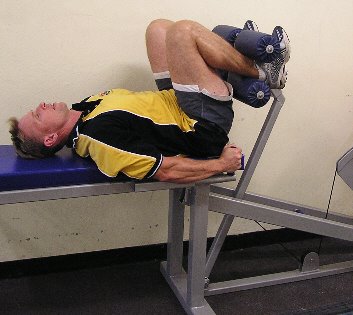
Figure 1 shows the basic mechanism of the HipneeFlex. The athlete operates from a supine position so that the action of the flexors - iliopsoas and hamstrings for the hip and knee joints respectively - can be effectively isolated. The feet are engaged between rollers which are cable-connected to the weighted QuadTorq mechanism.

The exercise movement involves the feet being drawn back from a fully extended position to a fully flexed position. Thus both hip and knee flexors are exercised through a range where the included angle at the joints varies from 180º to around 30º.
The arc through which the foot engagement device moves is designed to closely parallel the path that the feet would normally traverse if drawn back without resistance. It also creates a natural tendency for the two joint angles to vary synchronously so that they are both under continual load.
Biomechanical correspondence In going from full extension to full flexion the limb joints are moving towards a progressively inferior biomechanical orientation and consequently, less capacity to handle load.In view of this the QuadTorq mechanism for the HipneeFlex is configured for decreasing resistance. (This is opposite to MyoQuip's other machines, the ScrumTruk, JumpTruk and HipneeThrust. Because they involve limb extension rather than limb flexion their QuadTorq orientation is for increasing resistance.)
Hamstring development It could be argued that other exercises and apparatus cater adequately for hamstring development. For example, in their role as hip flexors, they are strongly activated in whole-leg extensor movements such as the barbell squat. But with regard to their other function as knee flexors the most commonly used apparatus, the leg curl machine, doesn't usually involve knee joint closure much below 90º and it is also a simple single-joint exercise. By contrast, many of the important sporting activities involving the knee flexor, such as sprinting, cycling or rowing, produce acute joint angles and also require complex coordination between the hamstrings and iliopsoas. The HipneeFlex is the only strength apparatus that effectively simulates that coordination.
Hip flexor strength and sport The most widely recognised sport-related function of the iliopsoas is in enhancing knee lift in sprinting. They also play a vital role in football kicking, swim kicking and sports such as rowing.
Iliopsoas strengthening has specific performance implications for cycling which involves continuous though offsetting leg extension and flexion. Enhanced hip flexor capacity has particular relevance to the cycling upstroke where both hip and knee joints are flexing. Concentration on using the hip flexors takes load off the hamstrings, the most overworked muscles in cycling.
Cross country skiing is particularly taxing on the hip flexors, as are other activities involving vertical movement of the body such as cross country running and mountain climbing.
Some of the more athletic forms of dance necessitate very strong hip flexors.
More generally, in any sporting activities requiring hip joint extension, the hip flexors perform a crucial antagonist function.
Tight hip flexors are recognised as contributing to lower back pain by causing the pelvis to tip forward. Full range activation of the iliopsoas through use of the HipneeFlex can be expected to have a beneficial effect on flexor flexibility.
Hip flexor development Until now the hip flexors have been the most neglected muscle group in strength training. Now with the release of the HipneeFlex there is a machine that has significant specificity to natural movement of these muscles, that involves their full range activation and that has a high degree of biomechanical correspondence between effective load and load-bearing capacity of those muscles at a particular limb position.
Athletes and their coaches constantly seek minor improvements that could conceivably give them a competitive edge. Here we have an apparatus that can safely and effectively strengthen a muscle group that is intrinsically involved in many athletic and sporting activities but which is virtually never developed to its full potential.
No one really knows the extent of the benefits that will flow from eliminating that imbalance.

We invite you to be one of the first to explore the potential of really strong hip flexors. Alternatively, you can wait and then play "catch-up" with the rest of the herd.
If you are located outside Australia please use the email link in the sidebar to obtain a quotation in your own currency including shipment options.
(See also my previous post, Hip flexors - the most underdeveloped muscle group in strength training.)
Read more...
Tuesday, February 14, 2006
Comment by Nick Tatalias on hip flexor strength
A comment by Nick Tatalias on my "Hip Flexor" post contains such significant observations and extensions to my arguments that I felt it deserved highlighting. It is by no means the first time that Nick has materially expanded on one of my posts. Here is an excerpt from the comment:
Read more...
... hip flexor strength is essential to athletic function simply because the body will begin to retard the agonist action early if the antagonist is weak. This reaction of the body prevents injury by preventing over extension. Strong antagonists allow the agonist to fire for much longer before the antagonist must fire to prevent joint over extension. The early retardation will slow the movement restrict range of motion and will cause slower runners. If the Weyland study is correct in its assertion that overall speed is dependant on ground forces generated and range of motion (as these two functions increase stride length) and not leg speed then by deduction if cycle times remain constant but stride length increase then speed must increase ...
Read more...
Saturday, February 11, 2006
Hip flexors - the most underdeveloped muscle group in strength training
[Summary: Strong hip flexors provide an advantage in a wide range of sports and athletic activities but they are the most neglected muscle group in strength training. The problem in developing hip flexor strength has been the lack of appropriate exercises, but the development of flexor-specific apparatus offers great potential for fully developing these muscles.]
Despite their importance to a wide range of athletic and sporting activities, the hip flexors are the most neglected major muscle group in strength training. It is very rare to find training programs that include hip flexor exercises. By contrast there is usually a great deal of emphasis on exercises for the leg extensors.
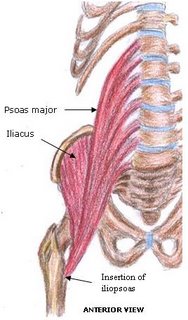
There are some obvious reasons for this comparative neglect. The principal muscles involved in hip flexion are the psoas and the iliacus, collectively known as the iliopsoas. Because they are relatively deep-seated rather than surface muscles they may have been overlooked by bodybuilders who have traditionally been the major innovators in strength training. Secondly, there are no obvious ways to adequately exercise them with free weights. Finally, these muscles do not have the obvious functional importance of their extensor counterparts. Yet, as antagonists, both hip and knee flexors perform a vital role in controlling the rate of descent and ascent in leg extension exercises such as the squat.
There is no corresponding problem of underdevelopment with the muscles responsible for knee joint flexion, the hamstring group. Because they cross two joints they are active in both leg extension and leg flexion. They act to flex the knee joint and also to extend the hip joint. Therefore they tend to be strengthened by complex leg extension exercises. Also hamstrings can be developed and strengthened through the use of the leg curl apparatus.
Strong hip flexors provide an advantage in a wide range of sports and athletic activities. In sprinting high knee lift is associated with increased stride length and therefore considerable attention is given to exercising the hip flexors. However, they are usually not exercised against resistance and consequently there is unlikely to be any appreciable strength increase.
Hip flexor strength is directly relevant to a range of activities in football. Kicking a ball is a complex coordinated action involving simultaneous knee extension and hip flexion, so developing a more powerful kick requires exercises applicable to these muscle groups. Strong hip flexors can also be very advantageous in the tackle situation in American football and both rugby union and rugby league where a player is attempting to take further steps forward with an opposing player clinging to his legs.
In addition those players in American football and rugby who have massively developed quadriceps and gluteus muscles are often unable to generate rapid knee lift and hence tend to shuffle around the field. Having stronger flexors would significantly improve their mobility.
It is commonly asserted that marked strength disparity between hip extensors and hip flexors may be a contributing factor in hamstring injuries in footballers. It is interesting to speculate on whether hip extensor/flexor imbalance might also be associated with the relatively high incidence of groin injuries.
Other sports where increased iliopsoas strength would appear to offer benefits include cycling, rowing and mountain climbing, in particular when scaling rock faces.
The problem in developing hip flexor strength has been the lack of appropriate exercises. Two that have traditionally been used for this muscle group are incline sit-ups and hanging leg raises, but in both cases the resistance is basically provided by the exerciser's own body weight. As a consequence these exercises can make only a very limited contribution to actually strengthening the flexors.
Until now the only weighted resistance equipment employed for this purpose has been the multi-hip type machine. When using this multi-function apparatus for hip flexion the exerciser pushes with the lower thigh against a padded roller which swings in an arc. One difficulty with this apparatus is that the position of the hip joint is not fixed and thus it is difficult to maintain correct form when using heavy weights or lifting the thigh above the horizontal.
With the release of the MyoQuip HipneeFlex there is now a machine specifically designed to develop and strengthen the leg flexors. It exercises both hip and knee flexors simultaneously from full extension to full flexion. Because the biomechanical efficiency of these joints decreases in moving from extension to flexion, the mechanism is configured to provide decreasing resistance throughout the exercise movement and thus appropriate loading to both sets of flexors.
The absence until now of effective techniques for developing the hip flexors means that we do not really know what benefits would flow from their full development. However, given that in elite sport comparatively minor performance improvements can translate into contest supremacy, it is an area that offers great potential.
(See also my follow-up postMyoQuip launches the HipneeFlex - hip and knee flexor strength builder.)
Read more...
Despite their importance to a wide range of athletic and sporting activities, the hip flexors are the most neglected major muscle group in strength training. It is very rare to find training programs that include hip flexor exercises. By contrast there is usually a great deal of emphasis on exercises for the leg extensors.

There are some obvious reasons for this comparative neglect. The principal muscles involved in hip flexion are the psoas and the iliacus, collectively known as the iliopsoas. Because they are relatively deep-seated rather than surface muscles they may have been overlooked by bodybuilders who have traditionally been the major innovators in strength training. Secondly, there are no obvious ways to adequately exercise them with free weights. Finally, these muscles do not have the obvious functional importance of their extensor counterparts. Yet, as antagonists, both hip and knee flexors perform a vital role in controlling the rate of descent and ascent in leg extension exercises such as the squat.
There is no corresponding problem of underdevelopment with the muscles responsible for knee joint flexion, the hamstring group. Because they cross two joints they are active in both leg extension and leg flexion. They act to flex the knee joint and also to extend the hip joint. Therefore they tend to be strengthened by complex leg extension exercises. Also hamstrings can be developed and strengthened through the use of the leg curl apparatus.
Strong hip flexors provide an advantage in a wide range of sports and athletic activities. In sprinting high knee lift is associated with increased stride length and therefore considerable attention is given to exercising the hip flexors. However, they are usually not exercised against resistance and consequently there is unlikely to be any appreciable strength increase.
Hip flexor strength is directly relevant to a range of activities in football. Kicking a ball is a complex coordinated action involving simultaneous knee extension and hip flexion, so developing a more powerful kick requires exercises applicable to these muscle groups. Strong hip flexors can also be very advantageous in the tackle situation in American football and both rugby union and rugby league where a player is attempting to take further steps forward with an opposing player clinging to his legs.
In addition those players in American football and rugby who have massively developed quadriceps and gluteus muscles are often unable to generate rapid knee lift and hence tend to shuffle around the field. Having stronger flexors would significantly improve their mobility.
It is commonly asserted that marked strength disparity between hip extensors and hip flexors may be a contributing factor in hamstring injuries in footballers. It is interesting to speculate on whether hip extensor/flexor imbalance might also be associated with the relatively high incidence of groin injuries.
Other sports where increased iliopsoas strength would appear to offer benefits include cycling, rowing and mountain climbing, in particular when scaling rock faces.
The problem in developing hip flexor strength has been the lack of appropriate exercises. Two that have traditionally been used for this muscle group are incline sit-ups and hanging leg raises, but in both cases the resistance is basically provided by the exerciser's own body weight. As a consequence these exercises can make only a very limited contribution to actually strengthening the flexors.
Until now the only weighted resistance equipment employed for this purpose has been the multi-hip type machine. When using this multi-function apparatus for hip flexion the exerciser pushes with the lower thigh against a padded roller which swings in an arc. One difficulty with this apparatus is that the position of the hip joint is not fixed and thus it is difficult to maintain correct form when using heavy weights or lifting the thigh above the horizontal.
With the release of the MyoQuip HipneeFlex there is now a machine specifically designed to develop and strengthen the leg flexors. It exercises both hip and knee flexors simultaneously from full extension to full flexion. Because the biomechanical efficiency of these joints decreases in moving from extension to flexion, the mechanism is configured to provide decreasing resistance throughout the exercise movement and thus appropriate loading to both sets of flexors.
The absence until now of effective techniques for developing the hip flexors means that we do not really know what benefits would flow from their full development. However, given that in elite sport comparatively minor performance improvements can translate into contest supremacy, it is an area that offers great potential.
(See also my follow-up postMyoQuip launches the HipneeFlex - hip and knee flexor strength builder.)
Read more...
Sunday, February 05, 2006
Is Australian rugby finally getting the message about power?
Today's Sun-Herald [Sydney] has a brief article titled "The Brumbies turn to power." It makes the point that the "multi-phase attacking style" used by both the ACT Brumbies and the Wallabies with success in the late 1990s and the first few years of the new century "has been superseded by a more robust forward-oriented play."
ACT coach Laurie Fisher is quoted as saying: "I think we've lacked it [forwards getting to the advantage line] every year but it hadn't been as important until last season. You can't just outskill a side with a quality back line now. You've got to have a quality set piece, you've got to have a power game."
Let's hope that the Brumbies have been making good use of the ScrumTruk that they installed a few months ago.
Read more...
ACT coach Laurie Fisher is quoted as saying: "I think we've lacked it [forwards getting to the advantage line] every year but it hadn't been as important until last season. You can't just outskill a side with a quality back line now. You've got to have a quality set piece, you've got to have a power game."
Let's hope that the Brumbies have been making good use of the ScrumTruk that they installed a few months ago.
Read more...
Subscribe to:
Posts (Atom)

 Posts
Posts


