drawings of muscles and exercise apparatus

Tuesday, August 22, 2006

MyoQuip releases the HipneeThrust leg extensor strength builder


Unique features and performance characteristics:

  • Fully recumbent exercise position.

  • Comfortable and natural body position throughout the full range of movement ensuring no adverse loading on spine, hips or knees.

  • Exercise movement range from extreme flexion of hip and knee joints to full extension.

  • Utilises QuadTorq technology providing effective activation of hip and knee extensors over the full range of movement

  • Synchronised joint angles distribute load evenly between hip and knee extensors.

  • 8-position adjustment of the rate of change of load providing multi-functionality of the apparatus.

  • Intuitive operation - no requirement for instruction in correct technique.

  • No danger of exerciser being trapped under excessive load.

  • No stress on ankle joint - no imposed dorsiflexion of the ankle.

  • Ideal for rehabilitation of hip or knee joints.


  • High functionality for developing and strengthening leg extensors


    The leg extensors - primarily the gluteus maximus and quadriceps - constitute the body's largest and most powerful muscle group. They are also vitally important for a wide range of athletic and sporting activities.

    Traditional methods of developing and strengthening leg extensors include the barbell squat and the leg press and leg extension machines. However each of these has significant limitations. They do not adequately exercise the muscles from full flexion to full extension, and there are also issues associated with adverse loading and excessive shear forces on the lumbar region and knee joints.

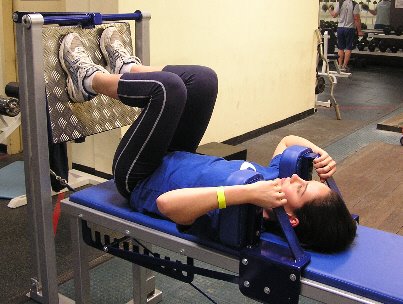
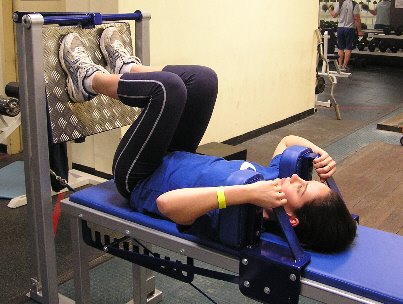
    The HipneeThrust has been designed to overcome these problems. As can be seen in the figure above the athlete operates from a supine position so that the action of the extensors can be effectively isolated. The recumbent position also means that the spine can comfortably cope with the compressive forces generated.

    The arc through which the foot plate of the machine moves is designed to closely parallel the path that the feet would normally traverse if moved from flexion to extension without resistance. It also creates a natural tendency for the two joint angles to vary synchronously so that they are effectively sharing the load throughout the exercise movement.

    Exercises the total range of limb movement


    Tom Carter in the deeply flexed position on the HipneeThrust leg extensor strength machine

    It can be seen that at the start position both hip and knee joints can be tightly flexed. As the feet move forward the trunk and shanks remain virtually parallel until the legs are fully extended. Thus the potential range of movement is from included angles of around 30° to 180°. (In fact, by starting with the feet placed low on the footplate it is possible to hyper-extend the hips beyond 180°.) Throughout this extreme range of movement high range muscle fibre recruitment is achieved by means of our QuadTorq technology.
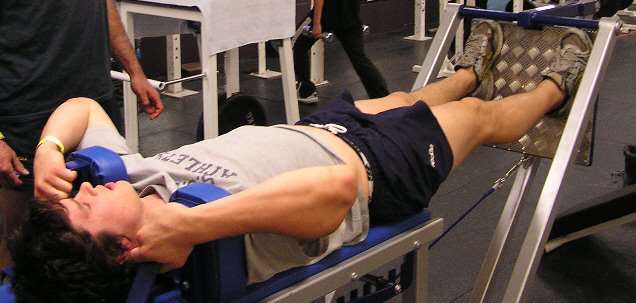
    Tom Carter in the fully extended position on the HipneeThrust leg extensor strength machine

    With an exercise like the squat or a machine such as the conventional leg press, exercisers attempting heavy loads tend to restrict themselves to modest degrees of hip and knee flexion. This is because as joint flexion increases, the exerciser's capacity to cope with resistance decreases. By contrast, with the HipneeThrust the effective load is automatically reduced when the joints are flexed and increased as they extend.

    Multi-functionality


    The rate at which the effective resistance changes is varied by selecting different notch positions on the machine's quadrant.

    With mid-range notch settings the effective load from the start of the movement to full lockout is intended to match the body's capacity to handle resistance, so that the exerciser has to expend basically the same degree of effort throughout the movement.

    With low-range notch settings the increase in effective load from start to finish of the exercise movement is greatly increased. These notch settings are ideal for practising explosive or ballistic movements. When utilising heavy loads there is a "ballistic braking" effect toward the end of the movement, eliminating the need to decelerate.

    High-range notch settings are ideal when the focus is on overcoming inertia, i.e., moving a heavy load from a position of rest. An example would be improving performance in the barbell squat because the additional initial loading conditions the leg extensors to operate more effectively in the deep squat position.
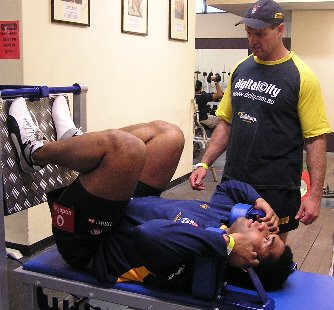
    Sydney University strength coach Martin Harland supervising Jerry Yanuyanutawa on the HipneeThrust leg extensor strength developer

    Laying a foundation of basic strength


    Until now there has been no means of developing optimal muscle strength through the full range of a complex bi-articular movement. With the introduction of the HipneeThrust and its complement the HipneeFlex, athletes now have the means to adequately strengthen all of the major muscles of the lower limbs before focussing on sport- and activity-specific tasks. It can be confidently anticipated that this will yield significant performance and injury-reducing benefits.


    Read more...

    Friday, August 18, 2006

    The effect of varying quadrant notch settings on MyoQuip's range of variable resistance machines

    MyoQuip's QuadTorq technology is designed as a compensation mechanism for biomechanical disadvantage. When a limb is fully flexed, i.e., the foot or hand is close to the trunk, the muscles of that limb are operating in a position of considerable biomechanical disadvantage, but as the limb extends away from the trunk it moves into a progressively more biomechanically efficient orientation.

    An example of this changing biomechanical efficiency can be seen with the barbell squat. When the hip and knee joints are flexed as in the deep position of the squat, the lifter's capacity to cope with resistance is considerably reduced; but as they rise and the joints fully extend, the amount of resistance that can be coped with increases dramatically. This is why there is a very strong tendency for unsupervised and inexperienced lifters to perform only partial squats and why the squat does not effectively work the leg extensor muscles through their full range.

    Each of the ScrumTruk, HipneeThrust and JumpTruk use the QuadTorq technology to provide increasing resistance. This enables the exercise to operate comfortably and effectively in the region of biomechanical disadvantage. In addition the technology exposes them to substantial effective loading and high-range muscle fibre recruitment throughout the whole range of movement.


    The rate at which the effective resistance changes is varied by selecting different notch positions on the machine's quadrant.

    Mid-range notch settings are designed to broadly compensate for the improvement in biomechanical advantage throughout the exercise movement. The increase in effective load from the start of the movement to full lockout is intended to match the body's capacity to handle resistance, so that the exerciser has to expend basically the same degree of effort throughout the movement. This can be contrasted with the squat where considerable effort is required at the bottom of the movement and very little at the top end.

    Thus with a mid-range notch setting the leg extensor muscles experience substantial activation throughout the whole range of movement.

    With low-range notch settings the increase in effective load from start to finish of the exercise movement is greatly increased. These notch settings are ideal for practising explosive or ballistic movements. The exerciser chooses a weight load they can comfortably handle at the start of the movement and then attempts to perform the concentric part of the exercise as rapidly as possible. However, as they move toward full leg extension the effective load is rapidly increasing thus slowing their momentum. As a result there is a "ballistic braking" effect toward the end of the movement, eliminating the need to decelerate. Because of this the exerciser can utilise explosive strength over the full range of the movement.

    This range of settings is particularly useful with the HipneeThrust where concentration on plyometric-type movements can be expected to produce significant improvements in vertical leap.

    With high-range notch settings the increase in effective load from start to finish of the exercise movement is greatly reduced. High pin settings are ideal when the focus is on overcoming inertia, i.e., moving a heavy load from a position of rest. A typical real world application is in rugby when there is the need to "shunt" the opposing pack. A similar situation applies in the rugby lineout when a lifter with poor vertical jumping ability has to be hoisted.

    High-range notch settings are also useful when the ScrumTruk or HipneeThrust is being used to improve performance in the barbell squat, because the additional loading at the start of the movement conditions the leg extensors to operate more effectively in the region of greatest biomechanical disadvantage, e.g., in the deep squat position.


    Read more...

    Tuesday, August 15, 2006

    The role of synchronised hip and knee joint angles in efficient squatting


    In recent days there has been discussion among some who use their blogs as weight training diaries about difficulties with squatting. The author of A prop's journey talks about "the quarter and half squats I'm stuck with at the moment because my leg/back/ankle (it's all connected) flexibility is terrible."

    And then we have Scott Bird posting in 99 shades of grey >> straight to the bar that "there was going to be some work to do" in order to reach parallel in the squat which he conceded he was "nowhere near." This was confirmed by a photo showing his inability to descend to the parallel position even with an unloaded bar. I hope that Scott doesn't mind me reproducing that photo in order to illustrate some of my own ideas on squatting.

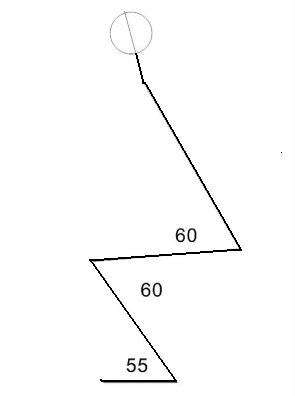
    I have endeavoured to estimate his joint angles from that image and I trust that the first stick-figure diagram is a reasonable approximation. Not to put too fine a point on it, Scott's squat technique looks ugly and uncomfortable.

    The first problem seems to be very limited ankle flexion as indicated by the fact that he is having difficulty getting the angle between his shanks and the horizontal below 70°. You have to wonder whether he does much calf work and if so whether he trains full range. Most people who exercise their calves only do plantar flexion - raising their heels from the floor - and never attempt dorsiflexion - lifting their toes.


    But the main problem appears to be with his knee flexion; by my estimate he seems unable to flex the joint below 85°. The apparent 30° difference between his flexion at the knee and the hip is indicative of very poor squatting technique. A number of things flow from this. Firstly he is only activating the quadriceps group through the top half of contraction, i.e., from 85° to 180° of knee joint angle - he is missing out on at least 50° of movement through the most vital range. One can almost guarantee that he has poor leg extensor strength.

    Note that he is working his hip joints through a much greater range. Basically for Scott the squat is only really a glute exercise, and to the extent that he was able to attempt heavy poundages he would be likely to impose severe loading on the lumbar region of his back.

    We can also see that until he learns to further flex his ankle and knee joints he cannot really take a loaded bar much lower than in the photo. This is because of the gravitational necessity to keep the bar directly above his feet. If he flexed his hips much more he would begin to lose balance.

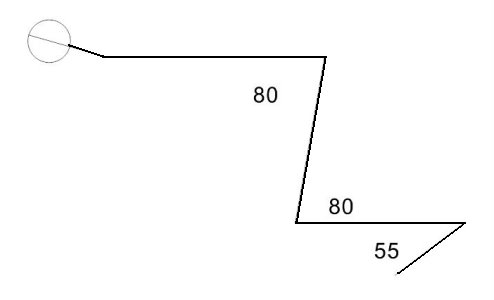
    Compare Scott's articular geometry with that of the second stick-figure. Biomechanically there is no comparison - the second figure looks comfortably balanced with the gravitational path of the weight bar passing through the midline of the feet. Greater ankle flexion is a contributing factor but the most important point to note is the symmetry between hip and knee joint angles. In fact an exerciser adopting this posture would probably have synchronicity between these angles through the whole range of movement. As a result the shanks and back remain parallel and there is no adverse loading on the spine. The weight of the bar is always directly above the feet and both the quadriceps and gluteus maximus are being worked through their full range.


    The first advice that I would give Scott would be to concentrate on keeping his back more erect. This would almost certainly lead him to flex his ankles more thus shifting his knees forward. It will probably feel uncomfortable at first as his quads are not used to being asked to do any serious work.

    I suspect that many people fall into the habit of excessive forward trunk lean from observing power lifters. However a typical power lifter is probably someone with a very strong back who is focussed on muscling up maximum weight without being concerned as to whether they are adequately exercising their leg extensors.

    In any case a 1978 study (McLaughlin, T.M., Lardner, T.J. & Dillman, C.J. Kinetics of the parallel squat. The Research Quarterly, 49, 173-89. 1978) of nationally-ranked and world-class powerlifters identified a tendency for less-skilled subjects to exhibit greater trunk torques than more highly-skilled subjects. "It would appear from the data that high-skilled subjects attempt to minimize the trunk torque, and do so largely by reducing forward trunk lean." It was noted that among the subjects, the then world super heavy weight champion maintained the greatest trunk angle of all subjects and, despite his much greater bar load, had a lower trunk torque than many smaller, less-skilled subjects.

    The high-skilled subjects demonstrated larger trunk angles, lower trunk torques and more extensor-dominant thigh torques. "It therefore appears that the high-skilled subjects strive to use the leg extensors to a greater extent than do less skilled subjects. This greater emphasis on the leg extensors is obtained by a minimization of the trunk torques by the high-skilled subjects (achieved by maintaining more erect trunk positions)."


    The final stick-figure shows a typical starting position for an exerciser using the ScrumTruk. So long as they are instructed to pack low against the shoulder pads and keep their hips low they tend to automatically have their backs and shanks parallel and consequently achieve and maintain synchronicity between their hip and knee joint angles. An almost universal observation from athletes using the ScrumTruk for the first time is that they have a definite "burn" or "pump" effect in the quadriceps indicating that the device is very much leg extensor specific. The apparatus also encourages them to significantly dorsiflex their ankles.

    Our observation from two years of athletes using the ScrumTruk is that its techniques and balanced development of the hip and leg extensors transfer well across to the barbell squat - athletes with extensive Scrumtruk experience tend to subsequently show very good form and depth on the squat.


    Read more...

    Thursday, August 10, 2006

    The Strength for Sport Refertory

    It has now become standard practice to click on search engines like Google, Yahoo or MSN whenever we require information but the results are frequently frustrating. Spam sites, dead sites and pages which contain the search term but have no real relevance to the object of the search can make the search process very tedious.

    A quite common and irritating occurrence is to find what looks like a very useful article only to be denied access to it. Usually an abstract is provided but in order to read the full text you have to subscribe to the journal or pay an exorbitant fee to read a few pages. Increasingly academic journals have been taken over by publishing companies who are motivated by the pursuit of profit rather than the dissemination of knowledge.

    Fortunately there are still some authors and websites who are happy to provide free access to their output but it is often difficult to find this material.

    I spend a lot of time trawling the 'net for information relevant to my company's activities and as a result have accumulated a fairly substantial data bank of useful articles and web pages on specific topics. I have recently assembled some of it as a section of our main company website which I have named the Strength for Sport Refertory.

    In the sense in which I am using the word, a "refertory" is basically a directory or catalog of references. However it is not a normal web directory as the links are not to whole websites, but to individual pages. Nor is it an articles directory as we don't store the articles on our own server, but rather simply provide a link to the host website. This use of the word "refertory" is not an original coinage as I have come across a university library website where it is used similarly to characterise a directory of references.

    What we have in my refertory is a theme-specific directory of articles, posts and web pages which conform to the commons principle by being freely available for viewing without payment and by not being password-protected. We have already created sections on specific sports such as American Football, Basketball and Rugby, as well as general strength themes such as Biomechanics, Explosive Power, Speed Development and Trunk Stability.

    Over time I will be progressively adding links to the site and also hope that others will suggest material for inclusion.


    Read more...

    Tuesday, August 08, 2006

    A prop's journey

    I came across a potentially interesting new blog, A prop's journey, the rugby diary of a young front rower from Brisbane, Queensland. It will be interesting to see how active he is in posting in the off-season but he seems determined to use the time for building up for the 2007 season. It could be worth following.


    Read more...

    Tuesday, June 20, 2006

    Building bigger and stronger rugby players - the Sydney University experiment

    It is widely acknowledged that the average bodyweight of rugby players has increased considerably over recent years. Less recognised is the extent to which modern defensive alignments and strategies have transformed rugby matches into contests of attrition where bigger and stronger teams tend to wear down their smaller and physically weaker opponents over the course of a game. Perhaps the most notable change has been the increased importance of physical dominance in the backline.


    Responding to this, Sydney University's rugby club has been able to demonstrate that with the right combination of coach and infrastructure, it is possible to fast track the physical development of players outside a professional playing environment. In fact within a couple of seasons these players are able to achieve a body mass comparable to that of seasoned professionals together with a solid foundation of basic strength.


    In late May, Sydney University announced its team for the first round of the Tooheys New Cup, the premier competition in Sydney club rugby. All of the fifteen players are past or current students who had been developed through the Club's Colts and lower grade teams. None of them are paid to play for the Club, although the eleven who are still students receive modest scholarship assistance. Only three of the players are on professional contracts.


    It is instructive to compare their bodyweight and age profiles with those of squads from four major rugby countries:


    TeamAverage Weight (kg)Average Age
    Wallabies - 2006 Squad102.626.1
    All Blacks - 2006 Squad102.925.5
    Springboks - 2006 Squad102.226.8
    England - 2006 6 Nations Squad101.227.2
    Sydney University - 2006 Tooheys New Cup Team100.522.5

    Comparative Bodyweight and Age Profiles


    It can be seen that the part-time, unpaid Sydney University players, though three to five years younger, weigh only a couple of kilograms less than the world's best players. This is quite extraordinary as normally a much greater weight disparity would be expected.


    For the past three years Sydney University Football Club has been operating an Elite Development Squad (EDS) program for its top grade and colts players. Utilising one of the best equipped gymnasiums in Australian rugby, players train for eleven months of the year and undertake four weights sessions per week off-season and a lesser number while playing.


    The program's strength and conditioning components have been devised and administered by Martin Harland, a sports scientist who has previously worked with professional rugby league, Australian football and basketball teams. His programs for rugby players place a high degree of emphasis on basic strength development and rugby-specific fitness. A distinguishing feature of his approach is a concentration on heavy lower body work through exercises such as squats, deadlifts and cleans. In addition, both backs and forwards make intensive use of the MyoQuip ScrumTruk, a rugby-specific apparatus that targets the large mass leg extensor muscles, specifically the gluteal and quadriceps groups. Hypertrophy or increased muscle mass is a natural and not unintended by-product of such training.


    Exposing backline players to basic strength training


    Another distinctive feature of Martin Harland's rugby training regimen is his requirement that backs undertake the same rigorous basic strength routines as forwards. Many strength and conditioning coaches reserve the heavy "grunt" work for forwards, or even restrict it to the tight five.


    Exposing backs to very serious weight training has produced a quite extraordinary outcome at Sydney University, as evidenced by the following table comparing body weights of forwards and backs for the Wallabies, the four Australian Super 14 franchises and Sydney University:


    Squad/Team (2006) Av Weight (kg) - ForwardsAv Weight (kg) - BacksDifference
    Wallabies - Squad111.191.819.3
    ACT Brumbies - Squad110.390.919.4
    NSW Waratahs - Squad110.892.818.0
    Queensland Reds - Squad109.792.417.3
    Western Force - Squad109.192.916.2
    Sydney University - Team105.395.110.2

    Comparative Bodyweight of Forwards and Backs


    Not surprisingly, the University's young forwards are outweighed by each of the five professional squads. However, in the backs the situation is reversed. The University players outweigh the national and provincial squads by between 2.2 and 4.2 kg per man.


    If we look at the column showing the difference in bodyweight between backs and forwards it can be seen that for Sydney University it averages 10.2 kg, against 16.2 to 19.4 kg for Australia's professional squads, a very substantial difference.


    The Sydney University experiment seems to be providing clear evidence that the bodyweight of rugby backs can be dramatically increased through serious weight training, but the question arises as to whether this has benefits in terms of playing performance.


    One answer is that the other strength-oriented football code, American football, has traditionally used training methods similar to those of Martin Harland. All players, whether linemen or running backs, are required to do heavy gym work. Surely no one would seriously suggest that their quick players have inferior dynamic abilities to rugby players.


    Another justification for building heavier backs with superior leg drive lies in the already mentioned importance of physical dominance in the rugby backline. With the modern emphasis on structure and coordination in defensive alignments, bigger and stronger backs are better able to continually repel opposition attacks and also over the course of a game are likely to create physical and mental fatigue in their counterparts.


    Having achieved a strong foundation of basic strength and greater body mass, Martin Harland is then able to focus on speed and explosiveness in his players. It is clear that the Sydney University approach yields results on the playing field. 2005 was the Club's most successful year, winning the Sydney Club Championship, the First Grade Premiership and four lower grade Premierships.


    Even more importantly, players who graduate from such a program are much better equipped to withstand the rigours of modern rugby.


    Read more...